
The Project Gutenberg eBook of Steep Trails, by John Muir
 Leave a comment
Steep Trails
by John Muir
California • Utah • Nevada • Washington
Oregon • The weighted stuffed animals for 2 year olds under 20 dollarsGrand Cañon
Contents
| EDITOR’S NOTE |
| Steep Trails |
| I. Wild Wool |
| II. A Geologist’s Winter Walk |
| III. Summer Days at Mount Shasta |
| IV. A Perilous Night on Shasta’s Summit |
| V. Shasta Rambles and Modoc Memories |
| VI. The City of the Saints |
| VII. A Great Storm in Utah |
| VIII. Bathing in Salt Lake |
| IX. Mormon Lilies |
| X. The San Gabriel Valley |
| XI. The San Gabriel Mountains |
| XII. Nevada Farms |
| XIII. Nevada Forests |
| XIV. Nevada’s Timber Belt |
| XV. Glacial Phenomena in Nevada |
| XVI. Nevada’s Dead Towns |
| XVII. Puget Sound |
| XVIII. The Forests of Washington |
| XIX. People and Towns of Puget Sound |
| XX. An Ascent of Mount Rainier |
| XXI. The Physical and Climatic Characteristics of Oregon |
| XXII. The Forests of Oregon and their Inhabitants |
| XXIII. The Rivers of Oregon |
| XXIV. The Grand Cañon of the Colorado |
| Footnotes: |
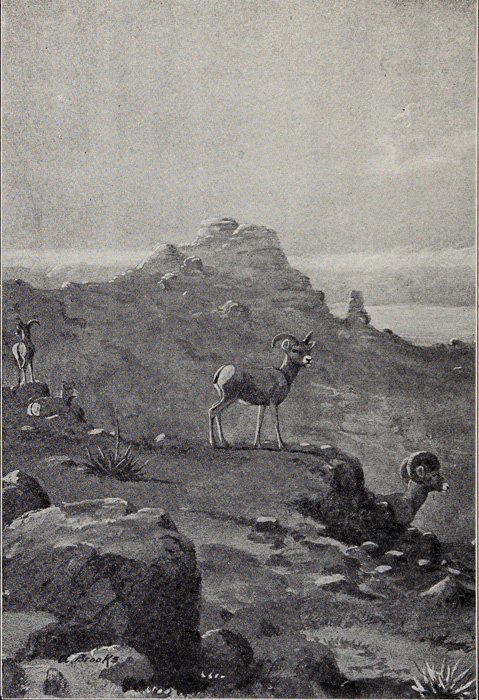
Mountain Sheep
(Ovis nelsoni)
From a drawing by Allan Brooks
Illustrations
| Mountain Sheep (Ovis nelsoni) |
| TISSIACK FROM GLACIER POINT: TENAYA CAÑON ON THE LEFT |
| MOUNT SHASTA AFTER A SNOWSTORM |
| AT SHASTA SODA SPRINGS |
| IN THE WAHSATCH MOUNTAINS |
| SEGO LILIES (Calochortus Nuttallii) |
| SAN GABRIEL VALLEY |
| THE SAGE LEVELS OF THE NEVADA DESERT |
| MOUNT RAINIER FROM THE SODA SPRINGS |
| THE OREGON SEA-BLUFFS |
| CAPE HORN, COLUMBIA RIVER |
| THE GRAND CAÑON AT O’NEILL’S POINT |
EDITOR’S NOTE
The papers brought together in this volume have, in a general way, beenarranged in chronological sequence. They span a period of twenty-nine years ofMuir’s life, during which they appeared as letters and articles, for themost part in publications of limited and local circulation. The Utah and Nevadasketches, and the two San Gabriel papers, were contributed, in the form ofletters, to the San Francisco Evening Bulletintoward the end of theseventies. Written in the field, they preserve the freshness of theauthor’s first impressions of those regions. Much of the material in thechapters on Mount Shasta first took similar shape in 1874. Subsequently it wasrewritten and much expanded for inclusion in Picturesque California, and theRegion West of the Rocky Mountains, which Muir began to edit in 1888. Inthe same work appeared the description of Washington and Oregon. The charminglittle essay “Wild Wool” was written for the OverlandMonthlyin 1875. “A Geologist’s Winter Walk” is anextract from a letter to a friend, who, appreciating its fine literary quality,took the responsibility of sending it to the Overland Monthlywithoutthe author’s knowledge. The concluding chapter on “The Grand Cañonof the Colorado” was published in the Century Magazinein 1902,and exhibits Muir’s powers of description at their maturity.
Some of these papers were revised by the author during the later years of hislife, and these revisions are a part of the form in which they now appear. Thechapters on Mount Shasta, Oregon, and Washington will be found to containoccasional sentences and a few paragraphs that were included, more or lessverbatim, in The Mountains of Californiaand Our National Parks.Being an important part of their present context, these paragraphs could not beomitted without impairing the unity of the author’s descriptions.
The editor feels confident that this volume will meet, in every way, the highexpectations of Muir’s readers. The recital of his experiences during astormy night on the summit of Mount Shasta will take rank among the mostthrilling of his records of adventure. His observations on the dead towns ofNevada, and on the Indians gathering their harvest of pine nuts, recall a phaseof Western life that has left few traces in American literature. Many, too,will read with pensive interest the author’s glowing description of whatwas one time called the New Northwest. Almost inconceivably great have been thechanges wrought in that region during the past generation. Henceforth thelandscapes that Muir saw there will live in good part only in his writings, forfire, axe, plough, and gunpowder have made away with the supposedly boundlessforest wildernesses and their teeming life.
WILLIAMFREDERICBADÈ
Berkeley, California
May, 1918
STEEP TRAILS
I. Wild Wool
Moral improvers have calls to preach. I have a friend who has a call to plough,and woe to the daisy sod or azalea thicket that falls under the savageredemption of his keen steel shares. Not content with the so-called subjugationof every terrestrial bog, rock, and moorland, he would fain discover somemethod of reclamation applicable to the ocean and the sky, that in due calendartime they might be brought to bud and blossom as the rose. Our efforts are ofno avail when we seek to turn his attention to wild roses, or to the fact thatboth ocean and sky are already about as rosy as possible—the one withstars, the other with dulse, and foam, and wild light. The practicaldevelopments of his culture are orchards and clover-fields wearing a smiling,benevolent aspect, truly excellent in their way, though a near view disclosessomething barbarous in them all. Wildness charms not my friend, charm it neverso wisely: and whatsoever may be the character of his heaven, his earth seemsonly a chaos of agricultural possibilities calling for grubbing-hoes andmanures.
Sometimes I venture to approach him with a plea for wildness, when hegood-naturedly shakes a big mellow apple in my face, reiterating his favoriteaphorism, “Culture is an orchard apple; Nature is a crab.” Not allculture, however, is equally destructive and inappreciative. Azure skies andcrystal waters find loving recognition, and few there be who would welcome theaxe among mountain pines, or would care to apply any correction to the tonesand costumes of mountain waterfalls. Nevertheless, the barbarous notion isalmost universally entertained by civilized man, that there is in all themanufactures of Nature something essentially coarse which can and must beeradicated by human culture. I was, therefore, delighted in finding that thewild wool growing upon mountain sheep in the neighborhood of Mount Shasta wasmuch finer than the average grades of cultivated wool. This FINE discovery wasmade some three months ago[1], while hunting among the Shasta sheepbetween Shasta and Lower Klamath Lake. Three fleeces were obtained—onethat belonged to a large ram about four years old, another to a ewe about thesame age, and another to a yearling lamb. After parting their beautiful wool onthe side and many places along the back, shoulders, and hips, and examining itclosely with my lens, I shouted: “Well done for wildness! Wild wool isfiner than tame!”
My companions stooped down and examined the fleeces for themselves, pulling outtufts and ringlets, spinning them between their fingers, and measuring thelength of the staple, each in turn paying tribute to wildness. It WAS finer,and no mistake; finer than Spanish Merino. Wild wool IS finer than tame.
“Here,” said I, “is an argument for fine wildness that needsno explanation. Not that such arguments are by any means rare, for all wildnessis finer than tameness, but because fine wool is appreciable by everybodyalike—from the most speculative president of national wool-growers’associations all the way down to the gude-wife spinning by heringleside.”
Nature is a good mother, and sees well to the clothing of her manybairns—birds with smoothly imbricated feathers, beetles with shiningjackets, and bears with shaggy furs. In the tropical south, where the sun warmslike a fire, they are allowed to go thinly clad; but in the snowy northland shetakes care to clothe warmly. The squirrel has socks and mittens, and a tailbroad enough for a blanket; the grouse is densely feathered down to the ends ofhis toes; and the wild sheep, besides his undergarment of fine wool, has athick overcoat of hair that sheds off both the snow and the rain. Otherprovisions and adaptations in the dresses of animals, relating less to climatethan to the more mechanical circumstances of life, are made with the sameconsummate skill that characterizes all the love work of Nature. Land, water,and air, jagged rocks, muddy ground, sand beds, forests, underbrush, grassyplains, etc., are considered in all their possible combinations while theclothing of her beautiful wildlings is preparing. No matter what thecircumstances of their lives may be, she never allows them to go dirty orragged. The mole, living always in the dark and in the dirt, is yet as clean asthe otter or the wave-washed seal; and our wild sheep, wading in snow, roamingthrough bushes, and leaping among jagged storm-beaten cliffs, wears a dress soexquisitely adapted to its mountain life that it is always found as unruffledand stainless as a bird.
On leaving the Shasta hunting grounds I selected a few specimen tufts, andbrought them away with a view to making more leisurely examinations; but, owingto the imperfectness of the instruments at my command, the results thus farobtained must be regarded only as rough approximations.
As already stated, the clothing of our wild sheep is composed of fine wool andcoarse hair. The hairs are from about two to four inches long, mostly of a dullbluish-gray color, though varying somewhat with the seasons. In generalcharacteristics they are closely related to the hairs of the deer and antelope,being light, spongy, and elastic, with a highly polished surface, and thoughsomewhat ridged and spiraled, like wool, they do not manifest the slightesttendency to felt or become taggy. A hair two and a half inches long, which isperhaps near the average length, will stretch about one fourth of an inchbefore breaking. The diameter decreases rapidly both at the top and bottom, butis maintained throughout the greater portion of the length with a fair degreeof regularity. The slender tapering point in which the hairs terminate isnearly black: but, owing to its fineness as compared with the main trunk, thequantity of blackness is not sufficient to affect greatly the general color.The number of hairs growing upon a square inch is about ten thousand; thenumber of wool fibers is about twenty-five thousand, or two and a half timesthat of the hairs. The wool fibers are white and glossy, and beautifully spiredinto ringlets. The average length of the staple is about an inch and a half. Afiber of this length, when growing undisturbed down among the hairs, measuresabout an inch; hence the degree of curliness may easily be inferred. I regretexceedingly that my instruments do not enable me to measure the diameter of thefibers, in order that their degrees of fineness might be definitely comparedwith each other and with the finest of the domestic breeds; but that the threewild fleeces under consideration are considerably finer than the average gradesof Merino shipped from San Francisco is, I think, unquestionable.
When the fleece is parted and looked into with a good lens, the skin appears ofa beautiful pale-yellow color, and the delicate wool fibers are seen growing upamong the strong hairs, like grass among stalks of corn, every individual fiberbeing protected about as specially and effectively as if inclosed in a separatehusk. Wild wool is too fine to stand by itself, the fibers being about as frailand invisible as the floating threads of spiders, while the hairs against whichthey lean stand erect like hazel wands; but, notwithstanding their greatdissimilarity in size and appearance, the wool and hair are forms of the samething, modified in just that way and to just that degree that renders them mostperfectly subservient to the well-being of the sheep. Furthermore, it will beobserved that these wild modifications are entirely distinct from those whichare brought chancingly into existence through the accidents and caprices ofculture; the former being inventions of God for the attainment of definiteends. Like the modifications of limbs—the fin for swimming, the wing forflying, the foot for walking—so the fine wool for warmth, the hair foradditional warmth and to protect the wool, and both together for a fabric towear well in mountain roughness and wash well in mountain storms.
The effects of human culture upon wild wool are analogous to those producedupon wild roses. In the one case there is an abnormal development of petals atthe expense of the stamens, in the other an abnormal development of wool at theexpense of the hair. Garden roses frequently exhibit stamens in which thetransmutation to petals may be observed in various stages of accomplishment,and analogously the fleeces of tame sheep occasionally contain a few wild hairsthat are undergoing transmutation to wool. Even wild wool presents here andthere a fiber that appears to be in a state of change. In the course of myexaminations of the wild fleeces mentioned above, three fibers were found thatwere wool at one end and hair at the other. This, however, does not necessarilyimply imperfection, or any process of change similar to that caused by humanculture. Water lilies contain parts variously developed into stamens at oneend, petals at the other, as the constant and normal condition. These halfwool, half hair fibers may therefore subserve some fixed requirement essentialto the perfection of the whole, or they may simply be the fine boundary-lineswhere and exact balance between the wool and the hair is attained.
I have been offering samples of mountain wool to my friends, demanding inreturn that the fineness of wildness be fairly recognized and confessed, butthe returns are deplorably tame. The first question asked, is, “Nowtruly, wild sheep, wild sheep, have you any wool?” while they peercuriously down among the hairs through lenses and spectacles. “Yes, wildsheep, you HAVE wool; but Mary’s lamb had more. In the name of use, howmany wild sheep, think you, would be required to furnish wool sufficient for apair of socks?” I endeavor to point out the irrelevancy of the latterquestion, arguing that wild wool was not made for man but for sheep, and that,however deficient as clothing for other animals, it is just the thing for thebrave mountain-dweller that wears it. Plain, however, as all this appears, thequantity question rises again and again in all its commonplace tameness. For inmy experience it seems well-nigh impossible to obtain a hearing on behalf ofNature from any other standpoint than that of human use. Domestic flocks yieldmore flannel per sheep than the wild, therefore it is claimed that culture hasimproved upon wildness; and so it has as far as flannel is concerned, but allto the contrary as far as a sheep’s dress is concerned. If every wildsheep inhabiting the Sierra were to put on tame wool, probably only a few wouldsurvive the dangers of a single season. With their fine limbs muffled andburied beneath a tangle of hairless wool, they would become short-winded, andfall an easy prey to the strong mountain wolves. In descending precipices theywould be thrown out of balance and killed, by their taggy wool catching uponsharp points of rocks. Disease would also be brought on by the dirt whichalways finds a lodgment in tame wool, and by the draggled and water-soakedcondition into which it falls during stormy weather.
No dogma taught by the present civilization seems to form so insuperable anobstacle in the way of a right understanding of the relations which culturesustains to wildness as that which regards the world as made especially for theuses of man. Every animal, plant, and crystal controverts it in the plainestterms. Yet it is taught from century to century as something ever new andprecious, and in the resulting darkness the enormous conceit is allowed to gounchallenged.
I have never yet happened upon a trace of evidence that seemed to show that anyone animal was ever made for another as much as it was made for itself. Notthat Nature manifests any such thing as selfish isolation. In the making ofevery animal the presence of every other animal has been recognized. Indeed,every atom in creation may be said to be acquainted with and married to everyother, but with universal union there is a division sufficient in degree forthe purposes of the most intense individuality; no matter, therefore, what maybe the note which any creature forms in the song of existence, it is made firstfor itself, then more and more remotely for all the world and worlds.
Were it not for the exercise of individualizing cares on the part of Nature,the universe would be felted together like a fleece of tame wool. But we aregoverned more than we know, and most when we are wildest. Plants, animals, andstars are all kept in place, bridled along appointed ways, withoneanother, and through the midstof one another—killing and beingkilled, eating and being eaten, in harmonious proportions and quantities. Andit is right that we should thus reciprocally make use of one another, rob,cook, and consume, to the utmost of our healthy abilities and desires. Starsattract one another as they are able, and harmony results. Wild lambs eat asmany wild flowers as they can find or desire, and men and wolves eat the lambsto just the same extent.
This consumption of one another in its various modifications is a kind ofculture varying with the degree of directness with which it is carried out, butwe should be careful not to ascribe to such culture any improving qualitiesupon those on whom it is brought to bear. The water-ousel plucks moss from theriverbank to build its nest, but is does not improve the moss by plucking it.We pluck feathers from birds, and less directly wool from wild sheep, for themanufacture of clothing and cradle-nests, without improving the wool for thesheep, or the feathers for the bird that wore them. When a hawk pounces upon alinnet and proceeds to pull out its feathers, preparatory to making a meal, thehawk may be said to be cultivating the linnet, and he certainly does effect animprovement as far as hawk-food is concerned; but what of the songster? Heceases to be a linnet as soon as he is snatched from the woodland choir; andwhen, hawklike, we snatch the wild sheep from its native rock, and, instead ofeating and wearing it at once, carry it home, and breed the hair out of itswool and the bones out of its body, it ceases to be a sheep.
These breeding and plucking processes are similarly improving as regards thesecondary uses aimed at; and, although the one requires but a few minutes forits accomplishment, the other many years or centuries, they are essentiallyalike. We eat wild oysters alive with great directness, waiting for nocultivation, and leaving scarce a second of distance between the shell and thelip; but we take wild sheep home and subject them to the many extendedprocesses of husbandry, and finish by boiling them in a pot—a processwhich completes all sheep improvements as far as man is concerned. It will beseen, therefore, that wild wool and tame wool—wild sheep and tamesheep—are terms not properly comparable, nor are they in any correctsense to be considered as bearing any antagonism toward each other; they aredifferent things. Planned and accomplished for wholly different purposes.
Illustrative examples bearing upon this interesting subject may be multipliedindefinitely, for they abound everywhere in the plant and animal kingdomswherever culture has reached. Recurring for a moment to apples. The beauty andcompleteness of a wild apple tree living its own life in the woods is heartilyacknowledged by all those who have been so happy as to form its acquaintance.The fine wild piquancy of its fruit is unrivaled, but in the great question ofquantity as human food wild apples are found wanting. Man, therefore, takes thetree from the woods, manures and prunes and grafts, plans and guesses, adds alittle of this and that, selects and rejects, until apples of every conceivablesize and softness are produced, like nut galls in response to the irritatingpunctures of insects. Orchard apples are to me the most eloquent words thatculture has ever spoken, but they reflect no imperfection upon Nature’sspicy crab. Every cultivated apple is a crab, not improved, but cooked,variously softened and swelled out in the process, mellowed, sweetened, spiced,and rendered pulpy and foodful, but as utterly unfit for the uses of nature asa meadowlark killed and plucked and roasted. Give to Nature every culturedapple—codling, pippin, russet—and every sheep so laboriouslycompounded—muffled Southdowns, hairy Cotswolds, wrinkledMerinos—and she would throw the one to her caterpillars, the other to herwolves.
It is now some thirty-six hundred years since Jacob kissed his mother and setout across the plains of Padan-aram to begin his experiments upon the flocks ofhis uncle, Laban; and, notwithstanding the high degree of excellence heattained as a wool-grower, and the innumerable painstaking efforts subsequentlymade by individuals and associations in all kinds of pastures and climates, westill seem to be as far from definite and satisfactory results as we ever were.In one breed the wool is apt to wither and crinkle like hay on a sun-beatenhillside. In another, it is lodged and matted together like the lush tangledgrass of a manured meadow. In one the staple is deficient in length, in anotherin fineness; while in all there is a constant tendency toward disease,rendering various washings and dippings indispensable to prevent its fallingout. The problem of the quality and quantity of the carcass seems to be asdoubtful and as far removed from a satisfactory solution as that of the wool.Desirable breeds blundered upon by long series of groping experiments are oftenfound to be unstable and subject to disease—bots, foot rot, blindstaggers, etc.—causing infinite trouble, both among breeders andmanufacturers. Would it not be well, therefore, for some one to go back as faras possible and take a fresh start?
The source or sources whence the various breeds were derived is not positivelyknown, but there can be hardly any doubt of their being descendants of the fouror five wild species so generally distributed throughout the mountainousportions of the globe, the marked differences between the wild and domesticspecies being readily accounted for by the known variability of the animal, andby the long series of painstaking selection to which all its characteristicshave been subjected. No other animal seems to yield so submissively to themanipulations of culture. Jacob controlled the color of his flocks merely bycausing them to stare at objects of the desired hue; and possibly Merinos mayhave caught their wrinkles from the perplexed brows of their breeders. TheCalifornia species (Ovis montana)[2]is a noble animal, weighing whenfull-grown some three hundred and fifty pounds, and is well worthy theattention of wool-growers as a point from which to make a new departure, forpure wildness is the one great want, both of men and of sheep.
II. A Geologist’s Winter Walk[3]
After reaching Turlock, I sped afoot over the stubble fields and through milesof brown hemizonia and purple erigeron, to Hopeton, conscious of little morethan that the town was behind and beneath me, and the mountains above andbefore me; on through the oaks and chaparral of the foothills to Coulterville;and then ascended the first great mountain step upon which grows the sugarpine. Here I slackened pace, for I drank the spicy, resiny wind, and beneaththe arms of this noble tree I felt that I was safely home. Never did pine treesseem so dear. How sweet was their breath and their song, and how grandly theywinnowed the sky! I tingled my fingers among their tassels, and rustled my feetamong their brown needles and burrs, and was exhilarated and joyful beyond allI can write.
When I reached Yosemite, all the rocks seemed talkative, and more telling andlovable than ever. They are dear friends, and seemed to have warm blood gushingthrough their granite flesh; and I love them with a love intensified by longand close companionship. After I had bathed in the bright river, sauntered overthe meadows, conversed with the domes, and played with the pines, I still feltblurred and weary, as if tainted in some way with the sky of your streets. Idetermined, therefore, to run out for a while to say my prayers in the highermountain temples. “The days are sunful,” I said, “and, thoughnow winter, no great danger need be encountered, and no sudden storm will blockmy return, if I am watchful.”
The morning after this decision, I started up the cañon of Tenaya, caringlittle about the quantity of bread I carried; for, I thought, a fast and astorm and a difficult cañon were just the medicine I needed. When I passedMirror Lake, I scarcely noticed it, for I was absorbed in the greatTissiack—her crown a mile away in the hushed azure; her purple granitedrapery flowing in soft and graceful folds down to my feet, embroideredgloriously around with deep, shadowy forest. I have gazed on Tissiack athousand times—in days of solemn storms, and when her form shone divinewith the jewelry of winter, or was veiled in living clouds; and I have heardher voice of winds, and snowy, tuneful waters when floods were falling; yetnever did her soul reveal itself more impressively than now. I hung about herskirts, lingering timidly, until the higher mountains and glaciers compelled meto push up the cañon.
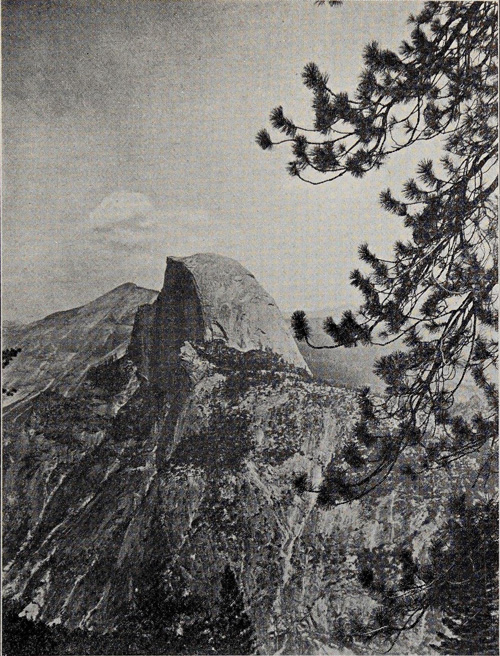
TISSIACK FROM GLACIER POINT: TENAYA CAÑON ON THE LEFT
This cañon is accessible only to mountaineers, and I was anxious to carry mybarometer and clinometer through it, to obtain sections and altitudes, so Ichose it as the most attractive highway. After I had passed the tall grovesthat stretch a mile above Mirror Lake, and scrambled around the Tenaya Fall,which is just at the head of the lake groves, I crept through the dense andspiny chaparral that plushes the roots of the mountains here for miles in warmgreen, and was ascending a precipitous rock front, smoothed by glacial action,when I suddenly fell—for the first time since I touched foot to Sierrarocks. After several somersaults, I became insensible from the shock, and whenconsciousness returned I found myself wedged among short, stiff bushes,trembling as if cold, not injured in the slightest.
Judging by the sun, I could not have been insensible very long; probably not aminute, possibly an hour; and I could not remember what made me fall, or whereI had fallen from; but I saw that if I had rolled a little further, my mountainclimbing would have been finished, for just beyond the bushes the cañon wallsteepened and I might have fallen to the bottom. “There,” said I,addressing my feet, to whose separate skill I had learned to trust night andday on any mountain, “that is what you get by intercourse with stupidtown stairs, and dead pavements.” I felt degraded and worthless. I hadnot yet reached the most difficult portion of the cañon, but I determined toguide my humbled body over the most nerve-trying places I could find; for I wasnow awake, and felt confident that the last of the town fog had been shakenfrom both head and feet.
I camped at the mouth of a narrow gorge which is cut into the bottom of themain cañon, determined to take earnest exercise next day. No plushy boughs didmy ill-behaved bones enjoy that night, nor did my bumped head get a spicy cedarplume pillow mixed with flowers. I slept on a naked boulder, and when I awokeall my nervous trembling was gone.
The gorged portion of the cañon, in which I spent all the next day, is about amile and a half in length; and I passed the time in tracing the action of theforces that determined this peculiar bottom gorge, which is an abrupt,ragged-walled, narrow-throated cañon, formed in the bottom of thewide-mouthed, smooth, and beveled main cañon. I will not stop now to tell youmore; some day you may see it, like a shadowy line, from Cloud’s Rest. Inhigh water, the stream occupies all the bottom of the gorge, surging andchafing in glorious power from wall to wall. But the sound of the grinding waslow as I entered the gorge, scarcely hoping to be able to pass through itsentire length. By cool efforts, along glassy, ice-worn slopes, I reached theupper end in a little over a day, but was compelled to pass the second night inthe gorge, and in the moonlight I wrote you this short pencil-letter in mynotebook:—
The moon is looking down into the cañon, and how marvelously the great rockskindle to her light! Every dome, and brow, and swelling boss touched by herwhite rays, glows as if lighted with snow. I am now only a mile from lastnight’s camp; and have been climbing and sketching all day in thisdifficult but instructive gorge. It is formed in the bottom of the main cañon,among the roots of Cloud’s Rest. It begins at the filled-up lake basinwhere I camped last night, and ends a few hundred yards above, in another basinof the same kind. The walls everywhere are craggy and vertical, and in someplaces they overlean. It is only from twenty to sixty feet wide, and not,though black and broken enough, the thin, crooked mouth of some mysteriousabyss; but it was eroded, for in many places I saw its solid, seamlessfloor.
I am sitting on a big stone, against which the stream divides, and goesbrawling by in rapids on both sides; half of my rock is white in the light,half in shadow. As I look from the opening jaws of this shadowy gorge, SouthDome is immediately in front—high in the stars, her face turned from themoon, with the rest of her body gloriously muffled in waved folds of granite.On the left, sculptured from the main Cloud’s Rest ridge, are threemagnificent rocks, sisters of the great South Dome. On the right is themassive, moonlit front of Mount Watkins, and between, low down in the furthestdistance, is Sentinel Dome, girdled and darkened with forest. In the nearforeground Tenaya Creek is singing against boulders that are white with snowand moonbeams. Now look back twenty yards, and you will see a waterfall fair asa spirit; the moonlight just touches it, bringing it into relief against a darkbackground of shadow. A little to the left, and a dozen steps this side of thefall, a flickering light marks my camp—and a precious camp it is. A huge,glacier-polished slab, falling from the smooth, glossy flank of Cloud’sRest, happened to settle on edge against the wall of the gorge. I did not knowthat this slab was glacier-polished until I lighted my fire. Judge of mydelight. I think it was sent here by an earthquake. It is about twelve feetsquare. I wish I could take it home[4]for a hearthstone. Beneath this slab isthe only place in this torrent-swept gorge where I could find sand sufficientfor a bed.
I expected to sleep on the boulders, for I spent most of the afternoon onthe slippery wall of the cañon, endeavoring to get around this difficult partof the gorge, and was compelled to hasten down here for water before dark. Ishall sleep soundly on this sand; half of it is mica. Here, wonderful tobehold, are a few green stems of prickly rubus, and a tiny grass. They are hereto meet us. Ay, even here in this darksome gorge, “frightened andtormented” with raging torrents and choking avalanches of snow. Can itbe? As if rubus and the grass leaf were not enough of God’s tenderprattle words of love, which we so much need in these mighty temples of power,yonder in the “benmost bore” are two blessed adiantums. Listen tothem! How wholly infused with God is this one big word of love that we call theworld! Good-night. Do you see the fire-glow on my ice-smoothed slab, and on mytwo ferns and the rubus and grass panicles? And do you hear how sweet a sleep-song the fall and cascades are singing?
The water-ground chips and knots that I found fastened between the rocks keptmy fire alive all through the night. Next morning I rose nerved and ready foranother day of sketching and noting, and any form of climbing. I escaped fromthe gorge about noon, after accomplishing some of the most delicate feats ofmountaineering I ever attempted; and here the cañon is all broadly openagain—the floor luxuriantly forested with pine, and spruce, and silverfir, and brown-trunked libocedrus. The walls rise in Yosemite forms, and TenayaCreek comes down seven hundred feet in a white brush of foam. This is a littleYosemite valley. It is about two thousand feet above the level of the mainYosemite, and about twenty-four hundred below Lake Tenaya.
I found the lake frozen, and the ice was so clear and unruffled that thesurrounding mountains and the groves that look down upon it were reflectedalmost as perfectly as I ever beheld them in the calm evening mirrors ofsummer. At a little distance, it was difficult to believe the lake frozen atall; and when I walked out on it, cautiously stamping at short intervals totest the strength of the ice, I seemed to walk mysteriously, without adequatefaith, on the surface of the water. The ice was so transparent that I could seethrough it the beautifully wave-rippled, sandy bottom, and the scales of micaglinting back the down-pouring light. When I knelt down with my face close tothe ice, through which the sunbeams were pouring, I was delighted to discovermyriads of Tyndall’s six-rayed water flowers, magnificently colored.
A grand old mountain mansion is this Tenaya region! In the glacier period itwas a mer de glace, far grander than the mer de glaceofSwitzerland, which is only about half a mile broad. The Tenaya mer deglacewas not less than two miles broad, late in the glacier epoch, whenall the principal dividing crests were bare; and its depth was not less thanfifteen hundred feet. Ice streams from Mounts Lyell and Dana, and all themountains between, and from the nearer Cathedral Peak, flowed hither, weldedinto one, and worked together. After eroding this Tanaya Lake basin, and allthe splendidly sculptured rocks and mountains that surround and adorn it, andthe great Tenaya Cañon, with its wealth of all that makes mountains sublime,they were welded with the vast South, Lyell, and Illilouette glaciers on oneside, and with those of Hoffman on the other—thus forming a portion of ayet grander mer de glacein Yosemite Valley.
I reached the Tenaya Cañon, on my way home, by coming in from the northeast,rambling down over the shoulders of Mount Watkins, touching bottom a mile aboveMirror Lake. From thence home was but a saunter in the moonlight.
After resting one day, and the weather continuing calm, I ran up over the leftshoulder of South Dome and down in front of its grand split face to make somemeasurements, completed my work, climbed to the right shoulder, struck offalong the ridge for Cloud’s Rest, and reached the topmost heave of hersunny wave in ample time to see the sunset.
Cloud’s Rest is a thousand feet higher than Tissiack. It is a wavelikecrest upon a ridge, which begins at Yosemite with Tissiack, and runscontinuously eastward to the thicket of peaks and crests around Lake Tenaya.This lofty granite wall is bent this way and that by the restless and wearilessaction of glaciers just as if it had been made of dough. But the grandcircumference of mountains and forests are coming from far and near, densinginto one close assemblage; for the sun, their god and father, with loveineffable, is glowing a sunset farewell. Not one of all the assembled rocks ortrees seemed remote. How impressively their faces shone with responsive love!
I ran home in the moonlight with firm strides; for the sun-love made me strong.Down through the junipers; down through the firs; now in jet shadows, now inwhite light; over sandy moraines and bare, clanking rocks; past the huge ghostof South Dome rising weird through the firs; past the glorious fall of Nevada,the groves of Illilouette; through the pines of the valley; beneath the brightcrystal sky blazing with stars. All of this mountain wealth in oneday!—one of the rich ripe days that enlarge one’s life; so much ofthe sun upon one side of it, so much of the moon and stars on the other.
III. Summer Days at Mount Shasta
Mount Shasta rises in solitary grandeur from the edge of a comparatively lowand lightly sculptured lava plain near the northern extremity of the Sierra,and maintains a far more impressive and commanding individuality than any othermountain within the limits of California. Go where you may, within a radius offrom fifty to a hundred miles or more, there stands before you the colossalcone of Shasta, clad in ice and snow, the one grand unmistakablelandmark—the pole star of the landscape. Far to the southward MountWhitney lifts its granite summit four or five hundred feet higher than Shasta,but it is nearly snowless during the late summer, and is so feeblyindividualized that the traveler may search for it in vain among the many rivalpeaks crowded along the axis of the range to north and south of it, which allalike are crumbling residual masses brought into relief in the degradation ofthe general mass of the range. The highest point on Mount Shasta, as determinedby the State Geological Survey, is 14,440 feet above mean tide. That ofWhitney, computed from fewer observations, is about 14,900 feet. But inasmuchas the average elevation of the plain out of which Shasta rises is only aboutfour thousand feet above the sea, while the actual base of the peak of MountWhitney lies at an elevation of eleven thousand feet, the individual height ofthe former is about two and a half times as great as that of the latter.
Approaching Shasta from the south, one obtains glimpses of its snowy cone hereand there through the trees from the tops of hills and ridges; but it is notuntil Strawberry Valley is reached, where there is a grand out-opening of theforests, that Shasta is seen in all its glory. From base to crown clearlyrevealed with its wealth of woods and waters and fountain snow, rejoicing inthe bright mountain sky, and radiating beauty on all the subject landscape likea sun. Standing in a fringing thicket of purple spiraea in the immediateforeground is a smooth expanse of green meadow with its meandering stream, oneof the smaller affluents of the Sacramento; then a zone of dark, close forest,its countless spires of pine and fir rising above one another on the swellingbase of the mountain in glorious array; and, over all, the great white conesweeping far into the thin, keen sky—meadow, forest, and grand icy summitharmoniously blending and making one sublime picture evenly balanced.
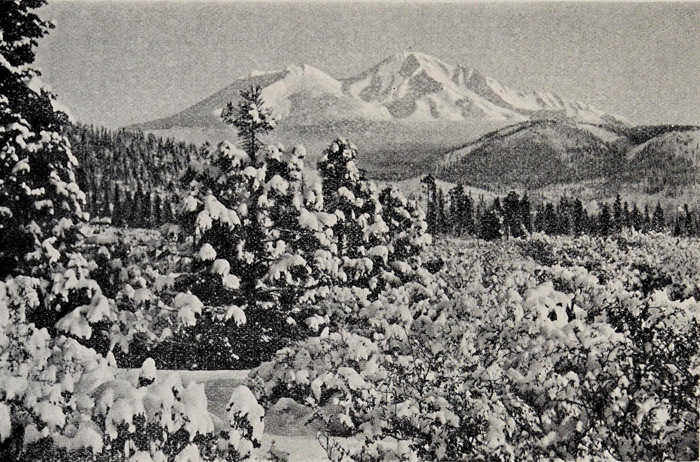
MOUNT SHASTA AFTER A SNOWSTORM
The main lines of the landscape are immensely bold and simple, and so regularthat it needs all its shaggy wealth of woods and chaparral and its finelytinted ice and snow and brown jutting crags to keep it from lookingconventional. In general views of the mountain three distinct zones may bereadily defined. The first, which may be called the Chaparral Zone, extendsaround the base in a magnificent sweep nearly a hundred miles in length on itslower edge, and with a breadth of about seven miles. It is a dense growth ofchaparral from three to six or eight feet high, composed chiefly of manzanita,cherry, chincapin, and several species of ceanothus, called deerbrush by thehunters, forming, when in full bloom, one of the most glorious flowerbedsconceivable. The continuity of this flowery zone is interrupted here and there,especially on the south side of the mountain, by wide swaths of coniferoustrees, chiefly the sugar and yellow pines, Douglas spruce, silver fir, andincense cedar, many specimens of which are two hundred feet high and five toseven feet in diameter. Goldenrods, asters, gilias, lilies, and lupines, withmany other less conspicuous plants, occur in warm sheltered openings in theselower woods, making charming gardens of wildness where bees and butterflies areat home and many a shy bird and squirrel.
The next higher is the Fir Zone, made up almost exclusively of two species ofsilver fir. It is from two to three miles wide, has an average elevation abovethe sea of some six thousand feet on its lower edge and eight thousand on itsupper, and is the most regular and best defined of the three.
The Alpine Zone has a rugged, straggling growth of storm-beaten dwarf pines(Pinus albicaulis), which forms the upper edge of the timberline. Thisspecies reaches an elevation of about nine thousand feet, but at this heightthe tops of the trees rise only a few feet into the thin frosty air, and areclosely pressed and shorn by wind and snow; yet they hold on bravely and putforth an abundance of beautiful purple flowers and produce cones and seeds.Down towards the edge of the fir belt they stand erect, forming small,well-formed trunks, and are associated with the taller two-leafed and mountainpines and the beautiful Williamson spruce. Bryanthus, a beautiful floweringheathwort, flourishes a few hundred feet above the timberline, accompanied withkalmia and spiraea. Lichens enliven the faces of the cliffs with their brightcolors, and in some of the warmer nooks of the rocks, up to a height of eleventhousand feet, there are a few tufts of dwarf daisies, wallflowers, andpenstemons; but, notwithstanding these bloom freely, they make no appreciableshow at a distance, and the stretches of rough brown lava beyond thestorm-beaten trees seem as bare of vegetation as the great snow fields andglaciers of the summit.
Shasta is a fire-mountain, an old volcano gradually accumulated and built upinto the blue deep of the sky by successive eruptions of ashes and molten lavawhich, shot high in the air and falling in darkening showers, and flowing fromchasms and craters, grew outward and upward like the trunk of a knotty, bulgingtree. Not in one grand convulsion was Shasta given birth, nor in any onespecial period of volcanic storm and stress, though mountains more than athousand feet in height have been cast up like molehills in a night—quickcontributions to the wealth of the landscapes, and most emphatic statements, onthe part of Nature, of the gigantic character of the power that dwells beneaththe dull, dead-looking surface of the earth. But sections cut by the glaciers,displaying some of the internal framework of Shasta, show that comparativelylong periods of quiescence intervened between many distinct eruptions, duringwhich the cooling lavas ceased to flow, and took their places as permanentadditions to the bulk of the growing mountain. Thus with alternate haste anddeliberation eruption succeeded eruption, until Mount Shasta surpassed even itspresent sublime height.
Then followed a strange contrast. The glacial winter came on. The sky that sooften had been darkened with storms of cinders and ashes and lighted by theglare of volcanic fires was filled with crystal snow-flowers, which, loadingthe cooling mountain, gave birth to glaciers that, uniting edge to edge, atlength formed one grand conical glacier—a down-crawling mantle of iceupon a fountain of smouldering fire, crushing and grinding its brown, flintylavas, and thus degrading and remodeling the entire mountain from summit tobase. How much denudation and degradation has been effected we have no means ofdetermining, the porous, crumbling rocks being ill adapted for the receptionand preservation of glacial inscriptions.
The summit is now a mass of ruins, and all the finer striations have beeneffaced from the flanks by post-glacial weathering, while the irregularity ofits lavas as regards susceptibility to erosion, and the disturbance caused byinter- and post-glacial eruptions, have obscured or obliterated those heaviercharacters of the glacial record found so clearly inscribed upon the granitepages of the high Sierra between latitude 36 degrees 30 minutes and 39 degrees.This much, however, is plain: that the summit of the mountain was considerablylowered, and the sides were deeply grooved and fluted while it was a center ofdispersal for the glaciers of the circumjacent region. And when at length theglacial period began to draw near its close, the ice mantle was graduallymelted off around the base of the mountain, and in receding and breaking upinto its present fragmentary condition the irregular heaps and rings of morainematter were stored upon its flanks on which the forests are growing. Theglacial erosion of most of the Shasta lavas gives rise to detritus composed ofrough subangular boulders of moderate size and porous gravel and sand, whichyields freely to the transporting power of running water. Several centuries agoimmense quantities of this lighter material were washed down from the higherslopes by a flood of extraordinary magnitude, caused probably by the suddenmelting of the ice and snow during an eruption, giving rise to the depositionof conspicuous delta-like beds around the base. And it is upon these flood-bedsof moraine soil, thus suddenly and simultaneously laid down and joined edge toedge, that the flowery chaparral is growing.
Thus, by forces seemingly antagonistic and destructive, Nature accomplishes herbeneficent designs—now a flood of fire, now a flood of ice, now a floodof water; and again in the fullness of time an outburst of organiclife—forest and garden, with all their wealth of fruit and flowers, theair stirred into one universal hum with rejoicing insects, a milky way of wingsand petals, girdling the newborn mountain like a cloud, as if the vivifyingsunbeams beating against its sides had broken into a foam of plant-bloom andbees.
But with such grand displays as Nature is making here, how grand are herreservations, bestowed only upon those who devotedly seek them! Beneath thesmooth and snowy surface the fountain fires are still aglow, to blaze forthafresh at their appointed times. The glaciers, looking so still and small at adistance, represented by the artist with a patch of white paint laid on by asingle stroke of his brush, are still flowing onward, unhalting, with deepcrystal currents, sculpturing the mountain with stern, resistless energy. Howmany caves and fountains that no eye has yet seen lie with all their finefurniture deep down in the darkness, and how many shy wild creatures are athome beneath the grateful lights and shadows of the woods, rejoicing in theirfullness of perfect life!
Standing on the edge of the Strawberry Meadows in the sun-days of summer, not afoot or feather or leaf seems to stir; and the grand, towering mountain withall its inhabitants appears in rest, calm as a star. Yet how profound is theenergy ever in action, and how great is the multitude of claws and teeth, wingsand eyes, wide awake and at work and shining! Going into the blessedwilderness, the blood of the plants throbbing beneath the life-giving sunshineseems to be heard and felt; plant growth goes on before our eyes, and everytree and bush and flower is seen as a hive of restless industry. The deeps ofthe sky are mottled with singing wings of every color and tone—clouds ofbrilliant chrysididae dancing and swirling in joyous rhythm, golden-barredvespidae, butterflies, grating cicadas and jolly rattlinggrasshoppers—fairly enameling the light, and shaking all the air intomusic. Happy fellows they are, every one of them, blowing tiny pipe andtrumpet, plodding and prancing, at work or at play.
Though winter holds the summit, Shasta in summer is mostly a massy, bossy moundof flowers colored like the alpenglow that flushes the snow. There are miles ofwild roses, pink bells of huckleberry and sweet manzanita, every bell ahoney-cup, plants that tell of the north and of the south; tall nodding lilies,the crimson sarcodes, rhododendron, cassiope, and blessed linnaea; phlox,calycanthus, plum, cherry, crataegus, spiraea, mints, and clovers in endlessvariety; ivesia, larkspur, and columbine; golden aplopappus, linosyris[5], bahia, wyethia,arnica, brodiaea, etc.,—making sheets and beds of light edgings of bloomin lavish abundance for the myriads of the air dependent on their bounty.
The common honeybees, gone wild in this sweet wilderness, gather tons of honeyinto the hollows of the trees and rocks, clambering eagerly through bramble andhucklebloom, shaking the clustered bells of the generous manzanita, now hummingaloft among polleny willows and firs, now down on the ashy ground among smallgilias and buttercups, and anon plunging into banks of snowy cherry andbuckthorn. They consider the lilies and roll into them, pushing their bluntpolleny faces against them like babies on their mother’s bosom; andfondly, too, with eternal love does Mother Nature clasp her small bee-babiesand suckle them, multitudes at once, on her warm Shasta breast. Besides thecommon honeybee there are many others here, fine, burly, mossy fellows, such aswere nourished on the mountains many a flowery century before the advent of thedomestic species—bumblebees, mason-bees, carpenter-bees, andleaf-cutters. Butterflies, too, and moths of every size and pattern; somewide-winged like bats, flapping slowly and sailing in easy curves; others likesmall flying violets shaking about loosely in short zigzag flights close to theflowers, feasting in plenty night and day.
Deer in great abundance come to Shasta from the warmer foothills every springto feed in the rich, cool pastures, and bring forth their young in theceanothus tangles of the chaparral zone, retiring again before the snowstormsof winter, mostly to the southward and westward of the mountain. In like mannerthe wild sheep of the adjacent region seek the lofty inaccessible crags of thesummit as the snow melts, and are driven down to the lower spurs and ridgeswhere there is but little snow, to the north and east of Shasta.
Bears, too, roam this foodful wilderness, feeding on grass, clover, berries,nuts, ant eggs, fish, flesh, or fowl,—whatever comes in theirway,—with but little troublesome discrimination. Sugar and honey theyseem to like best of all, and they seek far to find the sweets; but when hardpushed by hunger they make out to gnaw a living from the bark of trees androtten logs, and might almost live on clean lava alone.
Notwithstanding the California bears have had as yet but little experience withhoneybees, they sometimes succeed in reaching the bountiful stores of theseindustrious gatherers and enjoy the feast with majestic relish. But mosthoneybees in search of a home are wise enough to make choice of a hollow in aliving tree far from the ground, whenever such can be found. There they arepretty secure, for though the smaller brown and black bears climb well, theyare unable to gnaw their way into strong hives, while compelled to exertthemselves to keep from falling and at the same time endure the stings of thebees about the nose and eyes, without having their paws free to brush them off.But woe to the unfortunates who dwell in some prostrate trunk, and to the blackbumblebees discovered in their mossy, mouselike nests in the ground. Withpowerful teeth and claws these are speedily laid bare, and almost before timeis given for a general buzz the bees, old and young, larvae, honey, stings,nest, and all, are devoured in one ravishing revel.
The antelope may still be found in considerable numbers to the northeastward ofShasta, but the elk, once abundant, have almost entirely gone from the region.The smaller animals, such as the wolf, the various foxes, wildcats, coon,squirrels, and the curious wood rat that builds large brush huts, abound in allthe wilder places; and the beaver, otter, mink, etc., may still be found alongthe sources of the rivers. The blue grouse and mountain quail are plentiful inthe woods and the sage-hen on the plains about the northern base of themountain, while innumerable smaller birds enliven and sweeten every thicket andgrove.
There are at least five classes of human inhabitants about the Shasta region:the Indians, now scattered, few in numbers and miserably demoralized, thoughstill offering some rare specimens of savage manhood; miners and prospectors,found mostly to the north and west of the mountain, since the region about itsbase is overflowed with lava; cattle-raisers, mostly on the open plains to thenortheastward and around the Klamath Lakes; hunters and trappers, where thewoods and waters are wildest; and farmers, in Shasta Valley on the north sideof the mountain, wheat, apples, melons, berries, all the best production offarm and garden growing and ripening there at the foot of the great white cone,which seems at times during changing storms ready to fall upon them—themost sublime farm scenery imaginable.
The Indians of the McCloud River that have come under my observation differconsiderably in habits and features from the Diggers and other tribes of thefoothills and plains, and also from the Pah Utes and Modocs. They live chieflyon salmon. They seem to be closely related to the Tlingits of Alaska,Washington, and Oregon, and may readily have found their way here by passingfrom stream to stream in which salmon abound. They have much better featuresthan the Indians of the plains, and are rather wide awake, speculative andambitious in their way, and garrulous, like the natives of the northern coast.
Before the Modoc War they lived in dread of the Modocs, a tribe living aboutthe Klamath Lake and the Lava Beds, who were in the habit of crossing the lowSierra divide past the base of Shasta on freebooting excursions, stealingwives, fish, and weapons from the Pitts and McClouds. Mothers would hush theirchildren by telling them that the Modocs would catch them.
During my stay at the Government fish-hatching station on the McCloud I wasaccompanied in my walks along the riverbank by a McCloud boy about ten years ofage, a bright, inquisitive fellow, who gave me the Indian names of the birdsand plants that we met. The water-ousel he knew well and he seemed to like thesweet singer, which he called “Sussinny.” He showed me how stripsof the stems of the beautiful maidenhair fern were used to adorn baskets withhandsome brown bands, and pointed out several plants good to eat, particularlythe large saxifrage growing abundantly along the river margin. Once I rushedsuddenly upon him to see if he would be frightened; but he unflinchingly heldhis ground, struck a grand heroic attitude, and shouted, “Me no fraid; meModoc!”
Mount Shasta, so far as I have seen, has never been the home of Indians, noteven their hunting ground to any great extent, above the lower slopes of thebase. They are said to be afraid of fire-mountains and geyser basins as beingthe dwelling places of dangerously powerful and unmanageable gods. However, itis food and their relations to other tribes that mainly control the movementsof Indians; and here their food was mostly on the lower slopes, with nothingexcept the wild sheep to tempt them higher. Even these were brought withinreach without excessive climbing during the storms of winter.
On the north side of Shasta, near Sheep Rock, there is a long cavern, slopingto the northward, nearly a mile in length, thirty or forty feet wide, and fiftyfeet or more in height, regular in form and direction like a railroad tunnel,and probably formed by the flowing away of a current of lava after thehardening of the surface. At the mouth of this cave, where the light andshelter is good, I found many of the heads and horns of the wild sheep, and theremains of campfires, no doubt those of Indian hunters who in stormy weatherhad camped there and feasted after the fatigues of the chase. A wild picturethat must have formed on a dark night—the glow of the fire, the circle ofcrouching savages around it seen through the smoke, the dead game, and theweird darkness and half-darkness of the walls of the cavern, a picture ofcave-dwellers at home in the stone age!
Interest in hunting is almost universal, so deeply is it rooted as an inheritedinstinct ever ready to rise and make itself known. Fine scenery may not stir afiber of mind or body, but how quick and how true is the excitement of thepursuit of game! Then up flames the slumbering volcano of ancient wildness, allthat has been done by church and school through centuries of cultivation is forthe moment destroyed, and the decent gentleman or devout saint becomes ahowling, bloodthirsty, demented savage. It is not long since we all werecavemen and followed game for food as truly as wildcat or wolf, and the longrepression of civilization seems to make the rebound to savage love of bloodall the more violent. This frenzy, fortunately, does not last long in its mostexaggerated form, and after a season of wildness refined gentlemen from citiesare not more cruel than hunters and trappers who kill for a living.
Dwelling apart in the depths of the woods are the various kinds ofmountaineers,—hunters, prospectors, and the like,—rare men,“queer characters,” and well worth knowing. Their cabins arelocated with reference to game and the ledges to be examined, and areconstructed almost as simply as those of the wood rats made of sticks laidacross each other without compass or square. But they afford good shelter fromstorms, and so are “square” with the need of their builders. Thesemen as a class are singularly fine in manners, though their faces may bescarred and rough like the bark of trees. On entering their cabins you willpromptly be placed on your good behavior, and, your wants being perceived withquick insight, complete hospitality will be offered for body and mind to theextent of the larder.
These men know the mountains far and near, and their thousand voices, like theleaves of a book. They can tell where the deer may be found at any time of yearor day, and what they are doing; and so of all the other furred and featheredpeople they meet in their walks; and they can send a thought to its mark aswell as a bullet. The aims of such people are not always the highest, yet howbrave and manly and clean are their lives compared with too many in crowdedtowns mildewed and dwarfed in disease and crime! How fine a chance is here tobegin life anew in the free fountains and skylands of Shasta, where it is soeasy to live and to die! The future of the hunter is likely to be a good one;no abrupt change about it, only a passing from wilderness to wilderness, fromone high place to another.
Now that the railroad has been built up the Sacramento, everybody with moneymay go to Mount Shasta, the weak as well as the strong, fine-grained, succulentpeople, whose legs have never ripened, as well as sinewy mountaineers seasonedlong in the weather. This, surely, is not the best way of going to themountains, yet it is better than staying below. Many still small voices willnot be heard in the noisy rush and din, suggestive of going to the sky in achariot of fire or a whirlwind, as one is shot to the Shasta mark in a boomingpalace-car cartridge; up the rocky cañon, skimming the foaming river, abovethe level reaches, above the dashing spray—fine exhilarating translation,yet a pity to go so fast in a blur, where so much might be seen and enjoyed.
The mountains are fountains not only of rivers and fertile soil, but of men.Therefore we are all, in some sense, mountaineers, and going to the mountainsis going home. Yet how many are doomed to toil in town shadows while the whitemountains beckon all along the horizon! Up the cañon to Shasta would be a curefor all care. But many on arrival seem at a loss to know what to do withthemselves, and seek shelter in the hotel, as if that were the Shasta they hadcome for. Others never leave the rail, content with the window views, and clingto the comforts of the sleeping car like blind mice to their mothers. Many aresick and have been dragged to the healing wilderness unwillingly for body-goodalone. Were the parts of the human machine detachable like Yankee inventions,how strange would be the gatherings on the mountains of pieces of people out ofrepair!
How sadly unlike the whole-hearted ongoing of the seeker after gold is thispartial, compulsory mountaineering!—as if the mountain treasuriescontained nothing better than gold! Up the mountains they go, high-heeled andhigh-hatted, laden like Christian with mortifications and mortgages of diverssorts and degrees, some suffering from the sting of bad bargains, othersexulting in good ones; hunters and fishermen with gun and rod and leggins;blythe and jolly troubadours to whom all Shasta is romance; poets singing theirprayers; the weak and the strong, unable or unwilling to bear mental taxation.But, whatever the motive, all will be in some measure benefited. None maywholly escape the good of Nature, however imperfectly exposed to her blessings.The minister will not preach a perfectly flat and sedimentary sermon afterclimbing a snowy peak; and the fair play and tremendous impartiality of Nature,so tellingly displayed, will surely affect the after pleadings of the lawyer.Fresh air at least will get into everybody, and the cares of mere business willbe quenched like the fires of a sinking ship.
Possibly a branch railroad may some time be built to the summit of Mount Shastalike the road on Mount Washington. In the mean time tourists are dropped atSisson’s, about twelve miles from the summit, whence as headquarters theyradiate in every direction to the so-called “points of interest”;sauntering about the flowery fringes of the Strawberry Meadows, bathing in thebalm of the woods, scrambling, fishing, hunting; riding about Castle Lake, theMcCloud River, Soda Springs, Big Spring, deer pastures, and elsewhere. Somedemand bears, and make excited inquiries concerning their haunts, how manythere might be altogether on the mountain, and whether they are grizzly, brown,or black. Others shout, “Excelsior,” and make off at once for theupper snow fields. Most, however, are content with comparatively level groundand moderate distances, gathering at the hotel every evening laden withtrophies—great sheaves of flowers, cones of various trees, cedar and firbranches covered with yellow lichens, and possibly a fish or two, or quail, orgrouse.
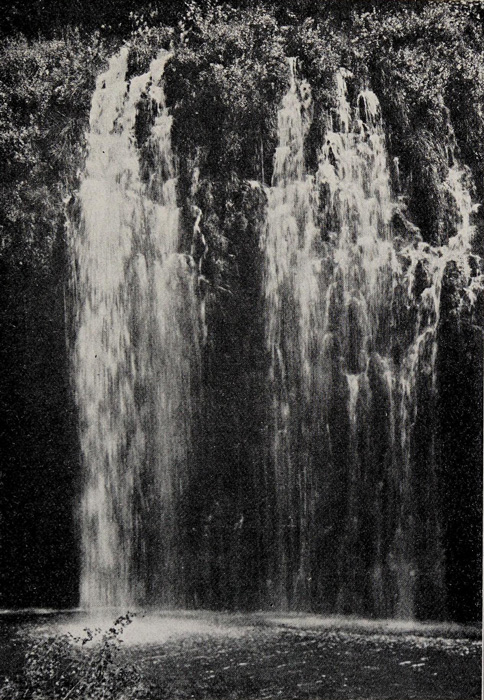
AT SHASTA SODA SPRINGS
But the heads of deer, antelope, wild sheep, and bears are conspicuously rareor altogether wanting in tourist collections in the “paradise ofhunters.” There is a grand comparing of notes and adventures. Most areexhilarated and happy, though complaints may occasionally beheard—“The mountain does not look so very high after all, nor sovery white; the snow is in patches like rags spread out to dry,”reminding one of Sydney Smith’s joke against Jeffrey, “D—nthe Solar System; bad light, planets too indistinct.” But far the greaternumber are in good spirits, showing the influence of holiday enjoyment andmountain air. Fresh roses come to cheeks that long have been pale, andsentiment often begins to blossom under the new inspiration.
The Shasta region may be reserved as a national park, with special reference tothe preservation of its fine forests and game. This should by all means bedone; but, as far as game is concerned, it is in little danger from tourists,notwithstanding many of them carry guns, and are in some sense hunters. Goingin noisy groups, and with guns so shining, they are oftentimes confronted byinquisitive Douglas squirrels, and are thus given opportunities for shooting;but the larger animals retire at their approach and seldom are seen. Other gunpeople, too wise or too lifeless to make much noise, move slowly along thetrails and about the open spots of the woods, like benumbed beetles in asnowdrift. Such hunters are themselves hunted by the animals, which in perfectsafety follow them out of curiosity.
During the bright days of midsummer the ascent of Shasta is only a long, safesaunter, without fright or nerve strain, or even serious fatigue, to those insound health. Setting out from Sisson’s on horseback, accompanied by aguide leading a pack animal with provision, blankets, and other necessaries,you follow a trail that leads up to the edge of the timberline, where you campfor the night, eight or ten miles from the hotel, at an elevation of about tenthousand feet. The next day, rising early, you may push on to the summit andreturn to Sisson’s. But it is better to spend more time in the enjoymentof the grand scenery on the summit and about the head of the Whitney Glacier,pass the second night in camp, and return to Sisson’s on the third day.Passing around the margin of the meadows and on through the zones of theforest, you will have good opportunities to get ever-changing views of themountain and its wealth of creatures that bloom and breathe.
The woods differ but little from those that clothe the mountains to thesouthward, the trees being slightly closer together and generally not quite solarge, marking the incipient change from the open sunny forests of the Sierrato the dense damp forests of the northern coast, where a squirrel may travel inthe branches of the thick-set trees hundreds of miles without touching theground. Around the upper belt of the forest you may see gaps where the groundhas been cleared by avalanches of snow, thousands of tons in weight, which,descending with grand rush and roar, brush the trees from their paths like somany fragile shrubs or grasses.
At first the ascent is very gradual. The mountain begins to leave the plain inslopes scarcely perceptible, measuring from two to three degrees. These arecontinued by easy gradations mile after mile all the way to the truncated,crumbling summit, where they attain a steepness of twenty to twenty-fivedegrees. The grand simplicity of these lines is partially interrupted on thenorth subordinate cone that rises from the side of the main cone about threethousand feet from the summit. This side cone, past which your way to thesummit lies, was active after the breaking-up of the main ice-cap of theglacial period, as shown by the comparatively unwasted crater in which itterminates and by streams of fresh-looking, unglaciated lava that radiate fromit as a center.
The main summit is about a mile and a half in diameter from southwest tonortheast, and is nearly covered with snow and névé, bounded bycrumbling peaks and ridges, among which we look in vain for any sure plan of anancient crater. The extreme summit is situated on the southern end of a narrowridge that bounds the general summit on the east. Viewed from the north, itappears as an irregular blunt point about ten feet high, and is fastdisappearing before the stormy atmospheric action to which it is subjected.
At the base of the eastern ridge, just below the extreme summit, hot sulphurousgases and vapor escape with a hissing, bubbling noise from a fissure in thelava. Some of the many small vents cast up a spray of clear hot water, whichfalls back repeatedly until wasted in vapor. The steam and spray seem to beproduced simply by melting snow coming in the way of the escaping gases, whilethe gases are evidently derived from the heated interior of the mountain, andmay be regarded as the last feeble expression of the mighty power that liftedthe entire mass of the mountain from the volcanic depths far below the surfaceof the plain.
The view from the summit in clear weather extends to an immense distance inevery direction. Southeastward, the low volcanic portion of the Sierra is seenlike a map, both flanks as well as the crater-dotted axis, as far asLassen’s Butte[6], a prominent landmark and an oldvolcano like Shasta, between ten and eleven thousand feet high, and distantabout sixty miles. Some of the higher summit peaks near Independence Lake, onehundred and eighty miles away, are at times distinctly visible. Far to thenorth, in Oregon, the snowy volcanic cones of Mounts Pitt, Jefferson, and theThree Sisters rise in clear relief, like majestic monuments, above the dim darksea of the northern woods. To the northeast lie the Rhett and Klamath Lakes,the Lava Beds, and a grand display of hill and mountain and gray rocky plains.The Scott, Siskiyou, and Trinity Mountains rise in long, compact waves to thewest and southwest, and the valley of the Sacramento and the coast mountains,with their marvelous wealth of woods and waters, are seen; while close aroundthe base of the mountain lie the beautiful Shasta Valley, Strawberry Valley,Huckleberry Valley, and many others, with the headwaters of the Shasta,Sacramento, and McCloud Rivers. Some observers claim to have seen the oceanfrom the summit of Shasta, but I have not yet been so fortunate.
The Cinder Cone near Lassen’s Butte is remarkable as being the scene ofthe most recent volcanic eruption in the range. It is a symmetrical truncatedcone covered with gray cinders and ashes, with a regular crater in which a fewpines an inch or two in diameter are growing. It stands between two small lakeswhich previous to the last eruption, when the cone was built, formed one lake.From near the base of the cone a flood of extremely rough black vesicular lavaextends across what was once a portion of the bottom of the lake into theforest of yellow pine.
This lava flow seems to have been poured out during the same eruption that gavebirth to the cone, cutting the lake in two, flowing a little way into the woodsand overwhelming the trees in its way, the ends of some of the charred trunksstill being visible, projecting from beneath the advanced snout of the flowwhere it came to rest; while the floor of the forest for miles around is sothickly strewn with loose cinders that walking is very fatiguing. The PittRiver Indians tell of a fearful time of darkness, probably due to thiseruption, when the sky was filled with falling cinders which, as they thought,threatened every living creature with destruction, and say that when at lengththe sun appeared through the gloom it was red like blood.
Less recent craters in great numbers dot the adjacent region, some with lakesin their throats, some overgrown with trees, others nearly bare—tellingmonuments of Nature’s mountain fires so often lighted throughout thenorthern Sierra. And, standing on the top of icy Shasta, the mightiestfire-monument of them all, we can hardly fail to look forward to the blare andglare of its next eruption and wonder whether it is nigh. Elsewhere men haveplanted gardens and vineyards in the craters of volcanoes quiescent for ages,and almost without warning have been hurled into the sky. More than a thousandyears of profound calm have been known to intervene between two violenteruptions. Seventeen centuries intervened between two consecutive eruptions onthe island of Ischia. Few volcanoes continue permanently in eruption. Likegigantic geysers, spouting hot stone instead of hot water, they work and sleep,and we have no sure means of knowing whether they are only sleeping or dead.
IV. A Perilous Night on Shasta’s Summit
Toward the end of summer, after a light, open winter, one may reach the summitof Mount Shasta without passing over much snow, by keeping on the crest of along narrow ridge, mostly bare, that extends from near the camp-ground at thetimberline. But on my first excursion to the summit the whole mountain, down toits low swelling base, was smoothly laden with loose fresh snow, presenting amost glorious mass of winter mountain scenery, in the midst of which Iscrambled and reveled or lay snugly snowbound, enjoying the fertile clouds andthe snow-bloom in all their growing, drifting grandeur.
I had walked from Redding, sauntering leisurely from station to station alongthe old Oregon stage road, the better to see the rocks and plants, birds andpeople, by the way, tracing the rushing Sacramento to its fountains around icyShasta. The first rains had fallen on the lowlands, and the first snows on themountains, and everything was fresh and bracing, while an abundance of balmysunshine filled all the noonday hours. It was the calm afterglow that usuallysucceeds the first storm of the winter. I met many of the birds that had rearedtheir young and spent their summer in the Shasta woods and chaparral. They werethen on their way south to their winter homes, leading their young full-fledgedand about as large and strong as the parents. Squirrels, dry and elastic afterthe storms, were busy about their stores of pine nuts, and the latestgoldenrods were still in bloom, though it was now past the middle of October.The grand color glow—the autumnal jubilee of ripe leaves—was pastprime, but, freshened by the rain, was still making a fine show along the banksof the river and in the ravines and the dells of the smaller streams.
At the salmon-hatching establishment on the McCloud River I halted a week toexamine the limestone belt, grandly developed there, to learn what I could ofthe inhabitants of the river and its banks, and to give time for the fresh snowthat I knew had fallen on the mountain to settle somewhat, with a view tomaking the ascent. A pedestrian on these mountain roads, especially so late inthe year, is sure to excite curiosity, and many were the interrogationsconcerning my ramble. When I said that I was simply taking a walk, and that icyShasta was my mark, I was invariably admonished that I had come on a dangerousquest. The time was far too late, the snow was too loose and deep to climb, andI should be lost in drifts and slides. When I hinted that new snow wasbeautiful and storms not so bad as they were called, my advisers shook theirheads in token of superior knowledge and declared the ascent of “ShastaButte” through loose snow impossible. Nevertheless, before noon of thesecond of November I was in the frosty azure of the utmost summit.
When I arrived at Sisson’s everything was quiet. The last of the summervisitors had flitted long before, and the deer and bears also were beginning toseek their winter homes. My barometer and the sighing winds and filmyhalf-transparent clouds that dimmed the sunshine gave notice of the approach ofanother storm, and I was in haste to be off and get myself establishedsomewhere in the midst of it, whether the summit was to be attained or not.Sisson, who is a mountaineer, speedily fitted me out for storm or calm as onlya mountaineer could, with warm blankets and a week’s provisions sogenerous in quantity and kind that they easily might have been made to last amonth in case of my being closely snowbound. Well I knew the weariness ofsnow-climbing, and the frosts, and the dangers of mountaineering so late in theyear; therefore I could not ask a guide to go with me, even had one beenwilling. All I wanted was to have blankets and provisions deposited as far upin the timber as the snow would permit a pack animal to go. There I could builda storm nest and lie warm, and make raids up and around the mountain inaccordance with the weather.
Setting out on the afternoon of November first, with Jerome Fay, mountaineerand guide, in charge of the animals, I was soon plodding wearily upward throughthe muffled winter woods, the snow of course growing steadily deeper andlooser, so that we had to break a trail. The animals began to get discouraged,and after night and darkness came on they became entangled in a bed of roughlava, where, breaking through four or five feet of mealy snow, their feet werecaught between angular boulders. Here they were in danger of being lost, butafter we had removed packs and saddles and assisted their efforts with ropes,they all escaped to the side of a ridge about a thousand feet below thetimberline.
To go farther was out of the question, so we were compelled to camp as best wecould. A pitch pine fire speedily changed the temperature and shed a blaze oflight on the wild lava-slope and the straggling storm-bent pines around us.Melted snow answered for coffee, and we had plenty of venison to roast. Towardmidnight I rolled myself in my blankets, slept an hour and a half, arose andate more venison, tied two days’ provisions to my belt, and set out forthe summit, hoping to reach it ere the coming storm should fall. Jeromeaccompanied me a little distance above camp and indicated the way as well as hecould in the darkness. He seemed loath to leave me, but, being reassured that Iwas at home and required no care, he bade me good-bye and returned to camp,ready to lead his animals down the mountain at daybreak.
After I was above the dwarf pines, it was fine practice pushing up the broadunbroken slopes of snow, alone in the solemn silence of the night. Half the skywas clouded; in the other half the stars sparkled icily in the keen, frostyair; while everywhere the glorious wealth of snow fell away from the summit ofthe cone in flowing folds, more extensive and continuous than any I had everseen before. When day dawned the clouds were crawling slowly and becoming moremassive, but gave no intimation of immediate danger, and I pushed onfaithfully, though holding myself well in hand, ready to return to the timber;for it was easy to see that the storm was not far off. The mountain rises tenthousand feet above the general level of the country, in blank exposure to thedeep upper currents of the sky, and no labyrinth of peaks and cañons I hadever been in seemed to me so dangerous as these immense slopes, bare againstthe sky.
The frost was intense, and drifting snow dust made breathing at times ratherdifficult. The snow was as dry as meal, and the finer particles drifted freely,rising high in the air, while the larger portions of the crystals rolled likesand. I frequently sank to my armpits between buried blocks of loose lava, butgenerally only to my knees. When tired with walking I still wallowed slowlyupward on all fours. The steepness of the slope—thirty-five degrees insome places—made any kind of progress fatiguing, while small avalancheswere being constantly set in motion in the steepest places. But the bracing airand the sublime beauty of the snowy expanse thrilled every nerve and madeabsolute exhaustion impossible. I seemed to be walking and wallowing in acloud; but, holding steadily onward, by half-past ten o’clock I hadgained the highest summit.
I held my commanding foothold in the sky for two hours, gazing on the gloriouslandscapes spread maplike around the immense horizon, and tracing the outlinesof the ancient lava-streams extending far into the surrounding plains, and thepathways of vanished glaciers of which Shasta had been the center. But, as Ihad left my coat in camp for the sake of having my limbs free in climbing, Isoon was cold. The wind increased in violence, raising the snow in magnificentdrifts that were drawn out in the form of wavering banners blowing in the sun.Toward the end of my stay a succession of small clouds struck against thesummit rocks like drifting icebergs, darkening the air as they passed, andproducing a chill as definite and sudden as if ice-water had been dashed in myface. This is the kind of cloud in which snow-flowers grow, and I turned andfled.
Finding that I was not closely pursued, I ventured to take time on the way downfor a visit to the head of the Whitney Glacier and the “CraterButte.” After I had reached the end of the main summit ridge the descentwas but little more than one continuous soft, mealy, muffled slide, mostluxurious and rapid, though the hissing, swishing speed attained was obscuredin great part by flying snow dust—a marked contrast to the boringseal-wallowing upward struggle. I reached camp about an hour before dusk,hollowed a strip of loose ground in the lee of a large block of red lava, wherefirewood was abundant, rolled myself in my blankets, and went to sleep.
Next morning, having slept little the night before the ascent and being wearywith climbing after the excitement was over, I slept late. Then, awakingsuddenly, my eyes opened on one of the most beautiful and sublime scenes I everenjoyed. A boundless wilderness of storm clouds of different degrees ofripeness were congregated over all the lower landscape for thousands of squaremiles, colored gray, and purple, and pearl, and deep-glowing white, amid whichI seemed to be floating; while the great white cone of the mountain above wasall aglow in the free, blazing sunshine. It seemed not so much an ocean as aland of clouds—undulating hill and dale, smooth purple plains, andsilvery mountains of cumuli, range over range, diversified with peak and domeand hollow fully brought out in light and shade.
I gazed enchanted, but cold gray masses, drifting like dust on a wind-sweptplain, began to shut out the light, forerunners of the coming storm I had beenso anxiously watching. I made haste to gather as much wood as possible,snugging it as a shelter around my bed. The storm side of my blankets wasfastened down with stakes to reduce as much as possible the sifting-in of driftand the danger of being blown away. The precious bread sack was placed safelyas a pillow, and when at length the first flakes fell I was exultingly ready towelcome them. Most of my firewood was more than half rosin and would blaze inthe face of the fiercest drifting; the winds could not demolish my bed, and mybread could be made to last indefinitely; while in case of need I had the meansof making snowshoes and could retreat or hold my ground as I pleased.
Presently the storm broke forth into full snowy bloom, and the throngingcrystals darkened the air. The wind swept past in hissing floods, grinding thesnow into meal and sweeping down into the hollows in enormous drifts all theheavier particles, while the finer dust was sifted through the sky, increasingthe icy gloom. But my fire glowed bravely as if in glad defiance of the driftto quench it, and, notwithstanding but little trace of my nest could be seenafter the snow had leveled and buried it, I was snug and warm, and thepassionate uproar produced a glad excitement.
Day after day the storm continued, piling snow on snow in weariless abundance.There were short periods of quiet, when the sun would seem to look eagerly downthrough rents in the clouds, as if to know how the work was advancing. Duringthese calm intervals I replenished my fire—sometimes without leaving thenest, for fire and woodpile were so near this could easily be done—orbusied myself with my notebook, watching the gestures of the trees in takingthe snow, examining separate crystals under a lens, and learning the methods oftheir deposition as an enduring fountain for the streams. Several times, whenthe storm ceased for a few minutes, a Douglas squirrel came frisking from thefoot of a clump of dwarf pines, moving in sudden interrupted spurts over thebossy snow; then, without any apparent guidance, he would dig rapidly into thedrift where were buried some grains of barley that the horses had left. TheDouglas squirrel does not strictly belong to these upper woods, and I wassurprised to see him out in such weather. The mountain sheep also, quite alarge flock of them, came to my camp and took shelter beside a clump of matteddwarf pines a little above my nest.
The storm lasted about a week, but before it was ended Sisson became alarmedand sent up the guide with animals to see what had become of me and recover thecamp outfit. The news spread that “there was a man on themountain,” and he must surely have perished, and Sisson was blamed forallowing any one to attempt climbing in such weather; while I was as safe asanybody in the lowlands, lying like a squirrel in a warm, fluffy nest, busiedabout my own affairs and wishing only to be let alone. Later, however, a trailcould not have been broken for a horse, and some of the camp furniture wouldhave had to be abandoned. On the fifth day I returned to Sisson’s, andfrom that comfortable base made excursions, as the weather permitted, to theBlack Butte, to the foot of the Whitney Glacier, around the base of themountain, to Rhett and Klamath Lakes, to the Modoc region and elsewhere,developing many interesting scenes and experiences.
But the next spring, on the other side of this eventful winter, I saw and feltstill more of the Shasta snow. For then it was my fortune to get into the veryheart of a storm, and to be held in it for a long time.
On the 28th of April 1875 I led a party up the mountain for the purpose ofmaking a survey of the summit with reference to the location of the Geodeticmonument. On the 30th, accompanied by Jerome Fay, I made another ascent to makesome barometrical observations, the day intervening between the two ascentsbeing devoted to establishing a camp on the extreme edge of the timberline.Here, on our red trachyte bed, we obtained two hours of shallow sleep brokenfor occasional glimpses of the keen, starry night. At two o’clock werose, breakfasted on a warmed tin-cupful of coffee and a piece of frozenvenison broiled on the coals, and started for the summit. Up to this time therewas nothing in sight that betokened the approach of a storm; but on gaining thesummit, we saw toward Lassen’s Butte hundreds of square miles of whitecumuli boiling dreamily in the sunshine far beneath us, and causing no alarm.
The slight weariness of the ascent was soon rested away, and our gloriousmorning in the sky promised nothing but enjoyment. At 9 a.m. the drythermometer stood at 34 degrees in the shade and rose steadily until at 1 p.m.it stood at 50 degrees, probably influenced somewhat by radiation from thesun-warmed cliffs. A common bumblebee, not at all benumbed, zigzaggedvigorously about our heads for a few moments, as if unconscious of the factthat the nearest honey flower was a mile beneath him.
In the mean time clouds were growing down in Shasta Valley—massiveswelling cumuli, displaying delicious tones of purple and gray in the hollowsof their sun-beaten bosses. Extending gradually southward around on both sidesof Shasta, these at length united with the older field towards Lassen’sButte, thus encircling Mount Shasta in one continuous cloud zone. Rhett andKlamath Lakes were eclipsed beneath clouds scarcely less brilliant than theirown silvery disks. The Modoc Lava Beds, many a snow-laden peak far north inOregon, the Scott and Trinity and Siskiyou Mountains, the peaks of the Sierra,the blue Coast Range, Shasta Valley, the dark forests filling the valley of theSacramento, all in turn were obscured or buried, leaving the lofty cone onwhich we stood solitary in the sunshine between two skies—a sky ofspotless blue above, a sky of glittering cloud beneath. The creative sun shoneglorious on the vast expanse of cloudland; hill and dale, mountain and valleyspringing into existence responsive to his rays and steadily developing inbeauty and individuality. One huge mountain-cone of cloud, corresponding toMount Shasta in these newborn cloud ranges, rose close alongside with a visiblemotion, its firm, polished bosses seeming so near and substantial that wealmost fancied that we might leap down upon them from where we stood and makeour way to the lowlands. No hint was given, by anything in their appearance, ofthe fleeting character of these most sublime and beautiful cloud mountains. Onthe contrary they impressed one as being lasting additions to the landscape.
The weather of the springtime and summer, throughout the Sierra in general, isusually varied by slight local rains and dustings of snow, most of which areobviously far too joyous and life-giving to be regarded as storms—singleclouds growing in the sunny sky, ripening in an hour, showering the heatedlandscape, and passing away like a thought, leaving no visible bodily remainsto stain the sky. Snowstorms of the same gentle kind abound among the highpeaks, but in spring they not unfrequently attain larger proportions, assuminga violence and energy of expression scarcely surpassed by those bred in thedepths of winter. Such was the storm now gathering about us.
It began to declare itself shortly after noon, suggesting to us the idea of atonce seeking our safe camp in the timber and abandoning the purpose of makingan observation of the barometer at 3 p.m.,—two having already been made,at 9 a.m., and 12 m., while simultaneous observations were made at StrawberryValley. Jerome peered at short intervals over the ridge, contemplating therising clouds with anxious gestures in the rough wind, and at length declaredthat if we did not make a speedy escape we should be compelled to pass the restof the day and night on the summit. But anxiety to complete my observationsstifled my own instinctive promptings to retreat, and held me to my work. Noinexperienced person was depending on me, and I told Jerome that we twomountaineers should be able to make our way down through any storm likely tofall.
Presently thin, fibrous films of cloud began to blow directly over the summitfrom north to south, drawn out in long fairy webs like carded wool, forming anddissolving as if by magic. The wind twisted them into ringlets and whirled themin a succession of graceful convolutions like the outside sprays of YosemiteFalls in flood time; then, sailing out into the thin azure over the precipitousbrink of the ridge they were drifted together like wreaths of foam on a river.These higher and finer cloud fabrics were evidently produced by the chilling ofthe air from its own expansion caused by the upward deflection of the windagainst the slopes of the mountain. They steadily increased on the north rim ofthe cone, forming at length a thick, opaque, ill-defined embankment from theicy meshes of which snow-flowers began to fall, alternating with hail. The skyspeedily darkened, and just as I had completed my last observation and boxed myinstruments ready for the descent, the storm began in serious earnest. At firstthe cliffs were beaten with hail, every stone of which, as far as I could see,was regular in form, six-sided pyramids with rounded base, rich andsumptuous-looking, and fashioned with loving care, yet seemingly thrown away onthose desolate crags down which they went rolling, falling, sliding in anetwork of curious streams.
After we had forced our way down the ridge and past the group of hissingfumaroles, the storm became inconceivably violent. The thermometer fell 22degrees in a few minutes, and soon dropped below zero. The hail gave place tosnow, and darkness came on like night. The wind, rising to the highest pitch ofviolence, boomed and surged amid the desolate crags; lightning flashes in quicksuccession cut the gloomy darkness; and the thunders, the most tremendouslyloud and appalling I ever heard, made an almost continuous roar, strokefollowing stroke in quick, passionate succession, as though the mountain werebeing rent to its foundations and the fires of the old volcano were breakingforth again.
Could we at once have begun to descend the snow slopes leading to the timber,we might have made good our escape, however dark and wild the storm. As it was,we had first to make our way along a dangerous ridge nearly a mile and a halflong, flanked in many places by steep ice-slopes at the head of the WhitneyGlacier on one side and by shattered precipices on the other. Apprehensive ofthis coming darkness, I had taken the precaution, when the storm began, to makethe most dangerous points clear to my mind, and to mark their relations withreference to the direction of the wind. When, therefore, the darkness came on,and the bewildering drift, I felt confident that we could force our way throughit with no other guidance. After passing the “Hot Springs” I haltedin the lee of a lava-block to let Jerome, who had fallen a little behind, comeup. Here he opened a council in which, under circumstances sufficientlyexciting but without evincing any bewilderment, he maintained, in opposition tomy views, that it was impossible to proceed. He firmly refused to make theventure to find the camp, while I, aware of the dangers that would necessarilyattend our efforts, and conscious of being the cause of his present peril,decided not to leave him.
Our discussions ended, Jerome made a dash from the shelter of the lava-blockand began forcing his way back against the wind to the “HotSprings,” wavering and struggling to resist being carried away, as if hewere fording a rapid stream. After waiting and watching in vain for some flawin the storm that might be urged as a new argument in favor of attempting thedescent, I was compelled to follow. “Here,” said Jerome, as weshivered in the midst of the hissing, sputtering fumaroles, “we shall besafe from frost.” “Yes,” said I, “we can lie in thismud and steam and sludge, warm at least on one side; but how can we protect ourlungs from the acid gases, and how, after our clothing is saturated, shall webe able to reach camp without freezing, even after the storm is over? We shallhave to wait for sunshine, and when will it come?”
The tempered area to which we had committed ourselves extended over about onefourth of an acre; but it was only about an eighth of an inch in thickness, forthe scalding gas jets were shorn off close to the ground by the oversweepingflood of frosty wind. And how lavishly the snow fell only mountaineers mayknow. The crisp crystal flowers seemed to touch one another and fairly tothicken the tremendous blast that carried them. This was the bloom-time, thesummer of the cloud, and never before have I seen even a mountain cloudflowering so profusely.
When the bloom of the Shasta chaparral is falling, the ground is sometimescovered for hundreds of square miles to a depth of half an inch. But the bloomof this fertile snow cloud grew and matured and fell to a depth of two feet ina few hours. Some crystals landed with their rays almost perfect, but most ofthem were worn and broken by striking against one another, or by rolling on theground. The touch of these snow-flowers in calm weather is infinitelygentle—glinting, swaying, settling silently in the dry mountain air, ormassed in flakes soft and downy. To lie out alone in the mountains of a stillnight and be touched by the first of these small silent messengers from the skyis a memorable experience, and the fineness of that touch none will forget. Butthe storm-blast laden with crisp, sharp snow seems to crush and bruise andstupefy with its multitude of stings, and compels the bravest to turn and flee.
The snow fell without abatement until an hour or two after what seemed to bethe natural darkness of the night. Up to the time the storm first broke on thesummit its development was remarkably gentle. There was a deliberate growth ofclouds, a weaving of translucent tissue above, then the roar of the wind andthe thunder, and the darkening flight of snow. Its subsidence was not lesssudden. The clouds broke and vanished, not a crystal was left in the sky, andthe stars shone out with pure and tranquil radiance.
During the storm we lay on our backs so as to present as little surface aspossible to the wind, and to let the drift pass over us. The mealy snow siftedinto the folds of our clothing and in many places reached the skin. We wereglad at first to see the snow packing about us, hoping it would deaden theforce of the wind, but it soon froze into a stiff, crusty heap as thetemperature fell, rather augmenting our novel misery.
When the heat became unendurable, on some spot where steam was escaping throughthe sludge, we tried to stop it with snow and mud, or shifted a little at atime by shoving with our heels; for to stand in blank exposure to the fearfulwind in our frozen-and-broiled condition seemed certain death. The acridincrustations sublimed from the escaping gases frequently gave way, opening newvents to scald us; and, fearing that if at any time the wind should fall,carbonic acid, which often formed a considerable portion of the gaseousexhalations of volcanoes, might collect in sufficient quantities to cause sleepand death, I warned Jerome against forgetting himself for a single moment, evenshould his sufferings admit of such a thing.
Accordingly, when during the long, dreary watches of the night we roused from astate of half-consciousness, we called each other by name in a frightened,startled way, each fearing the other might be benumbed or dead. The ordinarysensations of cold give but a faint conception of that which comes on afterhard climbing with want of food and sleep in such exposure as this. Life isthen seen to be a fire, that now smoulders, now brightens, and may be easilyquenched. The weary hours wore away like dim half-forgotten years, so long andeventful they seemed, though we did nothing but suffer. Still the pain was notalways of that bitter, intense kind that precludes thought and takes away allcapacity for enjoyment. A sort of dreamy stupor came on at times in which wefancied we saw dry, resinous logs suitable for campfires, just as after goingdays without food men fancy they see bread.
Frozen, blistered, famished, benumbed, our bodies seemed lost to us attimes—all dead but the eyes. For the duller and fainter we became theclearer was our vision, though only in momentary glimpses. Then, after the skycleared, we gazed at the stars, blessed immortals of light, shining withmarvelous brightness with long lance rays, near-looking and new-looking, as ifnever seen before. Again they would look familiar and remind us of stargazingat home. Oftentimes imagination coming into play would present charmingpictures of the warm zone below, mingled with others near and far. Then thebitter wind and the drift would break the blissful vision and dreary painscover us like clouds. “Are you suffering much?” Jerome wouldinquire with pitiful faintness. “Yes,” I would say, striving tokeep my voice brave, “frozen and burned; but never mind, Jerome, thenight will wear away at last, and tomorrow we go a-Maying, and what campfireswe will make, and what sunbaths we will take!”
The frost grew more and more intense, and we became icy and covered over with acrust of frozen snow, as if we had lain cast away in the drift all winter. Inabout thirteen hours—every hour like a year—day began to dawn, butit was long ere the summit’s rocks were touched by the sun. No cloudswere visible from where we lay, yet the morning was dull and blue, and bitterlyfrosty; and hour after hour passed by while we eagerly watched the pale lightstealing down the ridge to the hollow where we lay. But there was not a traceof that warm, flushing sunrise splendor we so long had hoped for.
As the time drew near to make an effort to reach camp, we became concerned toknow what strength was left us, and whether or no we could walk; for we hadlain flat all this time without once rising to our feet. Mountaineers, however,always find in themselves a reserve of power after great exhaustion. It is akind of second life, available only in emergencies like this; and, havingproved its existence, I had no great fear that either of us would fail, thoughone of my arms was already benumbed and hung powerless.
At length, after the temperature was somewhat mitigated on this memorable firstof May, we arose and began to struggle homeward. Our frozen trousers couldscarcely be made to bend at the knee, and we waded the snow with difficulty.The summit ridge was fortunately wind-swept and nearly bare, so we were notcompelled to lift our feet high, and on reaching the long home slopes ladenwith loose snow we made rapid progress, sliding and shuffling and pitchingheadlong, our feebleness accelerating rather than diminishing our speed. Whenwe had descended some three thousand feet the sunshine warmed our backs and webegan to revive. At 10 a.m. we reached the timber and were safe.
Half an hour later we heard Sisson shouting down among the firs, coming withhorses to take us to the hotel. After breaking a trail through the snow as faras possible he had tied his animals and walked up. We had been so long withoutfood that we cared but little about eating, but we eagerly drank the coffee heprepared for us. Our feet were frozen, and thawing them was painful, and had tobe done very slowly by keeping them buried in soft snow for several hours,which avoided permanent damage. Five thousand feet below the summit we foundonly three inches of new snow, and at the base of the mountain only a slightshower of rain had fallen, showing how local our storm had been,notwithstanding its terrific fury. Our feet were wrapped in sacking, and wewere soon mounted and on our way down into the thicksunshine—“God’s Country,” as Sisson calls the ChaparralZone. In two hours’ ride the last snowbank was left behind. Violetsappeared along the edges of the trail, and the chaparral was coming into bloom,with young lilies and larkspurs about the open places in rich profusion. Howbeautiful seemed the golden sunbeams streaming through the woods between thewarm brown boles of the cedars and pines! All my friends among the birds andplants seemed like oldfriends, and we felt like speaking to every oneof them as we passed, as if we had been a long time away in some far, strangecountry.
In the afternoon we reached Strawberry Valley and fell asleep. Next morning weseemed to have risen from the dead. My bedroom was flooded with sunshine, andfrom the window I saw the great white Shasta cone clad in forests and cloudsand bearing them loftily in the sky. Everything seemed full and radiant withthe freshness and beauty and enthusiasm of youth. Sisson’s children camein with flowers and covered my bed, and the storm on the mountaintop banishedlike a dream.
V. Shasta Rambles and Modoc Memories
Arctic beauty and desolation, with their blessings and dangers, all may befound here, to test the endurance and skill of adventurous climbers; but farbetter than climbing the mountain is going around its warm, fertile base,enjoying its bounties like a bee circling around a bank of flowers. Thedistance is about a hundred miles, and will take some of the time we hear somuch about—a week or two—but the benefits will compensate for anynumber of weeks. Perhaps the profession of doing good may be full, but everybody should be kind at least to himself. Take a course of good water and air,and in the eternal youth of Nature you may renew your own. Go quietly, alone;no harm will befall you. Some have strange, morbid fears as soon as they findthemselves with Nature, even in the kindest and wildest of her solitudes, likevery sick children afraid of their mother—as if God were dead and thedevil were king.
One may make the trip on horseback, or in a carriage, even; for a good levelroad may be found all the way round, by Shasta Valley, Sheep Rock, Elk Flat,Huckleberry Valley, Squaw Valley, following for a considerable portion of theway the old Emigrant Road, which lies along the east disk of the mountain, andis deeply worn by the wagons of the early gold-seekers, many of whom chose thisnorthern route as perhaps being safer and easier, the pass here being onlyabout six thousand feet above sea level. But it is far better to go afoot. Thenyou are free to make wide waverings and zigzags away from the roads to visitthe great fountain streams of the rivers, the glaciers also, and the wildestretreats in the primeval forests, where the best plants and animals dwell, andwhere many a flower-bell will ring against your knees, and friendly trees willreach out their fronded branches and touch you as you pass. One blanket will beenough to carry, or you may forego the pleasure and burden altogether, as woodfor fires is everywhere abundant. Only a little food will be required. Berriesand plums abound in season, and quail and grouse and deer—the magnificentshaggy mule deer as well as the common species.
As you sweep around so grand a center, the mountain itself seems to turn,displaying its riches like the revolving pyramids in jewelers’ windows.One glacier after another comes into view, and the outlines of the mountain areever changing, though all the way around, from whatever point of view, the formis maintained of a grand, simple cone with a gently sloping base and rugged,crumbling ridges separating the glaciers and the snowfields more or lesscompletely. The play of colors, from the first touches of the morning sun onthe summit, down the snowfields and the ice and lava until the forests areaglow, is a never-ending delight, the rosy lava and the fine flushings of thesnow being ineffably lovely. Thus one saunters on and on in the gloriousradiance in utter peace and forgetfulness of time.
Yet, strange to say, there are days even here somewhat dull-looking, when themountain seems uncommunicative, sending out no appreciable invitation, as ifnot at home. At such time its height seems much less, as if, crouching andweary, it were taking rest. But Shasta is always at home to those who love her,and is ever in a thrill of enthusiastic activity—burning fires within,grinding glaciers without, and fountains ever flowing. Every crystal dancesresponsive to the touches of the sun, and currents of sap in the growing cellsof all the vegetation are ever in a vital whirl and rush, and though many feetand wings are folded, how many are astir! And the wandering winds, how busythey are, and what a breadth of sound and motion they make, glinting andbubbling about the crags of the summit, sifting through the woods, feelingtheir way from grove to grove, ruffling the loose hair on the shoulders of thebears, fanning and rocking young birds in their cradles, making a trumpet ofevery corolla, and carrying their fragrance around the world.
In unsettled weather, when storms are growing, the mountain looms immenselyhigher, and its miles of height become apparent to all, especially in the gloomof the gathering clouds, or when the storm is done and they are rolling away,torn on the edges and melting while in the sunshine. Slight rainstorms arelikely to be encountered in a trip round the mountain, but one may easily findshelter beneath well-thatched trees that shed the rain like a roof. Then theshining of the wet leaves is delightful, and the steamy fragrance, and theburst of bird song from a multitude of thrushes and finches and warblers thathave nests in the chaparral.
The nights, too, are delightful, watching with Shasta beneath the great starrydome. A thousand thousand voices are heard, but so finely blended they seem apart of the night itself, and make a deeper silence. And how grandly do thegreat logs and branches of your campfire give forth the heat and light thatduring their long century-lives they have so slowly gathered from the sun,storing it away in beautiful dotted cells and beads of amber gum! Theneighboring trees look into the charmed circle as if the noon of another dayhad come, familiar flowers and grasses that chance to be near seem far morebeautiful and impressive than by day, and as the dead trees give forth theirlight all the other riches of their lives seem to be set free and with therejoicing flames rise again to the sky. In setting out from Strawberry Valley,by bearing off to the northwestward a few miles you may see
“...beneath dim aisles, in odorous beds,
The slight Linnaea hang its twin-born heads,
And [bless] the monument of the man of flowers,
Which breathes his sweet fame through the northern bowers.”
This is one of the few places in California where the charming linnaea isfound, though it is common to the northward through Oregon and Washington.Here, too, you may find the curious but unlovable darlingtonia, a carnivorousplant that devours bumblebees, grasshoppers, ants, moths, and other insects,with insatiable appetite. In approaching it, its suspicious-lookingyellow-spotted hood and watchful attitude will be likely to make you gocautiously through the bog where it stands, as if you were approaching adangerous snake. It also occurs in a bog near Sothern’s Station on thestage road, where I first saw it, and in other similar bogs throughout themountains hereabouts.
The “Big Spring” of the Sacramento is about a mile and a half aboveSisson’s, issuing from the base of a drift-covered hill. It is lined withemerald algae and mosses, and shaded with alder, willow, and thorn bushes,which give it a fine setting. Its waters, apparently unaffected by flood ordrouth, heat or cold, fall at once into white rapids with a rush and dash, asif glad to escape from the darkness to begin their wild course down the cañonto the plain.
Muir’s Peak, a few miles to the north of the spring, rises about threethousand feet above the plain on which it stands, and is easily climbed. Theview is very fine and well repays the slight walk to its summit, from whichmuch of your way about the mountain may be studied and chosen. The viewobtained of the Whitney Glacier should tempt you to visit it, since it is thelargest of the Shasta glaciers and its lower portion abounds in beautiful andinteresting cascades and crevasses. It is three or four miles long andterminates at an elevation of about nine thousand five hundred feet above sealevel, in moraine-sprinkled ice cliffs sixty feet high. The long gray slopesleading up to the glacier seem remarkably smooth and unbroken. They are muchinterrupted, nevertheless, with abrupt, jagged precipitous gorges, which thoughoffering instructive sections of the lavas for examination, would better beshunned by most people. This may be done by keeping well down on the base untilfronting the glacier before beginning the ascent.
The gorge through which the glacier is drained is raw-looking, deep and narrow,and indescribably jagged. The walls in many places overhang; in others they arebeveled, loose, and shifting where the channel has been eroded by cinders,ashes, strata of firm lavas, and glacial drift, telling of many a change fromfrost to fire and their attendant floods of mud and water. Most of the drainageof the glacier vanishes at once in the porous rocks to reappear in springs inthe distant valley, and it is only in time of flood that the channel carriesmuch water; then there are several fine falls in the gorge, six hundred feet ormore in height. Snow lies in it the year round at an elevation of eightthousand five hundred feet, and in sheltered spots a thousand feet lower.Tracing this wild changing channel-gorge, gully, or cañon, the sections willshow Mount Shasta as a huge palimpsest, containing the records, layer uponlayer, of strangely contrasted events in its fiery-icy history. But look wellto your footing, for the way will test the skill of the most cautiousmountaineers.
Regaining the low ground at the base of the mountain and holding on in yourgrand orbit, you pass through a belt of juniper woods, called “TheCedars,” to Sheep Rock at the foot of the Shasta Pass. Here you strikethe old emigrant road, which leads over the low divide to the eastern slopes ofthe mountain. In a north-northwesterly direction from the foot of the pass youmay chance to find Pluto’s Cave, already mentioned; but it is not easilyfound, since its several mouths are on a level with the general surface of theground, and have been made simply by the falling-in of portions of the roof.Far the most beautiful and richly furnished of the mountain caves of Californiaoccur in a thick belt of metamorphic limestone that is pretty generallydeveloped along the western flank of the Sierra from the McCloud River to theKaweah, a distance of nearly four hundred miles. These volcanic caves are notwanting in interest, and it is well to light a pitch pine torch and take a walkin these dark ways of the underworld whenever opportunity offers, if for noother reason to see with new appreciation on returning to the sunshine thebeauties that lie so thick about us.
Sheep Rock is about twenty miles from Sisson’s, and is one of theprincipal winter pasture grounds of the wild sheep, from which it takes itsname. It is a mass of lava presenting to the gray sage plain of Shasta Valley abold craggy front two thousand feet high. Its summit lies at an elevation offive thousand five hundred feet above the sea, and has several square miles ofcomparatively level surface, where bunchgrass grows and the snow does not liedeep, thus allowing the hardy sheep to pick up a living through the wintermonths when deep snows have driven them down from the lofty ridges of Shasta.
From here it might be well to leave the immediate base of the mountain for afew days and visit the Lava Beds made famous by the Modoc War. They lie aboutforty miles to the northeastward, on the south shore of Rhett or Tule[7]Lake, at anelevation above sea level of about forty-five hundred feet. They are a portionof a flow of dense black vesicular lava, dipping northeastward at a low angle,but little changed as yet by the weather, and about as destitute of soil as aglacial pavement. The surface, though smooth in a general way as seen from adistance, is dotted with hillocks and rough crater-like pits, and traversed bya network of yawning fissures, forming a combination of topographicalconditions of very striking character. The way lies by Mount Bremer, overstretches of gray sage plains, interrupted by rough lava slopes timbered withjuniper and yellow pine, and with here and there a green meadow and a stream.
This is a famous game region, and you will be likely to meet small bands ofantelope, mule deer, and wild sheep. Mount Bremer is the most noted strongholdof the sheep in the whole Shasta region. Large flocks dwell here from year toyear, winter and summer, descending occasionally into the adjacent sage plainsand lava beds to feed, but ever ready to take refuge in the jagged crags oftheir mountain at every alarm. While traveling with a company of hunters I sawabout fifty in one flock.
The Van Bremer brothers, after whom the mountain is named, told me that theyonce climbed the mountain with their rifles and hounds on a grand hunt; but,after keeping up the pursuit for a week, their boots and clothing gave way, andthe hounds were lamed and worn out without having run down a single sheep,notwithstanding they ran night and day. On smooth spots, level or ascending,the hounds gained on the sheep, but on descending ground, and over rough massesof angular rocks they fell hopelessly behind. Only half a dozen sheep were shotas they passed the hunters stationed near their paths circling round the ruggedsummit. The full-grown bucks weigh nearly three hundred and fifty pounds.
The mule deer are nearly as heavy. Their long, massive ears give them a verystriking appearance. One large buck that I measured stood three feet and seveninches high at the shoulders, and when the ears were extended horizontally thedistance across from tip to tip was two feet and one inch.
From the Van Bremer ranch the way to the Lava Beds leads down the BremerMeadows past many a smooth grassy knoll and jutting cliff, along the shore ofLower Klamath Lake, and thence across a few miles of sage plain to the brow ofthe wall-like bluff of lava four hundred and fifty feet above Tule Lake. Hereyou are looking southeastward, and the Modoc landscape, which at once takespossession of you, lies revealed in front. It is composed of three principalparts; on your left lies the bright expanse of Tule Lake, on your right anevergreen forest, and between the two are the black Lava Beds.
When I first stood there, one bright day before sundown, the lake was fairlyblooming in purple light, and was so responsive to the sky in both calmness andcolor it seemed itself a sky. No mountain shore hides its loveliness. It lieswide open for many a mile, veiled in no mystery but the mystery of light. Theforest also was flooded with sun-purple, not a spire moving, and Mount Shastawas seen towering above it rejoicing in the ineffable beauty of the alpenglow.But neither the glorified woods on the one hand, nor the lake on the other,could at first hold the eye. That dark mysterious lava plain between themcompelled attention. Here you trace yawning fissures, there clusters of somberpits; now you mark where the lava is bent and corrugated in swelling ridges anddomes, again where it breaks into a rough mass of loose blocks. Tufts of grassgrow far apart here and there and small bushes of hardy sage, but they have asinged appearance and can do little to hide the blackness. Deserts are charmingto those who know how to see them—all kinds of bogs, barrens, and heathymoors; but the Modoc Lava Beds have for me an uncanny look. As I gazed thepurple deepened over all the landscape. Then fell the gloaming, makingeverything still more forbidding and mysterious. Then, darkness like death.
Next morning the crisp, sunshiny air made even the Modoc landscape lesshopeless, and we ventured down the bluff to the edge of the Lava Beds. Just atthe foot of the bluff we came to a square enclosed by a stone wall. This is agraveyard where lie buried thirty soldiers, most of whom met their fate out inthe Lava Beds, as we learn by the boards marking the graves—a gloomyplace to die in, and deadly-looking even without Modocs. The poor fellows thatlie here deserve far more pity than they have ever received. Picking our wayover the strange ridges and hollows of the beds, we soon came to a circularflat about twenty yards in diameter, on the shore of the lake, where thecomparative smoothness of the lava and a few handfuls of soil have caused thegrass tufts to grow taller. This is where General Canby was slain while seekingto make peace with the treacherous Modocs.
Two or three miles farther on is the main stronghold of the Modocs, held bythem so long and defiantly against all the soldiers that could be brought tothe attack. Indians usually choose to hide in tall grass and bush and behindtrees, where they can crouch and glide like panthers, without casting updefenses that would betray their positions; but the Modoc castle is in therock. When the Yosemite Indians made raids on the settlers of the lower Merced,they withdrew with their spoils into Yosemite Valley; and the Modocs boastedthat in case of war they had a stone house into which no white man could comeas long as they cared to defend it. Yosemite was not held for a single dayagainst the pursuing troops; but the Modocs held their fort for months, until,weary of being hemmed in, they chose to withdraw.
It consists of numerous redoubts formed by the unequal subsidence of portionsof the lava flow, and a complicated network of redans abundantly supplied withsalient and re-entering angles, being united each to the other and to theredoubts by a labyrinth of open and covered corridors, some of which expand atintervals into spacious caverns, forming as a whole the most complete naturalGibraltar I ever saw. Other castles scarcely less strong are connected withthis by subterranean passages known only to the Indians, while the unnaturalblackness of the rock out of which Nature has constructed these defenses, andthe weird, inhuman physiognomy of the whole region are well calculated toinspire terror.
Deadly was the task of storming such a place. The breech-loading rifles of theIndians thrust through chinks between the rocks were ready to pick off everysoldier who showed himself for a moment, while the Indians lay utterlyinvisible. They were familiar with byways both over and under ground, and couldat any time sink suddenly out of sight like squirrels among the loose boulders.Our bewildered soldiers heard them shooting, now before, now behind them, asthey glided from place to place through fissures and subterranean passes, allthe while as invisible as Gyges wearing his magic ring. To judge from the few Ihave seen, Modocs are not very amiable-looking people at best. When, therefore,they were crawling stealthily in the gloomy caverns, unkempt and begrimed andwith the glare of war in their eyes, they must have seemed very demons of thevolcanic pit.
Captain Jack’s cave is one of the many somber cells of the castle. Itmeasures twenty-five or thirty feet in diameter at the entrance, and extendsbut a short distance in a horizontal direction. The floor is littered with thebones of the animals slaughtered for food during the war. Some eagerarchaeologist may hereafter discover this cabin and startle his world byannouncing another of the Stone Age caves. The sun shines freely into itsmouth, and graceful bunches of grass and eriogonums and sage grow about it,doing what they can toward its redemption from degrading associations andmaking it beautiful.
Where the lava meets the lake there are some fine curving bays, beautifullyembroidered with rushes and polygonums, a favorite resort of waterfowl. On ourreturn, keeping close along shore, we caused a noisy plashing and beating ofwings among cranes and geese. The ducks, less wary, kept their places, merelyswimming in and out through openings in the rushes, rippling the glassy water,and raising spangles in their wake. The countenance of the lava beds becameless and less forbidding. Tufts of pale grasses, relieved on the jet rocks,looked like ornaments on a mantel, thick-furred mats of emerald mosses appearedin damp spots next the shore, and I noticed one tuft of small ferns. From yearto year in the kindly weather the beds are thus gathering beauty—beautyfor ashes.
Returning to Sheep Rock and following the old emigrant road, one is soon backagain beneath the snows and shadows of Shasta, and the Ash Creek and McCloudGlaciers come into view on the east side of the mountain. They are broad,rugged, crevassed cloudlike masses of down-grinding ice, pouring forth streamsof muddy water as measures of the work they are doing in sculpturing the rocksbeneath them; very unlike the long, majestic glaciers of Alaska that riverlikego winding down the valleys through the forests to the sea. These, with a fewothers as yet nameless, are lingering remnants of once great glaciers thatoccupied the cañons now taken by the rivers, and in a few centuries will,under present conditions, vanish altogether.
The rivers of the granite south half of the Sierra are outspread on the peaksin a shining network of small branches, that divide again and again into smalldribbling, purling, oozing threads drawing their sources from the snow and iceof the surface. They seldom sink out of sight, save here and there in themoraines or glaciers, or, early in the season, beneath the banks and bridges ofsnow, soon to issue again. But in the north half, laden with rent and porouslava, small tributary streams are rare, and the rivers, flowing for a timebeneath the sky of rock, at length burst forth into the light in generousvolume from seams and caverns, filtered, cool, and sparkling, as if theirbondage in darkness, safe from the vicissitudes of the weather in their youth,were only a blessing.
Only a very small portion of the water derived from the melting ice and snow ofShasta flows down its flanks on the surface. Probably ninety-nine per cent ofit is at once absorbed and drained away beneath the porous lava-folds of themountain to gush forth, filtered and pure, in the form of immense springs, solarge, some of them, that they give birth to rivers that start on their journeybeneath the sun, full-grown and perfect without any childhood. Thus the ShastaRiver issues from a large lake-like spring in Shasta Valley, and about twothirds of the volume of the McCloud gushes forth in a grand spring on the eastside of the mountain, a few miles back from its immediate base.
To find the big spring of the McCloud, or “Mud Glacier,” which youwill know by its size (it being the largest on the east side), you make yourway through sunny, parklike woods of yellow pine, and a shaggy growth ofchaparral, and come in a few hours to the river flowing in a gorge of moderatedepth, cut abruptly down into the lava plain. Should the volume of the streamwhere you strike it seem small, then you will know that you are above thespring; if large, nearly equal to its volume at its confluence with the PittRiver, then you are below it; and in either case have only to follow the riverup or down until you come to it.
Under certain conditions you may hear the roar of the water rushing from therock at a distance of half a mile, or even more; or you may not hear it untilwithin a few rods. It comes in a grand, eager gush from a horizontal seam inthe face of the wall of the river gorge in the form of a partially interruptedsheet nearly seventy-five yards in width, and at a height above the riverbed ofabout forty feet, as nearly as I could make out without the means of exactmeasurement. For about fifty yards this flat current is in one unbroken sheet,and flows in a lacework of plashing, upleaping spray over boulders that areclad in green silky algae and water mosses to meet the smaller part of theriver, which takes its rise farther up. Joining the river at right angles toits course, it at once swells its volume to three times its size above thespring.
The vivid green of the boulders beneath the water is very striking, and colorsthe entire stream with the exception of the portions broken into foam. Thecolor is chiefly due to a species of algae which seems common in springs ofthis sort. That any kind of plant can hold on and grow beneath the wear of soboisterous a current seems truly wonderful, even after taking intoconsideration the freedom of the water from cutting drift, and the constance ofits volume and temperature throughout the year. The temperature is about 45degrees, and the height of the river above the sea is here about three thousandfeet. Asplenium, epilobium, heuchera, hazel, dogwood, and alder make aluxurious fringe and setting; and the forests of Douglas spruce along the banksare the finest I have ever seen in the Sierra.
From the spring you may go with the river—a fine travelingcompanion—down to the sportsman’s fishing station, where, if youare getting hungry, you may replenish your stores; or, bearing off around themountain by Huckleberry Valley, complete your circuit without interruption,emerging at length from beneath the outspread arms of the sugar pine atStrawberry Valley, with all the new wealth and health gathered in your walk;not tired in the least, and only eager to repeat the round.
Tracing rivers to their fountains makes the most charming of travels. As thelife-blood of the landscapes, the best of the wilderness comes to their banks,and not one dull passage is found in all their eventful histories. Tracing theMcCloud to its highest springs, and over the divide to the fountains of FallRiver, near Fort Crook, thence down that river to its confluence with the Pitt,on from there to the volcanic region about Lassen’s Butte, through theBig Meadows among the sources of the Feather River, and down through forests ofsugar pine to the fertile plains of Chico—this is a glorious saunter andimposes no hardship. Food may be had at moderate intervals, and the wholecircuit forms one ever-deepening, broadening stream of enjoyment.
Fall River is a very remarkable stream. It is only about ten miles long, and iscomposed of springs, rapids, and falls—springs beautifully shaded at oneend of it, a showy fall one hundred and eighty feet high at the other, and arush of crystal rapids between. The banks are fringed with rubus, rose, plumcherry, spiraea, azalea, honeysuckle, hawthorn, ash, alder, elder, aster,goldenrod, beautiful grasses, sedges, rushes, mosses, and ferns with fronds aslarge as the leaves of palms—all in the midst of a richly forestedlandscape. Nowhere within the limits of California are the forests of yellowpine so extensive and exclusive as on the headwaters of the Pitt. They coverthe mountains and all the lower slopes that border the wide, open valleys whichabound there, pressing forward in imposing ranks, seemingly the hardiest andmost firmly established of all the northern coniferae.
The volcanic region about Lassen’s Butte I have already in partdescribed. Miles of its flanks are dotted with hot springs, many of them sosulphurous and boisterous and noisy in their boiling that they seem inclined tobecome geysers like those of the Yellowstone.
The ascent of Lassen’s Butte is an easy walk, and the views from thesummit are extremely telling. Innumerable lakes and craters surround the base;forests of the charming Williamson spruce fringe lake and crater alike; thesunbeaten plains to east and west make a striking show, and the wilderness ofpeaks and ridges stretch indefinitely away on either hand. The lofty, icyShasta, towering high above all, seems but an hour’s walk from you,though the distance in an air-line is about sixty miles.
The “Big Meadows” lie near the foot of Lassen’s Butte, abeautiful spacious basin set in the heart of the richly forested mountains,scarcely surpassed in the grandeur of its surroundings by Tahoe. During theGlacial Period it was a mer de glace, then a lake, and now a level meadowshining with bountiful springs and streams. In the number and size of its bigspring fountains it excels even Shasta. One of the largest that I measuredforms a lakelet nearly a hundred yards in diameter, and, in the generous floodit sends forth offers one of the most telling symbols of Nature’saffluence to be found in the mountains.
The great wilds of our country, once held to be boundless and inexhaustible,are being rapidly invaded and overrun in every direction, and everythingdestructible in them is being destroyed. How far destruction may go it is noteasy to guess. Every landscape, low and high, seems doomed to be trampled andharried. Even the sky is not safe from scath—blurred and blackened wholesummers together with the smoke of fires that devour the woods.
The Shasta region is still a fresh unspoiled wilderness, accessible andavailable for travelers of every kind and degree. Would it not then be a finething to set it apart like the Yellowstone and Yosemite as a National Park forthe welfare and benefit of all mankind, preserving its fountains and forestsand all its glad life in primeval beauty? Very little of the region can ever bemore valuable for any other use—certainly not for gold nor for grain. Noprivate right or interest need suffer, and thousands yet unborn would come fromfar and near and bless the country for its wise and benevolent forethought.
VI. The City of the Saints[8]
The mountains rise grandly round about this curious city, the Zion of the newSaints, so grandly that the city itself is hardly visible. The Wahsatch Range,snow-laden and adorned with glacier-sculpted peaks, stretches continuouslyalong the eastern horizon, forming the boundary of the Great Salt Lake Basin;while across the valley of the Jordan southwestward from here, you behold theOquirrh Range, about as snowy and lofty as the Wahsatch. To the northwest youreye skims the blue levels of the great lake, out of the midst of which riseisland mountains, and beyond, at a distance of fifty miles, is seen thepicturesque wall of the lakeside mountains blending with the lake and the sky.
The glacial developments of these superb ranges are sharply sculptured peaksand crests, with ample wombs between them where the ancient snows of theglacial period were collected and transformed into ice, and ranks of profoundshadowy cañons, while moraines commensurate with the lofty fountains extendinto the valleys, forming far the grandest series of glacial monuments I haveyet seen this side of the Sierra.
In beginning this letter I meant to describe the city, but in the company ofthese noble old mountains, it is not easy to bend one’s attention uponanything else. Salt Lake cannot be called a very beautiful town, neither isthere anything ugly or repulsive about it. From the slopes of the Wahsatchfoothills, or old lake benches, toward Fort Douglas it is seen to occupy thesloping gravelly delta of City Creek, a fine, hearty stream that comes pouringfrom the snows of the mountains through a majestic glacial cañon; and it isjust where this stream comes forth into the light on the edge of the valley ofthe Jordan that the Mormons have built their new Jerusalem.
At first sight there is nothing very marked in the external appearance of thetown excepting its leafiness. Most of the houses are veiled with trees, as ifset down in the midst of one grand orchard; and seen at a little distance theyappear like a field of glacier boulders overgrown with aspens, such as oneoften meets in the upper valleys of the California Sierra, for only the angularroofs are clearly visible.
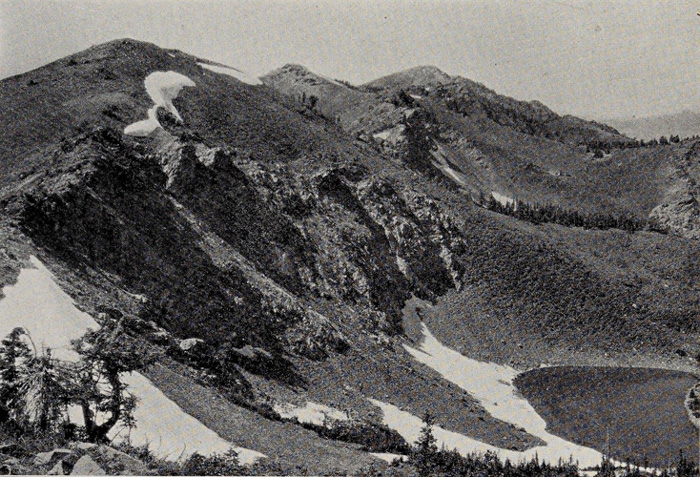
IN THE WAHSATCH MOUNTAINS
Perhaps nineteen twentieths of the houses are built of bluish-gray adobebricks, and are only one or two stories high, forming fine cottage homes whichpromise simple comfort within. They are set well back from the street, leavingroom for a flower garden, while almost every one has a thrifty orchard at thesides and around the back. The gardens are laid out with great simplicity,indicating love for flowers by people comparatively poor, rather thandeliberate efforts of the rich for showy artistic effects. They are like thepet gardens of children, about as artless and humble, and harmonize with thelow dwellings to which they belong. In almost every one you find daisies, andmint, and lilac bushes, and rows of plain English tulips. Lilacs and tulips arethe most characteristic flowers, and nowhere have I seen them in greaterperfection. As Oakland is pre-eminently a city of roses, so is this MormonSaints’ Rest a city of lilacs and tulips. The flowers, at least, aresaintly, and they are surely loved. Scarce a home, however obscure, is withoutthem, and the simple, unostentatious manner in which they are planted andgathered in pots and boxes about the windows shows how truly they are prized.
The surrounding commons, the marshy levels of the Jordan, and dry, gravellylake benches on the slopes of the Wahsatch foothills are now gay with wildflowers, chief among which are a species of phlox, with an abundance of richpink corollas, growing among sagebrush in showy tufts, and a beautifulpapilionaceous plant, with silky leaves and large clusters of purple flowers,banner, wings, and keel exquisitely shaded, a mertensia, hydrophyllum, whiteboragewort, orthocarpus, several species of violets, and a tall scarlet gilia.It is delightful to see how eagerly all these are sought after by the children,both boys and girls. Every day that I have gone botanizing I have met groups oflittle Latter-Days with their precious bouquets, and at such times it was hardto believe the dark, bloody passages of Mormon history.
But to return to the city. As soon as City Creek approaches its upper limit itswaters are drawn off right and left, and distributed in brisk rills, one oneach side of every street, the regular slopes of the delta upon which the cityis built being admirably adapted to this system of street irrigation. Thesestreams are all pure and sparkling in the upper streets, but, as they are usedto some extent as sewers, they soon manifest the consequence of contact withcivilization, though the speed of their flow prevents their becoming offensive,and little Saints not over particular may be seen drinking from themeverywhere.
The streets are remarkably wide and the buildings low, making them appear yetwider than they really are. Trees are planted along the sidewalks—elms,poplars, maples, and a few catalpas and hawthorns; yet they are mostly smalland irregular, and nowhere form avenues half so leafy and imposing as one wouldbe led to expect. Even in the business streets there is but little regularityin the buildings—now a row of plain adobe structures, half store, halfdwelling, then a high mercantile block of red brick or sandstone, and again arow of adobe cottages nestled back among apple trees. There is one immensestore with its sign upon the roof, in letters big enough to be read miles away,“Z.C.M.I.” (Zion’s Co-operative Mercantile Institution),while many a small, codfishy corner grocery bears the legend “Holiness tothe Lord, Z.C.M.I.” But little evidence will you find in this Zion, withits fifteen thousand souls, of great wealth, though many a Saint is seeking itas keenly as any Yankee Gentile. But on the other hand, searching throughoutall the city, you will not find any trace of squalor or extreme poverty.
Most of the women I have chanced to meet, especially those from the country,have a weary, repressed look, as if for the sake of their religion they werepatiently carrying burdens heavier than they were well able to bear. But,strange as it must seem to Gentiles, the many wives of one man, instead ofbeing repelled from one another by jealousy, appear to be drawn all the closertogether, as if the real marriage existed between the wives only. Groups ofhalf a dozen or so may frequently be seen on the streets in close conversation,looking as innocent and unspeculative as a lot of heifers, while the masculineSaints pass them by as if they belonged to a distinct species. In theTabernacle last Sunday, one of the elders of the church, in discoursing uponthe good things of life, the possessions of Latter-Day Saints, enumeratedfruitful fields, horses, cows, wives, and implements, the wives being placed asabove, between the cows and implements, without receiving any superioremphasis.
Polygamy, as far as I have observed, exerts a more degrading influence uponhusbands that upon wives. The love of the latter finds expression in flowersand children, while the former seem to be rendered incapable of pure love ofanything. The spirit of Mormonism is intensely exclusive and un-American. Amore withdrawn, compact, sealed-up body of people could hardly be found on theface of the earth than is gathered here, notwithstanding railroads, telegraphs,and the penetrating lights that go sifting through society everywhere in thisrevolutionary, question-asking century. Most of the Mormons I have met seem tobe in a state of perpetual apology, which can hardly be fully accounted for byGentile attacks. At any rate it is unspeakably offensive to any free man.
“We Saints,” they are continually saying, “are not as bad aswe are called. We don’t murder those who differ with us, but rather treatthem with all charity. You may go through our town night or day and no harmshall befall you. Go into our houses and you will be well used. We are as gladas you are that Lee was punished,” etc. While taking a saunter the otherevening we were overtaken by a characteristic Mormon, “an umbleman,” who made us a very deferential salute and then walked on with usabout half a mile. We discussed whatsoever of Mormon doctrines came to mindwith American freedom, which he defended as best he could, speaking in anexcited but deprecating tone. When hard pressed he would say: “Idon’t understand these deep things, but the elders do. I’m only anumble tradesman.” In taking leave he thanked us for the pleasure of ourquerulous conversation, removed his hat, and bowed lowly in a sort of UriahHeep manner, and then went to his humble home. How many humble wives itcontained, we did not learn.
Fine specimens of manhood are by no means wanting, but the number of people onemeets here who have some physical defect or who attract one’s attentionby some mental peculiarity that manifests itself through the eyes, isastonishingly great in so small a city. It would evidently be unfair toattribute these defects to Mormonism, though Mormonism has undoubtedly been themagnet that elected and drew these strange people together from all parts ofthe world.
But however “the peculiar doctrines” and “peculiarpractices” of Mormonism have affected the bodies and the minds of the oldSaints, the little Latter-Day boys and girls are as happy and natural aspossible, running wild, with plenty of good hearty parental indulgence,playing, fighting, gathering flowers in delightful innocence; and when weconsider that most of the parents have been drawn from the thickly settledportion of the Old World, where they have long suffered the repression ofhunger and hard toil, the Mormon children, “Utah’s bestcrop,” seem remarkably bright and promising.
From children one passes naturally into the blooming wilderness, to the purereligion of sunshine and snow, where all the good and the evil of this strangepeople lifts and vanishes from the mind like mist from the mountains.
VII. A Great Storm in Utah[9]
Utah has just been blessed with one of the grandest storms I have ever beheldthis side of the Sierra. The mountains are laden with fresh snow; wild streamsare swelling and booming adown the cañons, and out in the valley of the Jordana thousand rain-pools are gleaming in the sun.
With reference to the development of fertile storms bearing snow and rain, thegreater portion of the calendar springtime of Utah has been winter. In all theupper cañons of the mountains the snow is now from five to ten feet deep ormore, and most of it has fallen since March. Almost every other day during thelast three weeks small local storms have been falling on the Wahsatch andOquirrh Mountains, while the Jordan Valley remained dry and sun-filled. But onthe afternoon of Thursday, the 17th ultimo, wind, rain, and snow filled thewhole basin, driving wildly over valley and plain from range to range,bestowing their benefactions in most cordial and harmonious storm-measures. Theoldest Saints say they have never witnessed a more violent storm of this kindsince the first settlement of Zion, and while the gale from the northwest, withwhich the storm began, was rocking their adobe walls, uprooting trees anddarkening the streets with billows of dust and sand, some of them seemedinclined to guess that the terrible phenomenon was one of the signs of thetimes of which their preachers are so constantly reminding them, the beginningof the outpouring of the treasured wrath of the Lord upon the Gentiles for thekilling of Joseph Smith. To me it seemed a cordial outpouring of Nature’slove; but it is easy to differ with salt Latter-Days ineverything—storms, wives, politics, and religion.
About an hour before the storm reached the city I was so fortunate as to be outwith a friend on the banks of the Jordan enjoying the scenery. Clouds, withpeculiarly restless and self-conscious gestures, were marshaling themselvesalong the mountain-tops, and sending out long, overlapping wings across thevalley; and even where no cloud was visible, an obscuring film absorbed thesunlight, giving rise to a cold, bluish darkness. Nevertheless, distant objectsalong the boundaries of the landscape were revealed with wonderful distinctnessin this weird, subdued, cloud-sifted light. The mountains, in particular, withthe forests on their flanks, their mazy lacelike cañons, the wombs of theancient glaciers, and their marvelous profusion of ornate sculpture, were mostimpressively manifest. One would fancy that a man might be clearly seen walkingon the snow at a distance of twenty or thirty miles.
While we were reveling in this rare, ungarish grandeur, turning from range torange, studying the darkening sky and listening to the still small voices ofthe flowers at our feet, some of the denser clouds came down, crowning andwreathing the highest peaks and dropping long gray fringes whose smooth linearstructure showed that snow was beginning to fall. Of these partial storms therewere soon ten or twelve, arranged in two rows, while the main Jordan Valleybetween them lay as yet in profound calm. At 4:30 p.m. a dark brownish cloudappeared close down on the plain towards the lake, extending from the northernextremity of the Oquirrh Range in a northeasterly direction as far as the eyecould reach. Its peculiar color and structure excited our attention withoutenabling us to decide certainly as to its character, but we were not left longin doubt, for in a few minutes it came sweeping over the valley in a wilduproar, a torrent of wind thick with sand and dust, advancing with a mostmajestic front, rolling and overcombing like a gigantic sea-wave. Scarcely wasit in plain sight ere it was upon us, racing across the Jordan, over the city,and up the slopes of the Wahsatch, eclipsing all the landscapes in itscourse—the bending trees, the dust streamers, and the wild onrush ofeverything movable giving it an appreciable visibility that rendered it grandand inspiring.
This gale portion of the storm lasted over an hour, then down came the blessedrain and the snow all through the night and the next day, the snow and rainalternating and blending in the valley. It is long since I have seen snowcoming into a city. The crystal flakes falling in the foul streets was apitiful sight.
Notwithstanding the vaunted refining influences of towns, purity of allkinds—pure hearts, pure streams, pure snow—must here be exposed toterrible trials. City Creek, coming from its high glacial fountains, enters thestreets of this Mormon Zion pure as an angel, but how does it leave it? Evenroses and lilies in gardens most loved are tainted with a thousand impuritiesas soon as they unfold. I heard Brigham Young in the Tabernacle the other daywarning his people that if they did not mend their manners angels would notcome into their houses, though perchance they might be sauntering by withlittle else to do than chat with them. Possibly there may be Salt Lake familiessufficiently pure for angel society, but I was not pleased with the receptionthey gave the small snow angels that God sent among them the other night. Onlythe children hailed them with delight. The old Latter-Days seemed to shun them.I should like to see how Mr. Young, the Lake Prophet, would meet suchmessengers.
But to return to the storm. Toward the evening of the 18th it began to wither.The snowy skirts of the Wahsatch Mountains appeared beneath the lifting fringesof the clouds, and the sun shone out through colored windows, producing one ofthe most glorious after-storm effects I ever witnessed. Looking across theJordan, the gray sagey slopes from the base of the Oquirrh Mountains werecovered with a thick, plushy cloth of gold, soft and ethereal as a cloud, notmerely tinted and gilded like a rock with autumn sunshine, but deeply muffledbeyond recognition. Surely nothing in heaven, nor any mansion of the Lord inall his worlds, could be more gloriously carpeted. Other portions of the plainwere flushed with red and purple, and all the mountains and the clouds abovethem were painted in corresponding loveliness. Earth and sky, round and roundthe entire landscape, was one ravishing revelation of color, infinitely variedand interblended.
I have seen many a glorious sunset beneath lifting storm clouds on themountains, but nothing comparable with this. I felt as if new-arrived in someother far-off world. The mountains, the plains, the sky, all seemed new. Otherexperiences seemed but to have prepared me for this, as souls are prepared forheaven. To describe the colors on a single mountain would, if it were possibleat all, require many a volume—purples, and yellows, and delicious pearlygrays divinely toned and interblended, and so richly put on one seemed to belooking down through the ground as through a sky. The disbanding cloudslingered lovingly about the mountains, filling the cañons like tinted wool,rising and drooping around the topmost peaks, fondling their rugged bases, or,sailing alongside, trailed their lustrous fringes through the pines as iftaking a last view of their accomplished work. Then came darkness, and theglorious day was done.
This afternoon the Utah mountains and valleys seem to belong to our own veryworld again. They are covered with common sunshine. Down here on the banks ofthe Jordan, larks and redwings are swinging on the rushes; the balmy air isinstinct with immortal life; the wild flowers, the grass, and thefarmers’ grain are fresh as if, like the snow, they had come out ofheaven, and the last of the angel clouds are fleeing from the mountains.
VIII. Bathing in Salt Lake[10]
When the north wind blows, bathing in Salt Lake is a glorious baptism, for thenit is all wildly awake with waves, blooming like a prairie in snowy crystalfoam. Plunging confidently into the midst of the grand uproar you are huggedand welcomed, and swim without effort, rocking and heaving up and down, indelightful rhythm, while the winds sing in chorus and the cool, fragrant brinesearches every fiber of your body; and at length you are tossed ashore with aglad Godspeed, braced and salted and clean as a saint.
The nearest point on the shoreline is distant about ten miles from Salt LakeCity, and is almost inaccessible on account of the boggy character of theground, but, by taking the Western Utah Railroad, at a distance of twenty milesyou reach what is called Lake Point, where the shore is gravelly and wholesomeand abounds in fine retreating bays that seem to have been made on purpose forbathing. Here the northern peaks of the Oquirrh Range plant their feet in theclear blue brine, with fine curbing insteps, leaving no space for muddy levels.The crystal brightness of the water, the wild flowers, and the lovely mountainscenery make this a favorite summer resort for pleasure and health seekers.Numerous excursion trains are run from the city, and parties, some of themnumbering upwards of a thousand, come to bathe, and dance, and roam the floweryhillsides together.
But at the time of my first visit in May, I fortunately found myself alone. Thehotel and bathhouse, which form the chief improvements of the place, weresleeping in winter silence, notwithstanding the year was in full bloom. It wasone of those genial sun-days when flowers and flies come thronging to thelight, and birds sing their best. The mountain ranges, stretching majesticallynorth and south, were piled with pearly cumuli, the sky overhead was pureazure, and the wind-swept lake was all aroll and aroar with whitecaps.
I sauntered along the shore until I came to a sequestered cove, wherebuttercups and wild peas were blooming close down to the limit reached by thewaves. Here, I thought, is just the place for a bath; but the breakers seemedterribly boisterous and forbidding as they came rolling up the beach, or dashedwhite against the rocks that bounded the cove on the east. The outer ranks,ever broken, ever builded, formed a magnificent rampart, sculptured andcorniced like the hanging wall of a bergschrund, and appeared hopelesslyinsurmountable, however easily one might ride the swelling waves beyond. Ifeasted awhile on their beauty, watching their coming in from afar likefaithful messengers, to tell their stories one by one; then I turnedreluctantly away, to botanize and wait a calm. But the calm did not come thatday, nor did I wait long. In an hour or two I was back again to the same littlecove. The waves still sang the old storm song, and rose in high crystal walls,seemingly hard enough to be cut in sections, like ice.
Without any definite determination I found myself undressed, as if some oneelse had taken me in hand; and while one of the largest waves was ringing outits message and spending itself on the beach, I ran out with open arms to thenext, ducked beneath its breaking top, and got myself into right lustyrelationship with the brave old lake. Away I sped in free, glad motion, as if,like a fish, I had been afloat all my life, now low out of sight in the smooth,glassy valleys, now bounding aloft on firm combing crests, while the crystalfoam beat against my breast with keen, crisp clashing, as if composed of puresalt. I bowed to every wave, and each lifted me right royally to its shoulders,almost setting me erect on my feet, while they all went speeding by like livingcreatures, blooming and rejoicing in the brightness of the day, and chantingthe history of their grand mountain home.
A good deal of nonsense has been written concerning the difficulty of swimmingin this heavy water. “One’s head would go down, and heels come up,and the acrid brine would burn like fire.” I was conscious only of ajoyous exhilaration, my limbs seemingly heeding their own business, without anydiscomfort or confusion; so much so, that without previous knowledge myexperience on this occasion would not have led me to detect anything peculiar.In calm weather, however, the sustaining power of the water might probably bemore marked. This was by far the most exciting and effective wave excursion Iever made this side of the Rocky Mountains; and when at its close I was heavedashore among the sunny grasses and flowers, I found myself a new creatureindeed, and went bounding along the beach with blood all aglow, reinforced bythe best salts of the mountains, and ready for any race.
Since the completion of the transcontinental and Utah railways, thismagnificent lake in the heart of the continent has become as accessible as anywatering-place on either coast; and I am sure that thousands of travelers, sickand well, would throng its shores every summer were its merits but half known.Lake Point is only an hour or two from the city, and has hotel accommodationsand a steamboat for excursions; and then, besides the bracing waters, theclimate is delightful. The mountains rise into the cool sky furrowed withcañons almost yosemitic in grandeur, and filled with a glorious profusion offlowers and trees. Lovers of science, lovers of wildness, lovers of pure restwill find here more than they may hope for.
As for the Mormons one meets, however their doctrines be regarded, they will befound as rich in human kindness as any people in all our broad land, while thedark memories that cloud their earlier history will vanish from the mind ascompletely as when we bathe in the fountain azure of the Sierra.
IX. Mormon Lilies[11]
Lilies are rare in Utah; so also are their companions the ferns and orchids,chiefly on account of the fiery saltness of the soil and climate. You may walkthe deserts of the Great Basin in the bloom time of the year, all the wayacross from the snowy Sierra to the snowy Wahsatch, and your eyes will befilled with many a gay malva, and poppy, and abronia, and cactus, but you maynot see a single true lily, and only a very few liliaceous plants of any kind.Not even in the cool, fresh glens of the mountains will you find these favoriteflowers, though some of these desert ranges almost rival the Sierra in height.Nevertheless, in the building and planting of this grand Territory the lilieswere not forgotten. Far back in the dim geologic ages, when the sediments ofthe old seas were being gathered and outspread in smooth sheets like leaves ofa book, and when these sediments became dry land, and were baked and crumbledinto the sky as mountain ranges; when the lava-floods of the Fire Period werebeing lavishly poured forth from innumerable rifts and craters; when the ice ofthe Glacial Period was laid like a mantle over every mountain andvalley—throughout all these immensely protracted periods, in the throngof these majestic operations, Nature kept her flower children in mind. Sheconsidered the lilies, and, while planting the plains with sage and the hillswith cedar, she has covered at least one mountain with golden erythroniums andfritillarias as its crowning glory, as if willing to show what she could do inthe lily line even here.
Looking southward from the south end of Salt Lake, the two northmost peaks ofthe Oquirrh Range are seen swelling calmly into the cool sky without any markedcharacter, excepting only their snow crowns, and a few weedy-looking patches ofspruce and fir, the simplicity of their slopes preventing their real loftinessfrom being appreciated. Gray, sagey plains circle around their bases, and up toa height of a thousand feet or more their sides are tinged with purple, which Iafterwards found is produced by a close growth of dwarf oak just coming intoleaf. Higher you may detect faint tintings of green on a gray ground, fromyoung grasses and sedges; then come the dark pine woods filling glacialhollows, and over all the smooth crown of snow.
While standing at their feet, the other day, shortly after my memorableexcursion among the salt waves of the lake, I said: “Now I shall haveanother baptism. I will bathe in the high sky, among cool wind-waves from thesnow.” From the more southerly of the two peaks a long ridge comes down,bent like a bow, one end in the hot plains, the other in the snow of thesummit. After carefully scanning the jagged towers and battlements with whichit is roughened, I determined to make it my way, though it presented but afeeble advertisement of its floral wealth. This apparent barrenness, however,made no great objection just then, for I was scarce hoping for flowers, old ornew, or even for fine scenery. I wanted in particular to learn what the Oquirrhrocks were made of, what trees composed the curious patches of forest; and,perhaps more than all, I was animated by a mountaineer’s eagerness to getmy feet into the snow once more, and my head into the clear sky, after lyingdormant all winter at the level of the sea.
But in every walk with Nature one receives far more than he seeks. I had notgone more than a mile from Lake Point ere I found the way profusely decked withflowers, mostly compositae and purple leguminosae, a hundred corollas or moreto the square yard, with a corresponding abundance of winged blossoms abovethem, moths and butterflies, the leguminosae of the insect kingdom. Thisfloweriness is maintained with delightful variety all the way up through rocksand bushes to the snow—violets, lilies, gilias, oenotheras, wallflowers,ivesias, saxifrages, smilax, and miles of blooming bushes, chiefly azalea,honeysuckle, brier rose, buckthorn, and eriogonum, all meeting and blending indivine accord.
Two liliaceous plants in particular, Erythronium grandiflorumandFritillaria pudica, are marvelously beautiful and abundant. Neverbefore, in all my walks, have I met so glorious a throng of these fine showyliliaceous plants. The whole mountainside was aglow with them, from a height offifty-five hundred feet to the very edge of the snow. Although remarkablyfragile, both in form and in substance, they are endowed with plenty ofdeep-seated vitality, enabling them to grow in all kinds of places—downin leafy glens, in the lee of wind-beaten ledges, and beneath the brushytangles of azalea, and oak, and prickly roses—everywhere forming thecrowning glory of the flowers. If the neighboring mountains are as rich inlilies, then this may well be called the Lily Range.
After climbing about a thousand feet above the plain I came to a picturesquemass of rock, cropping up through the underbrush on one of the steepest slopesof the mountain. After examining some tufts of grass and saxifrage that weregrowing in its fissured surface, I was going to pass it by on the upper side,where the bushes were more open, but a company composed of the two lilies Ihave mentioned were blooming on the lower side, and though they were as yet outof sight, I suddenly changed my mind and went down to meet them, as ifattracted by the ringing of their bells. They were growing in a small, nestlikeopening between the rock and the bushes, and both the erythronium and thefritillaria were in full flower. These were the first of the species I hadseen, and I need not try to tell the joy they made. They are both lowlyplants,—lowly as violets,—the tallest seldom exceeding six inchesin height, so that the most searching winds that sweep the mountains scarcereach low enough to shake their bells.
The fritillaria has five or six linear, obtuse leaves, put on irregularly nearthe bottom of the stem, which is usually terminated by one large bell-shapedflower; but its more beautiful companion, the erythronium, has two radicalleaves only, which are large and oval, and shine like glass. They extendhorizontally in opposite directions, and form a beautiful glossy ground, overwhich the one large down-looking flower is swung from a simple stem, the petalsbeing strongly recurved, like those of Lilium superbum. Occasionally aspecimen is met which has from two to five flowers hung in a loose panicle.People oftentimes travel far to see curious plants like the carnivorousdarlingtonia, the fly-catcher, the walking fern, etc. I hardly know how thelittle bells I have been describing would be regarded by seekers of this class,but every true flower-lover who comes to consider these Utah lilies will surelybe well rewarded, however long the way.
Pushing on up the rugged slopes, I found many delightful seclusions—moistnooks at the foot of cliffs, and lilies in every one of them, not growing closetogether like daisies, but well apart, with plenty of room for their bells toswing free and ring. I found hundreds of them in full bloom within two feet ofthe snow. In winter only the bulbs are alive, sleeping deep beneath the ground,like field mice in their nests; then the snow-flowers fall above them, liliesover lilies, until the spring winds blow, and these winter lilies wither inturn; then the hiding erythroniums and fritillarias rise again, responsive tothe first touches of the sun.
I noticed the tracks of deer in many places among the lily gardens, and at theheight of about seven thousand feet I came upon the fresh trail of a flock ofwild sheep, showing that these fine mountaineers still flourish here above therange of Mormon rifles. In the planting of her wild gardens, Nature takes thefeet and teeth of her flocks into account, and makes use of them to trim andcultivate, and keep them in order, as the bark and buds of the tree are tendedby woodpeckers and linnets.
The evergreen woods consist, as far as I observed, of two species, a spruce anda fir, standing close together, erect and arrowy in a thrifty, compact growth;but they are quite small, say from six to twelve or fourteen inches indiameter, and bout forty feet in height. Among their giant relatives of theSierra the very largest would seem mere saplings. A considerable portion of thesouth side of the mountain is planted with a species of aspen, called“quaking asp” by the wood-choppers. It seems to be quite abundanton many of the eastern mountains of the basin, and forms a marked feature oftheir upper forests.
Wading up the curves of the summit was rather toilsome, for the snow, which wassoftened by the blazing sun, was from ten to twenty feet deep, but the view wasone of the most impressively sublime I ever beheld. Snowy, ice-sculpturedranges bounded the horizon all around, while the great lake, eighty miles longand fifty miles wide, lay fully revealed beneath a lily sky. The shorelines,marked by a ribbon of white sand, were seen sweeping around many a bay andpromontory in elegant curves, and picturesque islands rising to mountainheights, and some of them capped with pearly cumuli. And the wide prairie ofwater glowing in the gold and purple of evening presented all the colors thattint the lips of shells and the petals of lilies—the most beautiful lakethis side of the Rocky Mountains. Utah Lake, lying thirty-five miles to thesouth, was in full sight also, and the river Jordan, which links the twotogether, may be traced in silvery gleams throughout its whole course.
Descending the mountain, I followed the windings of the main central glen onthe north, gathering specimens of the cones and sprays of the evergreens, andmost of the other new plants I had met; but the lilies formed the crowningglory of my bouquet—the grandest I had carried in many a day. I reachedthe hotel on the lake about dusk with all my fresh riches, and my firstmountain ramble in Utah was accomplished. On my way back to the city, the nextday, I met a grave old Mormon with whom I had previously held some Latter-Daydiscussions. I shook my big handful of lilies in his face and shouted,“Here are the true saints, ancient and Latter-Day, enduringforever!” After he had recovered from his astonishment he said,“They are nice.”
The other liliaceous plants I have met in Utah are two species of zigadenas,Fritillaria atropurpurea, Calochortus Nuttallii, and three or fourhandsome alliums. One of these lilies, the calochortus, several species ofwhich are well known in California as the “Mariposa tulips,” hasreceived great consideration at the hands of the Mormons, for to it hundreds ofthem owe their lives. During the famine years between 1853 and 1858, greatdestitution prevailed, especially in the southern settlements, on account ofdrouth and grasshoppers, and throughout one hungry winter in particular,thousands of the people subsisted chiefly on the bulbs of the tulips, called“sego” by the Indians, who taught them its use.
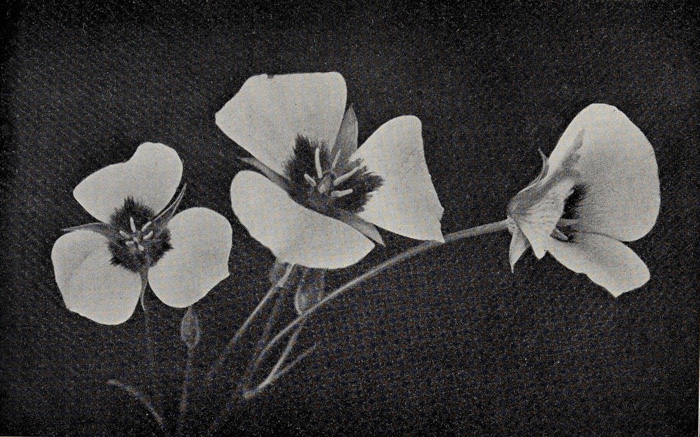
SEGO LILIES
(Calochortus Nuttallii)
Liliaceous women and girls are rare among the Mormons. They have seen too muchhard, repressive toil to admit of the development of lily beauty either in formor color. In general they are thickset, with large feet and hands, and withsun-browned faces, often curiously freckled like the petals of Fritillariaatropurpurea. They are fruit rather than flower—good brown bread. Butdown in the San Pitch Valley at Gunnison, I discovered a genuine lily, happilynamed Lily Young. She is a granddaughter of Brigham Young, slender andgraceful, with lily-white cheeks tinted with clear rose, She was brought up inthe old Salt Lake Zion House, but by some strange chance has been transplantedto this wilderness, where she blooms alone, the “Lily of SanPitch.” Pitch is an old Indian, who, I suppose, pitched into the settlersand thus acquired fame enough to give name to the valley. Here I feel uneasyabout the name of this lily, for the compositors have a perverse trick ofmaking me say all kinds of absurd things wholly unwarranted by plain copy, andI fear that the “Lily of San Pitch” will appear in print as thewidow of Sam Patch. But, however this may be, among my memories of this strangeland, that Oquirrh mountain, with its golden lilies, will ever rise in clearrelief, and associated with them will always be the Mormon lily of San Pitch.
X. The San Gabriel Valley[12]
The sun valley of San Gabriel is one of the brightest spots to be found in allour bright land, and most of its brightness is wildness—wild southsunshine in a basin rimmed about with mountains and hills. Cultivation is notwholly wanting, for here are the choices of all the Los Angeles orange groves,but its glorious abundance of ripe sun and soil is only beginning to be coinedinto fruit. The drowsy bits of cultivation accomplished by the old missionariesand the more recent efforts of restless Americans are scarce as yet visible,and when comprehended in general views form nothing more than mere freckles onthe smooth brown bosom of the Valley.
I entered the sunny south half a month ago, coming down along the cool sea, andlanding at Santa Monica. An hour’s ride over stretches of bare, brownplain, and through cornfields and orange groves, brought me to the handsome,conceited little town of Los Angeles, where one finds Spanish adobes and Yankeeshingles meeting and overlapping in very curious antagonism. I believe thereare some fifteen thousand people here, and some of their buildings are ratherfine, but the gardens and the sky interested me more. A palm is seen here andthere poising its royal crown in the rich light, and the banana, with itsmagnificent ribbon leaves, producing a marked tropical effect—notsemi-tropical, as they are so fond of saying here, while speaking of theirfruits. Nothing I have noticed strikes me as semi, save the brusque little bitsof civilization with which the wilderness is checkered. These aresemi-barbarous or less; everything else in the region has a most exuberantpronounced wholeness. The city held me but a short time, for the San GabrielMountains were in sight, advertising themselves grandly along the northern sky,and I was eager to make my way into their midst.
At Pasadena I had the rare good fortune to meet my old friend Doctor Congar,with whom I had studied chemistry and mathematics fifteen years ago. He exaltedSan Gabriel above all other inhabitable valleys, old and new, on the face ofthe globe. “I have rambled,” said he, “ever since we leftcollege, tasting innumerable climates, and trying the advantages offered bynearly every new State and Territory. Here I have made my home, and here Ishall stay while I live. The geographical position is exactly right, soil andclimate perfect, and everything that heart can wish comes to ourefforts—flowers, fruits, milk and honey, and plenty of money. Andthere,” he continued, pointing just beyond his own precious possessions,“is a block of land that is for sale; buy it and be my neighbor; plantfive acres with orange trees, and by the time your last mountain is climbedtheir fruit will be your fortune.” He then led my down the valley,through the few famous old groves in full bearing, and on the estate of Mr.Wilson showed me a ten-acre grove eighteen years old, the last year’scrop from which was sold for twenty thousand dollars. “There,” saidhe, with triumphant enthusiasm, “what do you think of that? Two thousanddollars per acre per annum for land worth only one hundred dollars.”
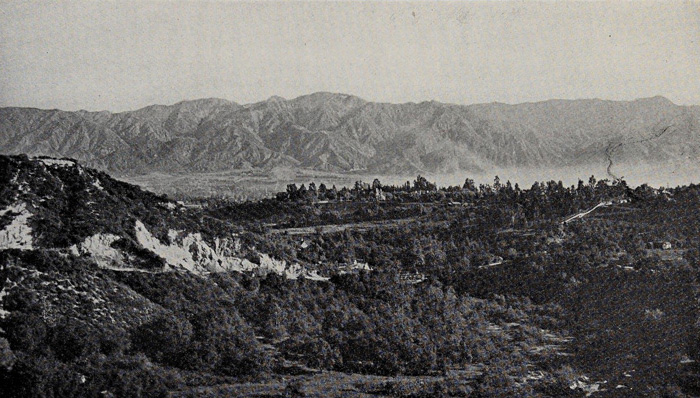
SAN GABRIEL VALLEY
The number of orange trees planted to the acre is usually from forty-nine tosixty-nine; they then stand from twenty-five to thirty feet apart each way,and, thus planted, thrive and continue fruitful to a comparatively great age.J. DeBarth Shorb, an enthusiastic believer in Los Angeles and oranges, says,“We have trees on our property fully forty years old, and eighteen inchesin diameter, that are still vigorous and yielding immense crops of fruit,although they are only twenty feet apart.” Seedlings are said to begin tobear remunerative crops in their tenth year, but by superior cultivation thislong unproductive period my be somewhat lessened, while trees from three tofive years old may be purchased from the nurserymen, so that the newcomer whosets out an orchard may begin to gather fruit by the fifth or sixth year. Whenfirst set out, and for some years afterward, the trees are irrigated by makingrings of earth around them, which are connected with small ditches, throughwhich the water is distributed to each tree. Or, where the ground is nearlylevel, the whole surface is flooded from time to time as required. From 309trees, twelve years old from the seed, DeBarth Shorb says that in the season of1874 he obtained an average of $20.50 per tree, or $1435 per acre, over andabove the cost of transportation to San Francisco, commission on sales, etc. Heconsiders $1000 per acre a fair average at present prices, after the trees havereached the age of twelve years. The average price throughout the county forthe last five years has been about $20 or $25 per thousand; and, inasmuch asthe area adapted to orange culture is limited, it is hoped that this price maynot greatly fall for many years.
The lemon and lime are also cultivated here to some extent, and considerableattention is now being given to the Florida banana, and the olive, almond, andEnglish walnut. But the orange interest heavily overshadows every other, whilevines have of late years been so unremunerative they are seldom mentioned.
This is pre-eminently a fruit land, but the fame of its productions has in someway far outrun the results that have as yet been attained. Experiments havebeen tried, and good beginnings made, but the number of really valuable,well-established groves is scarce as one to fifty, compared with the newlyplanted. Many causes, however, have combined of late to give the business awonderful impetus, and new orchards are being made every day, while the few oldgroves, aglow with golden fruit, are the burning and shining lights that directand energize the sanguine newcomers.
After witnessing the bad effect of homelessness, developed to so destructive anextent in California, it would reassure every lover of his race to see thehearty home-building going on here and the blessed contentment that naturallyfollows it. Travel-worn pioneers, who have been tossed about like boulders inflood time, are thronging hither as to a kind of a terrestrial heaven, resolvedto rest. They build, and plant, and settle, and so come under naturalinfluences. When a man plants a tree he plants himself. Every root is ananchor, over which he rests with grateful interest, and becomes sufficientlycalm to feel the joy of living. He necessarily makes the acquaintance of thesun and the sky. Favorite trees fill his mind, and, while tending them likechildren, and accepting the benefits they bring, he becomes himself abenefactor. He sees down through the brown common ground teeming with coloredfruits, as if it were transparent, and learns to bring them to the surface.What he wills he can raise by true enchantment. With slips and rootlets, hismagic wands, they appear at his bidding. These, and the seeds he plants, arehis prayers, and by them brought into right relations with God, he worksgrander miracles every day than ever were written.
The Pasadena Colony, located on the southwest corner of the well-known SanPasqual Rancho, is scarce three years old, but it is growing rapidly, like apet tree, and already forms one of the best contributions to culture yetaccomplished in the county. It now numbers about sixty families, mostly drawnfrom the better class of vagabond pioneers, who, during their rolling-stonedays have managed to gather sufficient gold moss to purchase from ten to fortyacres of land. They are perfectly hilarious in their newly found life, worklike ants in a sunny noonday, and, looking far into the future, hopefully counttheir orange chicks ten years or more before they are hatched; supportingthemselves in the meantime on the produce of a few acres of alfalfa, togetherwith garden vegetables and the quick-growing fruits, such as figs, grapes,apples, etc., the whole reinforced by the remaining dollars of their landpurchase money. There is nothing more remarkable in the character of the colonythan the literary and scientific taste displayed. The conversation of most Ihave met here is seasoned with a smack of mental ozone, Attic salt, whichstruck me as being rare among the tillers of California soil. People of tasteand money in search of a home would do well to prospect the resources of thisaristocratic little colony.
If we look now at these southern valleys in general, it will appear at oncethat with all their advantages they lie beyond the reach of poor settlers, notonly on account of the high price of irrigable land—one hundred dollarsper acre and upwards—but because of the scarcity of labor. A settler withthree or four thousand dollars would be penniless after paying for twenty acresof orange land and building ever so plain a house, while many years would go byere his trees yielded an income adequate to the maintenance of his family.
Nor is there anything sufficiently reviving in the fine climate to form areliable inducement for very sick people. Most of this class, from all I canlearn, come here only to die, and surely it is better to die comfortably athome, avoiding the thousand discomforts of travel, at a time when they are soheard to bear. It is indeed pitiful to see so many invalids, already on theverge of the grave, making a painful way to quack climates, hoping to changeage to youth, and the darkening twilight of their day to morning. No suchhealth-fountain has been found, and this climate, fine as it is, seems, likemost others, to be adapted for well people only. From all I could find outregarding its influence upon patients suffering from pulmonary difficulties, itis seldom beneficial to any great extent in advanced cases. The cold sea windsare less fatal to this class of sufferers than the corresponding winds furthernorth, but, notwithstanding they are tempered on their passage inland overwarm, dry ground, they are still more or less injurious.
The summer climate of the fir and pine woods of the Sierra Nevada would, Ithink, be found infinitely more reviving; but because these woods have not beenadvertised like patent medicines, few seem to think of the spicy, vivifyinginfluences that pervade their fountain freshness and beauty.
XI. The San Gabriel Mountains[13]
After saying so much for human culture in my last, perhaps I may now be alloweda word for wildness—the wildness of this southland, pure and untamable asthe sea.
In the mountains of San Gabriel, overlooking the lowland vines and fruitgroves, Mother Nature is most ruggedly, thornily savage. Not even in the Sierrahave I ever made the acquaintance of mountains more rigidly inaccessible. Theslopes are exceptionally steep and insecure to the foot of the explorer,however great his strength or skill may be, but thorny chaparral constitutestheir chief defense. With the exception of little park and garden spots notvisible in comprehensive views, the entire surface is covered with it, from thehighest peaks to the plain. It swoops into every hollow and swells over everyridge, gracefully complying with the varied topography, in shaggy, ungovernableexuberance, fairly dwarfing the utmost efforts of human culture out of sightand mind.
But in the very heart of this thorny wilderness, down in the dells, you mayfind gardens filled with the fairest flowers, that any child would love, andunapproachable linns lined with lilies and ferns, where the ousel builds itsmossy hut and sings in chorus with the white falling water. Bears, also, andpanthers, wolves, wildcats; wood rats, squirrels, foxes, snakes, andinnumerable birds, all find grateful homes here, adding wildness to wildness inglorious profusion and variety.
Where the coast ranges and the Sierra Nevada come together we find a verycomplicated system of short ranges, the geology and topography of which is yethidden, and many years of laborious study must be given for anything like acomplete interpretation of them. The San Gabriel is one or more of theseranges, forty or fifty miles long, and half as broad, extending from the CajonPass on the east, to the Santa Monica and Santa Susanna ranges on the west. SanAntonio, the dominating peak, rises towards the eastern extremity of the rangeto a height of about six thousand feet, forming a sure landmark throughout thevalley and all the way down to the coast, without, however, possessing muchstriking individuality. The whole range, seen from the plain, with the hot sunbeating upon its southern slopes, wears a terribly forbidding aspect. There isnothing of the grandeur of snow, or glaciers, or deep forests, to excitecuriosity or adventure; no trace of gardens or waterfalls. From base to summitall seems gray, barren, silent—dead, bleached bones of mountains,overgrown with scrubby bushes, like gray moss. But all mountains are full ofhidden beauty, and the next day after my arrival at Pasadena I supplied myselfwith bread and eagerly set out to give myself to their keeping.
On the first day of my excursion I went only as far as the mouth of EatonCañon, because the heat was oppressive, and a pair of new shoes were chafingmy feet to such an extent that walking began to be painful. While looking for acamping ground among the boulder beds of the cañon, I came upon a strange,dark man of doubtful parentage. He kindly invited me to camp with him, and ledme to his little hut. All my conjectures as to his nationality failed, and nowonder, since his father was Irish and mother Spanish, a mixture not often meteven in California. He happened to be out of candles, so we sat in the darkwhile he gave me a sketch of his life, which was exceedingly picturesque. Thenhe showed me his plans for the future. He was going to settle among thesecañon boulders, and make money, and marry a Spanish woman. People mine forirrigating water along the foothills as for gold. He is now driving aprospecting tunnel into a spur of the mountains back of his cabin. “Myprospect is good,” he said, “and if I strike a strong flow, I shallsoon be worth five or ten thousand dollars. That flat out there,” hecontinued, referring to a small, irregular patch of gravelly detritus that hadbeen sorted out and deposited by Eaton Creek during some flood season,“is large enough for a nice orange grove, and, after watering my owntrees, I can sell water down the valley; and then the hillside back of thecabin will do for vines, and I can keep bees, for the white sage and black sageup the mountains is full of honey. You see, I’ve got a good thing.”All this prospective affluence in the sunken, boulder-choked flood-bed of EatonCreek! Most home-seekers would as soon think of settling on the summit of SanAntonio.
Half an hour’s easy rambling up the cañon brought me to the foot of“The Fall,” famous throughout the valley settlements as the finestyet discovered in the range. It is a charming little thing, with a voice sweetas a songbird’s, leaping some thirty-five or forty feet into a round,mirror pool. The cliff back of it and on both sides is completely covered withthick, furry mosses, and the white fall shines against the green like a silverinstrument in a velvet case. Here come the Gabriel lads and lassies from thecommonplace orange groves, to make love and gather ferns and dabble away theirhot holidays in the cool pool. They are fortunate in finding so fresh a retreatso near their homes. It is the Yosemite of San Gabriel. The walls, though notof the true Yosemite type either in form or sculpture, rise to a height ofnearly two thousand feet. Ferns are abundant on all the rocks within reach ofthe spray, and picturesque maples and sycamores spread a grateful shade over arich profusion of wild flowers that grow among the boulders, from the edge ofthe pool a mile or more down the dell-like bottom of the valley, the wholeforming a charming little poem of wildness—the vestibule of these shaggymountain temples.
The foot of the fall is about a thousand feet above the level of the sea, andhere climbing begins. I made my way out of the valley on the west side,followed the ridge that forms the western rim of the Eaton Basin to the summitof one of the principal peaks, thence crossed the middle of the basin, forcinga way over its many subordinate ridges, and out over the eastern rim, and fromfirst to last during three days spent in this excursion, I had to contend withthe richest, most self-possessed and uncompromising chaparral I have everenjoyed since first my mountaineering began.
For a hundred feet or so the ascent was practicable only by means of bosses ofthe club moss that clings to the rock. Above this the ridge is weathered awayto a slender knife-edge for a distance of two or three hundred yards, andthence to the summit it is a bristly mane of chaparral. Here and there smallopenings occur, commanding grand views of the valley and beyond to the ocean.These are favorite outlooks and resting places for bears, wolves, and wildcats.In the densest places I came upon woodrat villages whose huts were from four toeight feet high, built in the same style of architecture as those of themuskrats.
The day was nearly done. I reached the summit and I had time to make only ahasty survey of the topography of the wild basin now outspread maplike beneath,and to drink in the rare loveliness of the sunlight before hastening down insearch of water. Pushing through another mile of chaparral, I emerged into oneof the most beautiful parklike groves of live oak I ever saw. The groundbeneath was planted only with aspidiums and brier roses. At the foot of thegrove I came to the dry channel of one of the tributary streams, but, followingit down a short distance, I descried a few specimens of the scarlet mimulus;and I was assured that water was near. I found about a bucketful in a granitebowl, but it was full of leaves and beetles, making a sort of brown coffee thatcould be rendered available only by filtering it through sand and charcoal.This I resolved to do in case the night came on before I found better.Following the channel a mile farther down to its confluence with another,larger tributary, I found a lot of boulder pools, clear as crystal, andbrimming full, linked together by little glistening currents just strong enoughto sing. Flowers in full bloom adorned the banks, lilies ten feet high, andluxuriant ferns arching over one another in lavish abundance, while a noble oldlive oak spread its rugged boughs over all, forming one of the most perfect andmost secluded of Nature’s gardens. Here I camped, making my bed on smoothcobblestones.
Next morning, pushing up the channel of a tributary that takes its rise onMount San Antonio, I passed many lovely gardens watered by oozing currentlets,every one of which had lilies in them in the full pomp of bloom, and a richgrowth of ferns, chiefly woodwardias and aspidiums and maidenhairs; but towardthe base of the mountain the channel was dry, and the chaparral closed overfrom bank to bank, so that I was compelled to creep more than a mile on handsand knees.
In one spot I found an opening in the thorny sky where I could stand erect, andon the further side of the opening discovered a small pool. “Now,here,” I said, “I must be careful in creeping, for the birdsof the neighborhood come here to drink, and the rattlesnakes come here to catchthem.” I then began to cast my eye along the channel, perhapsinstinctively feeling a snaky atmosphere, and finally discovered one rattlerbetween my feet. But there was a bashful look in his eye, and a withdrawing,deprecating kink in his neck that showed plainly as words could tell that hewould not strike, and only wished to be let alone. I therefore passed on,lifting my foot a little higher than usual, and left him to enjoy his life inthis his own home.
My next camp was near the heart of the basin, at the head of a grand system ofcascades from ten to two hundred feet high, one following the other in closesuccession and making a total descent of nearly seventeen hundred feet. Therocks above me leaned over in a threatening way and were full of seams, makingthe camp a very unsafe one during an earthquake.
Next day the chaparral, in ascending the eastern rim of the basin, was, ifpossible, denser and more stubbornly bayoneted than ever. I followed beartrails, where in some places I found tufts of their hair that had been pulledout in squeezing a way through; but there was much of a very interestingcharacter that far overpaid all my pains. Most of the plants are identical withthose of the Sierra, but there are quite a number of Mexican species. Oneconiferous tree was all I found. This is a spruce of a species new to me,Douglasii macrocarpa.[14]
My last camp was down at the narrow, notched bottom of a dry channel, the onlyopen way for the life in the neighborhood. I therefore lay between two fires,built to fence out snakes and wolves.
From the summit of the eastern rim I had a glorious view of the valley out tothe ocean, which would require a whole book for its description. My bread gaveout a day before reaching the settlements, but I felt all the fresher andclearer for the fast.
XII. Nevada Farms[15]
To the farmer who comes to this thirsty land from beneath rainy skies, Nevadaseems one vast desert, all sage and sand, hopelessly irredeemable now andforever. And this, under present conditions, is severely true. Fornotwithstanding it has gardens, grainfields, and hayfields generouslyproductive, these compared with the arid stretches of valley and plain, asbeheld in general views from the mountain tops, are mere specks lyinginconspicuously here and there, in out-of-the-way places, often thirty or fortymiles apart.
In leafy regions, blessed with copious rains, we learn to measure theproductive capacity of the soil by its natural vegetation. But this rule isalmost wholly inapplicable here, for, notwithstanding its savage nakedness,scarce at all veiled by a sparse growth of sage and linosyris[16], the desert soilof the Great Basin is as rich in the elements that in rainy regions rise andripen into food as that of any other State in the Union. The rocks of itsnumerous mountain ranges have been thoroughly crushed and ground by glaciers,thrashed and vitalized by the sun, and sifted and outspread in lake basins bypowerful torrents that attended the breaking-up of the glacial period, as if inevery way Nature had been making haste to prepare the land for the husbandman.Soil, climate, topographical conditions, all that the most exacting coulddemand, are present, but one thing, water, is wanting. The present rainfallwould be wholly inadequate for agriculture, even if it were advantageouslydistributed over the lowlands, while in fact the greater portion is poured outon the heights in sudden and violent thundershowers called“cloud-bursts,” the waters of which are fruitlessly swallowed up insandy gulches and deltas a few minutes after their first boisterous appearance.The principal mountain chains, trending nearly north and south, parallel withthe Sierra and the Wahsatch, receive a good deal of snow during winter, but nogreat masses are stored up as fountains for large perennial streams capable ofirrigating considerable areas. Most of it is melted before the end of May andabsorbed by moraines and gravelly taluses, which send forth small rills thatslip quietly down the upper cañons through narrow strips of flowery verdure,most of them sinking and vanishing before they reach the base of their fountainranges. Perhaps not one in ten of the whole number flow out into the openplains, not a single drop reaches the sea, and only a few are large enough toirrigate more than one farm of moderate size.
It is upon these small outflowing rills that most of the Nevada ranches arelocated, lying countersunk beneath the general level, just where the mountainsmeet the plains, at an average elevation of five thousand feet above sea level.All the cereals and garden vegetables thrive here, and yield bountiful crops.Fruit, however, has been, as yet, grown successfully in only a few speciallyfavored spots.
Another distinct class of ranches are found sparsely distributed along thelowest portions of the plains, where the ground is kept moist by springs, or bynarrow threads of moving water called rivers, fed by some one or more of themost vigorous of the mountain rills that have succeeded in making their escapefrom the mountains. These are mostly devoted to the growth of wild hay, thoughin some the natural meadow grasses and sedges have been supplemented by timothyand alfalfa; and where the soil is not too strongly impregnated with salts,some grain is raised. Reese River Valley, Big Smoky Valley, and White RiverValley offer fair illustrations of this class. As compared with the foothillranches, they are larger and less inconspicuous, as they lie in the wide,unshadowed levels of the plains—wavy-edged flecks of green in awilderness of gray.
Still another class equally well defined, both as to distribution and as toproducts, is restricted to that portion of western Nevada and the easternborder of California which lies within the redeeming influences of Californiawaters. Three of the Sierra rivers descend from their icy fountains into thedesert like angels of mercy to bless Nevada. These are the Walker, Carson, andTruckee; and in the valleys through which they flow are found by far the mostextensive hay and grain fields within the bounds of the State. Irrigatingstreams are led off right and left through innumerable channels, and thesleeping ground, starting at once into action, pours forth its wealth withoutstint.
But notwithstanding the many porous fields thus fertilized, considerableportions of the waters of all these rivers continue to reach their olddeathbeds in the desert, indicating that in these salt valleys there still isroom for coming farmers. In middle and eastern Nevada, however, every rill thatI have seen in a ride of three thousand miles, at all available for irrigation,has been claimed and put to use.
It appears, therefore, that under present conditions the limit of agriculturaldevelopment in the dry basin between the Sierra and the Wahsatch has beenalready approached, a result caused not alone by natural restrictions as to thearea capable of development, but by the extraordinary stimulus furnished by themines to agricultural effort. The gathering of gold and silver, hay and barley,have gone on together. Most of the mid-valley bogs and meadows, and foothillrills capable of irrigating from ten to fifty acres, were claimed more thantwenty years ago.
A majority of these pioneer settlers are plodding Dutchmen, living content inthe back lanes and valleys of Nature; but the high price of all kinds of farmproducts tempted many of even the keen Yankee prospectors, made wise inCalifornia, to bind themselves down to this sure kind of mining. The wildest ofwild hay, made chiefly of carices and rushes, was sold at from two to threehundred dollars per ton on ranches. The same kind of hay is still worth fromfifteen to forty dollars per ton, according to the distance from mines andcomparative security from competition. Barley and oats are from forty to onehundred dollars a ton, while all sorts of garden products find ready sale athigh prices.
With rich mine markets and salubrious climate, the Nevada farmer can make moremoney by loose, ragged methods than the same class of farmers in any otherState I have yet seen, while the almost savage isolation in which they liveseems grateful to them. Even in those cases where the advent of neighborsbrings no disputes concerning water rights and ranges, they seem to prefersolitude, most of them having been elected from adventurers fromCalifornia—the pioneers of pioneers. The passing stranger, however, isalways welcomed and supplied with the best the home affords, and around thefireside, while he smokes his pipe, very little encouragement is required tobring forth the story of the farmer’s life—hunting, mining,fighting, in the early Indian times, etc. Only the few who are married hope toreturn to California to educate their children, and the ease with which moneyis made renders the fulfillment of these hopes comparatively sure.
After dwelling thus long on the farms of this dry wonderland, my readers may beled to fancy them of more importance as compared with the unbroken fields ofNature than they really are. Making your way along any of the wide gray valleysthat stretch from north to south, seldom will your eye be interrupted by asingle mark of cultivation. The smooth lake-like ground sweeps on indefinitely,growing more and more dim in the glowing sunshine, while a mountain range fromeight to ten thousand feet high bounds the view on either hand. No singingwater, no green sod, no moist nook to rest in—mountain and valley alikenaked and shadowless in the sun-glare; and though, perhaps, traveling awell-worn road to a gold or silver mine, and supplied with repeatedinstructions, you can scarce hope to find any human habitation from day to day,so vast and impressive is the hot, dusty, alkaline wildness.
But after riding some thirty or forty miles, and while the sun may be sinkingbehind the mountains, you come suddenly upon signs of cultivation. Clumps ofwillows indicate water, and water indicates a farm. Approaching more nearly,you discover what may be a patch of barley spread out unevenly along the bottomof a flood bed, broken perhaps, and rendered less distinct by boulder piles andthe fringing willows of a stream. Speedily you can confidently say that thegrain patch is surely such; its ragged bounds become clear; a sand-roofed cabincomes to view littered with sun-cracked implements and with an outer girdle ofpotato, cabbage, and alfalfa patches.
The immense expanse of mountain-girt valleys, on the edges of which thesehidden ranches lie, make even the largest fields seem comic in size. Thesmallest, however, are by no means insignificant in a pecuniary view. On theeast side of the Toyabe Range I discovered a jolly Irishman who informed methat his income from fifty acres, reinforced by a sheep range on the adjacenthills, was from seven to nine thousand dollars per annum. His irrigating brookis about four feet wide and eight inches deep, flowing about two miles perhour.
On Duckwater Creek, Nye County, Mr. Irwin has reclaimed a tule swamp severalhundred acres in extent, which is now chiefly devoted to alfalfa. Ontwenty-five acres he claims to have raised this year thirty-seven tons ofbarley. Indeed, I have not yet noticed a meager crop of any kind in the State.Fruit alone is conspicuously absent.
On the California side of the Sierra grain will not ripen at much greaterelevation than four thousand feet above sea level. The valleys of Nevada lie ata height of from four to six thousand feet, and both wheat and barley ripen,wherever water may be had, up to seven thousand feet. The harvest, of course,is later as the elevation increases. In the valleys of the Carson and WalkerRivers, four thousand feet above the sea, the grain harvest is about a monthlater than in California. In Reese River Valley, six thousand feet, it beginsnear the end of August. Winter grain ripens somewhat earlier, whileoccasionally one meets a patch of barley in some cool, high-lying cañon thatwill not mature before the middle of September.
Unlike California, Nevada will probably be always richer in gold and silverthan in grain. Utah farmers hope to change the climate of the east side of thebasin by prayer, and point to the recent rise in the waters of the Great SaltLake as a beginning of moister times. But Nevada’s only hope, in the wayof any considerable increase in agriculture, is from artesian wells. Theexperiment has been tried on a small scale with encouraging success. But whatis now wanted seems to be the boring of a few specimen wells of a large sizeout in the main valleys. The encouragement that successful experiments of thiskind would give to emigration seeking farms forms an object well worthy theattention of the Government. But all that California farmers in the grandcentral valley require is the preservation of the forests and the wisedistribution of the glorious abundance of water from the snow stored on thewest flank of the Sierra.
Whether any considerable area of these sage plains will ever thus be made toblossom in grass and wheat, experience will show. But in the mean time Nevadais beautiful in her wildness, and if tillers of the soil can thus be brought tosee that possibly Nature may have other uses even for richsoils besidesthe feeding of human beings, then will these foodless “deserts”have taught a fine lesson.
XIII. Nevada Forests[17]
When the traveler from California has crossed the Sierra and gone a little waydown the eastern flank, the woods come to an end about as suddenly andcompletely as if, going westward, he had reached the ocean. From the verynoblest forests in the world he emerges into free sunshine and dead alkalinelake-levels. Mountains are seen beyond, rising in bewildering abundance, rangebeyond range. But however closely we have been accustomed to associate forestsand mountains, these always present a singularly barren aspect, appearing grayand forbidding and shadeless, like heaps of ashes dumped from the blazing sky.
But wheresoever we may venture to go in all this good world, nature is everfound richer and more beautiful than she seems, and nowhere may you meet withmore varied and delightful surprises than in the byways and recesses of thissublime wilderness—lovely asters and abronias on the dusty plains,rose-gardens around the mountain wells, and resiny woods, where all seemed sodesolate, adorning the hot foothills as well as the cool summits, fed bycordial and benevolent storms of rain and hail and snow; all of these scant andrare as compared with the immeasurable exuberance of California, but stillamply sufficient throughout the barest deserts for a clear manifestation ofGod’s love.
Though Nevada is situated in what is called the “Great Basin,” noless than sixty-five groups and chains of mountains rise within the bounds ofthe State to a height of about from eight thousand to thirteen thousand feetabove the level of the sea, and as far as I have observed, every one of theseis planted, to some extent, with coniferous trees, though it is only upon thehighest that we find anything that may fairly be called a forest. The lowerranges and the foothills and slopes of the higher are roughened with smallscrubby junipers and nut pines, while the dominating peaks, together with theridges that swing in grand curves between them, are covered with a closer andmore erect growth of pine, spruce, and fir, resembling the forests of theEastern States both as to size and general botanical characteristics. Here isfound what is called the heavy timber, but the tallest and most fully developedsections of the forests, growing down in sheltered hollows on moist moraines,would be regarded in California only as groves of saplings, and so, relatively,they are, for by careful calculation we find that more than a thousand of thesetrees would be required to furnish as much timber as may be obtained from asingle specimen of our Sierra giants.
The height of the timberline in eastern Nevada, near the middle of the GreatBasin, is about eleven thousand feet above sea level; consequently the forests,in a dwarfed, storm-beaten condition, pass over the summits of nearly everyrange in the State, broken here and there only by mechanical conditions of thesurface rocks. Only three mountains in the State have as yet come under myobservation whose summits rise distinctly above the treeline. These areWheeler’s Peak, twelve thousand three hundred feet high, Mount Moriah,about twelve thousand feet, and Granite Mountain, about the same height, all ofwhich are situated near the boundary line between Nevada and Utah Territory.
In a rambling mountaineering journey of eighteen hundred miles across thestate, I have met nine species of coniferous trees,—four pines, twospruces, two junipers, and one fir,—about one third the number found inCalifornia. By far the most abundant and interesting of these is the PinusFremontiana,[18]or nut pine. In the number ofindividual trees and extent of range this curious little conifer surpasses allthe others combined. Nearly every mountain in the State is planted with it fromnear the base to a height of from eight thousand to nine thousand feet abovethe sea. Some are covered from base to summit by this one species, with only asparse growth of juniper on the lower slopes to break the continuity of thesecurious woods, which, though dark-looking at a little distance, are yet almostshadeless, and without any hint of the dark glens and hollows so characteristicof other pine woods. Tens of thousands of acres occur in one continuous belt.Indeed, viewed comprehensively, the entire State seems to be pretty evenlydivided into mountain ranges covered with nut pines and plains covered withsage—now a swath of pines stretching from north to south, now a swath ofsage; the one black, the other gray; one severely level, the other sweeping oncomplacently over ridge and valley and lofty crowning dome.
The real character of a forest of this sort would never be guessed by theinexperienced observer. Traveling across the sage levels in the dazzlingsunlight, you gaze with shaded eyes at the mountains rising along their edges,perhaps twenty miles away, but no invitation that is at all likely to beunderstood is discernible. Every mountain, however high it swells into the sky,seems utterly barren. Approaching nearer, a low brushy growth is seen,strangely black in aspect, as though it had been burned. This is a nut pineforest, the bountiful orchard of the red man. When you ascend into its midstyou find the ground beneath the trees, and in the openings also, nearly naked,and mostly rough on the surface—a succession of crumbling ledges of lava,limestones, slate, and quartzite, coarsely strewn with soil weathered fromthem. Here and there occurs a bunch of sage or linosyris, or a purple aster, ora tuft of dry bunch-grass.
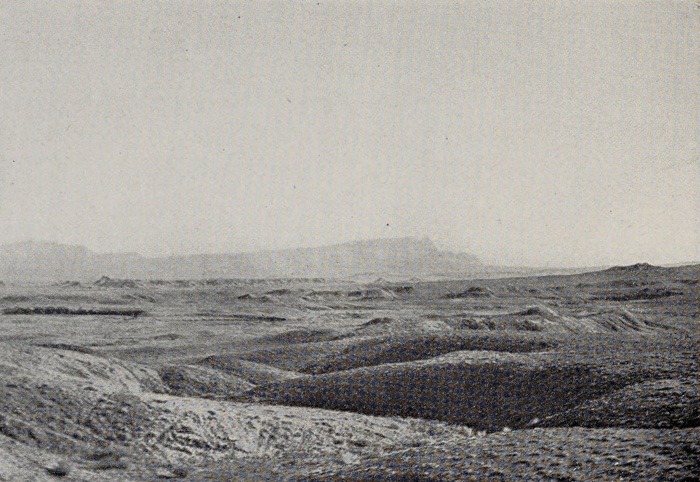
THE SAGE LEVELS OF THE NEVADA DESERT
The harshest mountainsides, hot and waterless, seem best adapted to the nutpine’s development. No slope is too steep, none too dry; every situationseems to be gratefully chosen, if only it be sufficiently rocky and firm toafford secure anchorage for the tough, grasping roots. It is a sturdy, thicksetlittle tree, usually about fifteen feet high when full grown, and about asbroad as high, holding its knotty branches well out in every direction in stiffzigzags, but turning them gracefully upward at the ends in rounded bosses.Though making so dark a mass in the distance, the foliage is a pale grayishgreen, in stiff, awl-shaped fascicles. When examined closely these roundneedles seem inclined to be two-leaved, but they are mostly held firmlytogether, as if to guard against evaporation. The bark on the older sections isnearly black, so that the boles and branches are clearly traced against theprevailing gray of the mountains on which they delight to dwell.
The value of this species to Nevada is not easily overestimated. It furnishesfuel, charcoal, and timber for the mines, and, together with the enduringjuniper, so generally associated with it, supplies the ranches with abundanceof firewood and rough fencing. Many a square mile has already been denuded insupplying these demands, but, so great is the area covered by it, noappreciable loss has as yet been sustained. It is pretty generally known thatthis tree yields edible nuts, but their importance and excellence as human foodis infinitely greater than is supposed. In fruitful seasons like this one, thepine nut crop of Nevada is, perhaps, greater than the entire wheat crop ofCalifornia, concerning which so much is said and felt throughout the foodmarkets of the world.
The Indians alone appreciate this portion of Nature’s bounty andcelebrate the harvest home with dancing and feasting. The cones, which are abright grass-green in color and about two inches long by one and a half indiameter, are beaten off with poles just before the scales open, gathered inheaps of several bushels, and lightly scorched by burning a thin covering ofbrushwood over them. The resin, with which the cones are bedraggled, is thusburned off, the nuts slightly roasted, and the scales made to open. Then theyare allowed to dry in the sun, after which the nuts are easily thrashed out andare ready to be stored away. They are about half an inch long by a quarter ofan inch in diameter, pointed at the upper end, rounded at the base, light brownin general color, and handsomely dotted with purple, like birds’ eggs.The shells are thin, and may be crushed between the thumb and finger. Thekernels are white and waxy-looking, becoming brown by roasting, sweet anddelicious to every palate, and are eaten by birds, squirrels, dogs, horses, andman. When the crop is abundant the Indians bring in large quantities for sale;they are eaten around every fireside in the State, and oftentimes fed to horsesinstead of barley.
Looking over the whole continent, none of Nature’s bounties seems to meso great as this in the way of food, none so little appreciated. Fortunatelyfor the Indians and wild animals that gather around Nature’s board, thiscrop is not easily harvested in a monopolizing way. If it could be gatheredlike wheat the whole would be carried away and dissipated in towns, leaving thebrave inhabitants of these wilds to starve.
Long before the harvest time, which is in September and October, the Indiansexamine the trees with keen discernment, and inasmuch as the cones require twoyears to mature from the first appearance of the little red rosettes of thefertile flowers, the scarcity or abundance of the crop may be predicted morethan a year in advance. Squirrels, and worms, and Clarke crows, make haste tobegin the harvest. When the crop is ripe the Indians make ready their longbeating-poles; baskets, bags, rags, mats, are gotten together. The squaws outamong the settlers at service, washing and drudging, assemble at the familyhuts; the men leave their ranch work; all, old and young, are mounted onponies, and set off in great glee to the nut lands, forming cavalcadescuriously picturesque. Flaming scarfs and calico skirts stream loosely over theknotty ponies, usually two squaws astride of each, with the small baby midgetsbandaged in baskets slung on their backs, or balanced upon the saddle-bow,while the nut baskets and water jars project from either side, and the longbeating-poles, like old-fashioned lances, angle out in every direction.
Arrived at some central point already fixed upon, where water and grass isfound, the squaws with baskets, the men with poles, ascend the ridges to theladen trees, followed by the children; beating begins with loud noise andchatter; the burs fly right and left, lodging against stones and sagebrush; thesquaws and children gather them with fine natural gladness; smoke columnsspeedily mark the joyful scene of their labors as the roasting fires arekindled; and, at night, assembled in circles, garrulous as jays, the firstgrand nut feast begins. Sufficient quantities are thus obtained in a few weeksto last all winter.
The Indians also gather several species of berries and dry them to vary theirstores, and a few deer and grouse are killed on the mountains, besides immensenumbers of rabbits and hares; but the pine-nuts are their maindependence—their staff of life, their bread.
Insects also, scarce noticed by man, come in for their share of this finebounty. Eggs are deposited, and the baby grubs, happy fellows, find themselvesin a sweet world of plenty, feeding their way through the heart of the conefrom one nut chamber to another, secure from rain and wind and heat, untiltheir wings are grown and they are ready to launch out into the free ocean ofair and light.
XIV. Nevada’s Timber Belt[19]
The pine woods on the tops of the Nevada mountains are already shining andblooming in winter snow, making a most blessedly refreshing appearance to theweary traveler down on the gray plains. During the fiery days of summer thewhole of this vast region seems so perfectly possessed by the sun that the verymemories of pine trees and snow are in danger of being burned away, leaving onebut little more than dust and metal. But since these first winter blessingshave come, the wealth and beauty of the landscapes have come fairly into view,and one is rendered capable of looking and seeing.
The grand nut harvest is over, as far as the Indians are concerned, thoughperhaps less than one bushel in a thousand of the whole crop has been gathered.But the squirrels and birds are still busily engaged, and by the time thatNature’s ends are accomplished, every nut will doubtless have been put touse.
All of the nine Nevada conifers mentioned in my last letter are also found inCalifornia, excepting only the Rocky Mountain spruce, which I have not observedwestward of the Snake Range. So greatly, however, have they been made to varyby differences of soil and climate, that most of them appear as distinctspecies. Without seeming in any way dwarfed or repressed in habit, they nowheredevelop to anything like California dimensions. A height of fifty feet anddiameter of twelve or fourteen inches would probably be found to be above theaverage size of those cut for lumber. On the margin of the Carson and HumboldtSink the larger sage bushes are called “heavy timber”; and to thesettlers here any tree seems large enough for saw-logs.
Mills have been built in the most accessible cañons of the higher ranges, andsufficient lumber of an inferior kind is made to supply most of the localdemand. The principal lumber trees of Nevada are the white pine (Pinusflexilis), foxtail pine, and Douglas spruce, or “red pine,” asit is called here. Of these the first named is most generally distributed,being found on all the higher ranges throughout the State. In botanicalcharacters it is nearly allied to the Weymouth, or white, pine of the EasternStates, and to the sugar and mountain pines of the Sierra. In open situationsit branches near the ground and tosses out long down-curving limbs all around,often gaining in this way a very strikingly picturesque habit. It is seldomfound lower than nine thousand feet above the level of the sea, but from thisheight it pushes upward over the roughest ledges to the extreme limit of treegrowth—about eleven thousand feet.
On the Hot Creek, White Pine, and Golden Gate ranges we find a still hardierand more picturesque species, called the foxtail pine, from its long denseleaf-tassels. About a foot or eighteen inches of the ends of the branches aredensely packed with stiff outstanding needles, which radiate all around like anelectric fox- or squirrel-tail. The needles are about an inch and a half long,slightly curved, elastic, and glossily polished, so that the sunshine siftingthrough them makes them burn with a fine silvery luster, while their number andelastic temper tell delightfully in the singing winds.
This tree is pre-eminently picturesque, far surpassing not only its companionspecies of the mountains in this respect, but also the most noted of thelowland oaks and elms. Some stand firmly erect, feathered with radiant tailtassels down to the ground, forming slender, tapering towers of shiningverdure; others with two or three specialized branches pushed out at rightangles to the trunk and densely clad with the tasseled sprays, take the form ofbeautiful ornamental crosses. Again, in the same woods you find trees that aremade up of several boles united near the ground, and spreading in easy curvesat the sides in a plane parallel to the axis of the mountain, with the eleganttassels hung in charming order between them the whole making a perfect harp,ranged across the main wind-lines just where they may be most effective in thegrand storm harmonies. And then there is an infinite variety of arching forms,standing free or in groups, leaning away from or toward each other in curiousarchitectural structures,—innumerable tassels drooping under the archesand radiating above them, the outside glowing in the light, masses of deepshade beneath, giving rise to effects marvelously beautiful,—while on theroughest ledges of crumbling limestone are lowly old giants, five or six feetin diameter, that have braved the storms of more than a thousand years. But,whether old or young, sheltered or exposed to the wildest gales, this tree isever found to be irrepressibly and extravagantly picturesque, offering a richerand more varied series of forms to the artist than any other species I have yetseen.
One of the most interesting mountain excursions I have made in the State was upthrough a thick spicy forest of these trees to the top of the highest summit ofthe Troy Range, about ninety miles to the south of Hamilton. The day was fullof perfect Indian-summer sunshine, calm and bracing. Jays and Clarke crows madea pleasant stir in the foothill pines and junipers; grasshoppers danced in thehazy light, and rattled on the wing in pure glee, reviving suddenly from thetorpor of a frosty October night to exuberant summer joy. The squirrels wereworking industriously among the falling nuts; ripe willows and aspens madegorgeous masses of color on the russet hillsides and along the edges of thesmall streams that threaded the higher ravines; and on the smooth slopinguplands, beneath the foxtail pines and firs, the ground was covered with browngrasses, enriched with sunflowers, columbines, and larkspurs and patches oflinosyris, mostly frost-nipped and gone to seed, yet making fine bits of yellowand purple in the general brown.
At a height of about ninety-five hundred feet we passed through a magnificentgrove of aspens, about a hundred acres in extent, through which the mellowsunshine sifted in ravishing splendor, showing every leaf to be as beautiful incolor as the wing of a butterfly, and making them tell gloriously against theevergreens. These extensive groves of aspen are a marked feature of the Nevadawoods. Some of the lower mountains are covered with them, giving rise toremarkably beautiful masses of pale, translucent green in spring and summer,yellow and orange in autumn, while in winter, after every leaf has fallen, thewhite bark of the boles and branches seen in mass seems like a cloud of mistthat has settled close down on the mountain, conforming to all its hollows andridges like a mantle, yet roughened on the surface with innumerable ascendingspires.
Just above the aspens we entered a fine, close growth of foxtail pine, thetallest and most evenly planted I had yet seen. It extended along a wavingridge tending north and south and down both sides with but little interruptionfor a distance of about five miles. The trees were mostly straight in the bole,and their shade covered the ground in the densest places, leaving only smallopenings to the sun. A few of the tallest specimens measured over eighty feet,with a diameter of eighteen inches; but many of the younger trees, growing intufts, were nearly fifty feet high, with a diameter of only five or six inches,while their slender shafts were hidden from top to bottom by a close, fringygrowth of tasseled branchlets. A few white pines and balsam firs occur here andthere, mostly around the edges of sunny openings, where they enrich the airwith their rosiny fragrance, and bring out the peculiar beauties of thepredominating foxtails by contrast.
Birds find grateful homes here—grouse, chickadees, and linnets, of whichwe saw large flocks that had a delightfully enlivening effect. But thewoodpeckers are remarkably rare. Thus far I have noticed only one species, thegolden-winged; and but few of the streams are large enough or long enough toattract the blessed ousel, so common in the Sierra.
On Wheeler’s Peak, the dominating summit of the Snake Mountains, I foundall the conifers I had seen on the other ranges of the State, excepting thefoxtail pine, which I have not observed further east than the White Pine range,but in its stead the beautiful Rocky Mountain spruce. First, as in the otherranges, we find the juniper and nut pine; then, higher, the white pine andbalsam fir; then the Douglas spruce and this new Rocky Mountain spruce, whichis common eastward from here, though this range is, as far as I have observed,its western limit. It is one of the largest and most important of Nevadaconifers, attaining a height of from sixty to eighty feet and a diameter ofnearly two feet, while now and then an exceptional specimen may be found inshady dells a hundred feet high or more.
The foliage is bright yellowish and bluish green, according to exposure andage, growing all around the branchlets, though inclined to turn upward from theundersides, like that of the plushy firs of California, making remarkablyhandsome fernlike plumes. While yet only mere saplings five or six inches thickat the ground, they measure fifty or sixty feet in height and are beautifullyclothed with broad, level, fronded plumes down to the base, preserving a strictarrowy outline, though a few of the larger branches shoot out in freeexuberance, relieving the spire from any unpicturesque stiffness of aspect,while the conical summit is crowded with thousands of rich brown cones tocomplete its beauty.
We made the ascent of the peak just after the first storm had whitened itssummit and brightened the atmosphere. The foot-slopes are like those of theTroy range, only more evenly clad with grasses. After tracing a long, ruggedridge of exceedingly hard quartzite, said to be veined here and there withgold, we came to the North Dome, a noble summit rising about a thousand feetabove the timberline, its slopes heavily tree-clad all around, but mostperfectly on the north. Here the Rocky Mountain spruce forms the bulk of theforest. The cones were ripe; most of them had shed their winged seeds, and theshell-like scales were conspicuously spread, making rich masses of brown fromthe tops of the fertile trees down halfway to the ground, cone touching cone inlavish clusters. A single branch that might be carried in the hand would befound to bear a hundred or more.
Some portions of the wood were almost impenetrable, but in general we found nodifficulty in mazing comfortably on over fallen logs and under the spreadingboughs, while here and there we came to an opening sufficiently spacious forstandpoints, where the trees around their margins might be seen from top tobottom. The winter sunshine streamed through the clustered spires, glinting andbreaking into a fine dust of spangles on the spiky leaves and beads of ambergum, and bringing out the reds and grays and yellows of the lichened boleswhich had been freshened by the late storm; while the tip of every spirelooking up through the shadows was dipped in deepest blue.
The ground was strewn with burs and needles and fallen trees; and, down in thedells, on the north side of the dome, where strips of aspen are imbedded in thespruces, every breeze sent the ripe leaves flying, some lodging in the spruceboughs, making them bloom again, while the fresh snow beneath looked like afine painting.
Around the dome and well up toward the summit of the main peak, the snow-shedwas well marked with tracks of the mule deer and the pretty stitching andembroidery of field mice, squirrels, and grouse; and on the way back to camp Icame across a strange track, somewhat like that of a small bear, but morespreading at the toes. It proved to be that of a wolverine. In my conversationswith hunters, both Indians and white men assure me that there are no bears inNevada, notwithstanding the abundance of pine-nuts, of which they are so fond,and the accessibility of these basin ranges from their favorite haunts in theSierra Nevada and Wahsatch Mountains. The mule deer, antelope, wild sheep,wolverine, and two species of wolves are all of the larger animals that I haveseen or heard of in the State.
XV. Glacial Phenomena in Nevada[20]
The monuments of the Ice Age in the Great Basin have been greatly obscured andbroken, many of the more ancient of them having perished altogether, leavingscarce a mark, however faint, of their existence—a condition of thingsdue not alone to the long-continued action of post-glacial agents, but also ingreat part to the perishable character of the rocks of which they were made.The bottoms of the main valleys, once grooved and planished like the glacierpavements of the Sierra, lie buried beneath sediments and detritus derived fromthe adjacent mountains, and now form the arid sage plains; characteristicU-shaped cañons have become V-shaped by the deepening of their bottoms andstraightening of their sides, and decaying glacier headlands have beenundermined and thrown down in loose taluses, while most of the moraines andstriae and scratches have been blurred or weathered away. Nevertheless, enoughremains of the more recent and the more enduring phenomena to cast a good lightwell back upon the conditions of the ancient ice sheet that covered thisinteresting region, and upon the system of distinct glaciers that loaded thetops of the mountains and filled the cañons long after the ice sheet had beenbroken up.
The first glacial traces that I noticed in the basin are on the Wassuck,Augusta, and Toyabe ranges, consisting of ridges and cañons, whose trends,contours, and general sculpture are in great part specifically glacial, thoughdeeply blurred by subsequent denudation. These discoveries were made during thesummer of 1876-77. And again, on the 17th of last August, while making theascent of Mount Jefferson, the dominating mountain of the Toquima range, Idiscovered an exceedingly interesting group of moraines, cañons with V-shapedcross sections, wide neve amphitheatres, moutoneed rocks, glacier meadows, andone glacier lake, all as fresh and telling as if the glaciers to which theybelonged had scarcely vanished.
The best preserved and most regular of the moraines are two laterals about twohundred feet in height and two miles long, extending from the foot of amagnificent cañon valley on the north side of the mountain and trending firstin a northerly direction, then curving around to the west, while awell-characterized terminal moraine, formed by the glacier towards the close ofits existence, unites them near their lower extremities at a height ofeighty-five hundred feet. Another pair of older lateral moraines, belonging toa glacier of which the one just mentioned was a tributary, extend in a generalnorthwesterly direction nearly to the level of Big Smoky Valley, aboutfifty-five hundred feet above sea level.
Four other cañons, extending down the eastern slopes of this grand oldmountain into Monito Valley, are hardly less rich in glacial records, while theeffects of the mountain shadows in controlling and directing the movements ofthe residual glaciers to which all these phenomena belonged are everywheredelightfully apparent in the trends of the cañons and ridges, and in themassive sculpture of the neve wombs at their heads. This is a very marked andimposing mountain, attracting the eye from a great distance. It presents asmooth and gently curved outline against the sky, as observed from the plains,and is whitened with patches of enduring snow. The summit is made up ofirregular volcanic tables, the most extensive of which is about two and a halfmiles long, and like the smaller ones is broken abruptly down on the edges bythe action of the ice. Its height is approximately eleven thousand threehundred feet above the sea.
A few days after making these interesting discoveries, I found otherwell-preserved glacial traces on Arc Dome, the culminating summit of the ToyabeRange. On its northeastern slopes there are two small glacier lakes, and thebasins of two others which have recently been filled with down-washed detritus.One small residual glacier lingered until quite recently beneath the coolestshadows of the dome, the moraines and névé-fountains of which are still asfresh and unwasted as many of those lying at the same elevation on theSierra—ten thousand feet—while older and more wasted specimens maybe traced on all the adjacent mountains. The sculpture, too, of all the ridgesand summits of this section of the range is recognized at once as glacial, someof the larger characters being still easily readable from the plains at adistance of fifteen or twenty miles.
The Hot Creek Mountains, lying to the east of the Toquima and Monito ranges,reach the culminating point on a deeply serrate ridge at a height of tenthousand feet above the sea. This ridge is found to be made up of a series ofimposing towers and pinnacles which have been eroded from the solid mass of themountain by a group of small residual glaciers that lingered in their shadowslong after the larger ice rivers had vanished. On its western declivities arefound a group of well-characterized moraines, cañons, and rochesmoutonnées, all of which are unmistakably fresh and telling. The morainesin particular could hardly fail to attract the eye of any observer. Some of theshort laterals of the glaciers that drew their fountain snows from the jaggedrecesses of the summit are from one to two hundred feet in height, and scarceat all wasted as yet, notwithstanding the countless storms that have fallenupon them, while cool rills flow between them, watering charming gardens ofarctic plants—saxifrages, larkspurs, dwarf birch, ribes, and parnassia,etc.—beautiful memories of the Ice Age, representing a once greatlyextended flora.
In the course of explorations made to the eastward of here, between the 38thand 40th parallels, I observed glacial phenomena equally fresh anddemonstrative on all the higher mountains of the White Pine, Golden Gate, andSnake ranges, varying from those already described only as determined bydifferences of elevation, relations to the snow-bearing winds, and the physicalcharacteristics of the rock formations.
On the Jeff Davis group of the Snake Range, the dominating summit of which isnearly thirteen thousand feet in elevation, and the highest ground in thebasin, every marked feature is a glacier monument—peaks, valleys, ridges,meadows, and lakes. And because here the snow-fountains lay at a greaterheight, while the rock, an exceedingly hard quartzite, offered superiorresistance to post-glacial agents, the ice-characters are on a larger scale,and are more sharply defined than any we have noticed elsewhere, and it isprobably here that the last lingering glacier of the basin was located. Thesummits and connecting ridges are mere blades and points, ground sharp by theglaciers that descended on both sides to the main valleys. From one standpointI counted nine of these glacial channels with their moraines sweeping grandlyout to the plains to deep sheer-walled névé-fountains at their heads, making amost vivid picture of the last days of the Ice Period.
I have thus far directed attention only to the most recent and appreciable ofthe phenomena; but it must be borne in mind that less recent and less obvioustraces of glacial action abound on allthe ranges throughout the entirebasin, where the fine striae and grooves have been obliterated, and most of themoraines have been washed away, or so modified as to be no longer recognizable,and even the lakes and meadows, so characteristic of glacial regions, havealmost entirely vanished. For there are other monuments, far more enduring thanthese, remaining tens of thousands of years after the more perishable recordsare lost. Such are the cañons, ridges, and peaks themselves, the glacialpeculiarities of whose trends and contours cannot be hid from the eye of theskilled observer until changes have been wrought upon them far more destructivethan those to which these basin ranges have yet been subjected.
It appears, therefore, that the last of the basin glaciers have but recentlyvanished, and that the almost innumerable ranges trending north and southbetween the Sierra and the Wahsatch Mountains were loaded with glaciers thatdescended to the adjacent valleys during the last glacial period, and that itis to this mighty host of ice streams that all the more characteristic of thepresent features of these mountain ranges are due.
But grand as is this vision delineated in these old records, this is not all;for there is not wanting evidence of a still grander glaciation extending overall the valleys now forming the sage plains as well as the mountains. Thebasins of the main valleys alternating with the mountain ranges, and whichcontained lakes during at least the closing portion of the Ice Period, wereeroded wholly, or in part, from a general elevated tableland, by immenseglaciers that flowed north and south to the ocean. The mountains as well as thevalleys present abundant evidence of this grand origin.
The flanks of all the interior ranges are seen to have been heavily abraded andground away by the ice acting in a direction parallel with their axes. Thisaction is most strikingly shown upon projecting portions where the pressure hasbeen greatest. These are shorn off in smooth planes and bossy outswellingcurves, like the outstanding portions of cañon walls. Moreover, theextremities of the ranges taper out like those of dividing ridges which havebeen ground away by dividing and confluent glaciers. Furthermore, thehorizontal sections of separate mountains, standing isolated in the greatvalleys, are lens-shaped like those of mere rocks that rise in the channels ofordinary cañon glaciers, and which have been overflowed or pastflowed, whilein many of the smaller valleys roches moutonnéesoccur in greatabundance.
Again, the mineralogical and physical characters of the two ranges bounding thesides of many of the valleys indicate that the valleys were formed simply bythe removal of the material between the ranges. And again, the rim of thegeneral basin, where it is elevated, as for example on the southwesternportion, instead of being a ridge sculptured on the sides like a mountainrange, is found to be composed of many short ranges, parallel to one another,and to the interior ranges, and so modeled as to resemble a row of convexlenses set on edge and half buried beneath a general surface, withoutmanifesting any dependence upon synclinal or anticlinal axes—a series offorms and relations that could have resulted only from the outflow of vastbasin glaciers on their courses to the ocean.
I cannot, however, present all the evidence here bearing upon these interestingquestions, much less discuss it in all its relations. I will, therefore, closethis letter with a few of the more important generalizations that have grown upout of the facts that I have observed. First, at the beginning of the glacialperiod the region now known as the Great Basin was an elevated tableland, notfurrowed as at present with mountains and valleys, but comparatively bald andfeatureless.
Second, this tableland, bounded on the east and west by lofty mountain ranges,but comparatively open on the north and south, was loaded with ice, which wasdischarged to the ocean northward and southward, and in its flow brought most,if not all, the present interior ranges and valleys into relief by erosion.
Third, as the glacial winter drew near its close the ice vanished from thelower portions of the basin, which then became lakes, into which separateglaciers descended from the mountains. Then these mountain glaciers vanished inturn, after sculpturing the ranges into their present condition.
Fourth, the few immense lakes extending over the lowlands, in the midst ofwhich many of the interior ranges stood as islands, became shallow as the icevanished from the mountains, and separated into many distinct lakes, whosewaters no longer reached the ocean. Most of these have disappeared by thefilling of their basins with detritus from the mountains, and now form sageplains and “alkali flats.”
The transition from one to the other of these various conditions was gradualand orderly: first, a nearly simple tableland; then a grand mer de glaceshedding its crawling silver currents to the sea, and becoming gradually morewrinkled as unequal erosion roughened its bed, and brought the highest peaksand ridges above the surface; then a land of lakes, an almost continuous sheetof water stretching from the Sierra to the Wahsatch, adorned with innumerableisland mountains; then a slow desiccation and decay to present conditions ofsage and sand.
XVI. Nevada’s Dead Towns[21]
Nevada is one of the very youngest and wildest of the States; nevertheless itis already strewn with ruins that seem as gray and silent and time-worn as ifthe civilization to which they belonged had perished centuries ago. Yet,strange to say, all these ruins are results of mining efforts made within thelast few years. Wander where you may throughout the length and breadth of thismountain-barred wilderness, you everywhere come upon these dead mining towns,with their tall chimney stacks, standing forlorn amid broken walls andfurnaces, and machinery half buried in sand, the very names of many of themalready forgotten amid the excitements of later discoveries, and now known onlythrough tradition—tradition ten years old.
While exploring the mountain ranges of the State during a considerable portionof three summers, I think that I have seen at least five of these desertedtowns and villages for every one in ordinary life. Some of them were probablyonly camps built by bands of prospectors, and inhabited for a few months oryears, while some specially interesting cañon was being explored, and thencarelessly abandoned for more promising fields. But many were real towns,regularly laid out and incorporated, containing well-built hotels, churches,schoolhouses, post offices, and jails, as well as the mills on which they alldepended; and whose well-graded streets were filled with lawyers, doctors,brokers, hangmen, real estate agents, etc., the whole population numberingseveral thousand.
A few years ago the population of Hamilton is said to have been nearly eightthousand; that of Treasure Hill, six thousand; of Shermantown, seven thousand;of Swansea, three thousand. All of these were incorporated towns with mayors,councils, fire departments, and daily newspapers. Hamilton has now about onehundred inhabitants, most of whom are merely waiting in dreary inaction forsomething to turn up. Treasure Hill has about half as many, Shermantown onefamily, and Swansea none, while on the other hand the graveyards are far toofull.
In one cañon of the Toyabe range, near Austin, I found no less than five deadtowns without a single inhabitant. The streets and blocks of “realestate” graded on the hillsides are rapidly falling back into thewilderness. Sagebrushes are growing up around the forges of the blacksmithshops, and lizards bask on the crumbling walls.
While traveling southward from Austin down Big Smoky Valley, I noticed aremarkably tall and imposing column, rising like a lone pine out of thesagebrush on the edge of a dry gulch. This proved to be a smokestack of solidmasonry. It seemed strangely out of place in the desert, as if it had beentransported entire from the heart of some noisy manufacturing town and lefthere by mistake. I learned afterwards that it belonged to a set of furnacesthat were built by a New York company to smelt ore that never was found. Thetools of the workmen are still lying in place beside the furnaces, as ifdropped in some sudden Indian or earthquake panic and never afterwards handled.These imposing ruins, together with the desolate town, lying a quarter of amile to the northward, present a most vivid picture of wasted effort. Coyotesnow wander unmolested through the brushy streets, and of all the busy throngthat so lavishly spent their time and money here only one man remains—alone bachelor with one suspender.
Mining discoveries and progress, retrogression and decay, seem to have beencrowded more closely against each other here than on any other portion of theglobe. Some one of the band of adventurous prospectors who came from theexhausted placers of California would discover some rich ore—how much orlittle mattered not at first. These specimens fell among excited seekers afterwealth like sparks in gunpowder, and in a few days the wilderness was disturbedwith the noisy clang of miners and builders. A little town would then springup, and before anything like a careful survey of any particular lode would bemade, a company would be formed, and expensive mills built. Then, after all themachinery was ready for the ore, perhaps little, or none at all, was to befound. Meanwhile another discovery was reported, and the young town wasabandoned as completely as a camp made for a single night; and so on, untilsome really valuable lode was found, such as those of Eureka, Austin, Virginia,etc., which formed the substantial groundwork for a thousand other excitements.
Passing through the dead town of Schellbourne last month, I asked one of thefew lingering inhabitants why the town was built. “For the mines,”he replied. “And where are the mines?” “On the mountains backhere.” “And why were they abandoned?” I asked. “Arethey exhausted?” “Oh, no,” he replied, “they are notexhausted; on the contrary, they have never been worked at all, forunfortunately, just as we were about ready to open them, the Cherry Creek mineswere discovered across the valley in the Egan range, and everybody rushed offthere, taking what they could with them—houses machinery, and all. But weare hoping that somebody with money and speculation will come and revive usyet.”
The dead mining excitements of Nevada were far more intense and destructive intheir action than those of California, because the prizes at stake weregreater, while more skill was required to gain them. The long trains ofgold-seekers making their way to California had ample time and means to recoverfrom their first attacks of mining fever while crawling laboriously across theplains, and on their arrival on any portion of the Sierra gold belt, they atonce began to make money. No matter in what gulch or cañon they worked, somemeasure of success was sure, however unskillful they might be. And though whilemaking ten dollars a day they might be agitated by hopes of making twenty, orof striking their picks against hundred- or thousand-dollar nuggets, men ofordinary nerve could still work on with comparative steadiness, and remainrational.
But in the case of the Nevada miner, he too often spent himself in years ofweary search without gaining a dollar, traveling hundreds of miles frommountain to mountain, burdened with wasting hopes of discovering some hiddenvein worth millions, enduring hardships of the most destructive kind, drivinginnumerable tunnels into the hillsides, while his assayed specimens again andagain proved worthless. Perhaps one in a hundred of these brave prospectorswould “strike it rich,” while ninety-nine died alone in themountains or sank out of sight in the corners of saloons, in a haze of whiskeyand tobacco smoke.
The healthful ministry of wealth is blessed; and surely it is a fine thing thatso many are eager to find the gold and silver that lie hid in the veins of themountains. But in the search the seekers too often become insane, and strikeabout blindly in the dark like raving madmen. Seven hundred and fifty tons ofore from the original Eberhardt mine on Treasure Hill yielded a million and ahalf dollars, the whole of this immense sum having been obtained within twohundred and fifty feet of the surface, the greater portion within one hundredand forty feet. Other ore masses were scarcely less marvelously rich, givingrise to one of the most violent excitements that ever occurred in the historyof mining. All kinds of people—shoemakers, tailors, farmers, etc., aswell as miners—left their own right work and fell in a perfect storm ofenergy upon the White Pine Hills, covering the ground like grasshoppers, andseeming determined by the very violence of their efforts to turn every stone tosilver. But with few exceptions, these mining storms pass away about assuddenly as they rise, leaving only ruins to tell of the tremendous energyexpended, as heaps of giant boulders in the valley tell of the spent power ofthe mountain floods.
In marked contrast with this destructive unrest is the orderly deliberationinto which miners settle in developing a truly valuable mine. At Eureka we werekindly led through the treasure chambers of the Richmond and EurekaConsolidated, our guides leisurely leading the way from level to level, callingattention to the precious ore masses which the workmen were slowly breaking topieces with their picks, like navvies wearing away the day in a railroadcutting; while down at the smelting works the bars of bullion were handled withless eager haste than the farmer shows in gathering his sheaves.
The wealth Nevada has already given to the world is indeed wonderful, but theonly grand marvel is the energy expended in its development. The amount ofprospecting done in the face of so many dangers and sacrifices, the innumerabletunnels and shafts bored into the mountains, the mills that have beenbuilt—these would seem to require a race of giants. But, in full view ofthe substantial results achieved, the pure waste manifest in the ruins onemeets never fails to produce a saddening effect.
The dim old ruins of Europe, so eagerly sought after by travelers, havesomething pleasing about them, whatever their historical associations; for theyat least lend some beauty to the landscape. Their picturesque towers and archesseem to be kindly adopted by nature, and planted with wild flowers and wreathedwith ivy; while their rugged angles are soothed and freshened and embossed withgreen mosses, fresh life and decay mingling in pleasing measures, and the wholevanishing softly like a ripe, tranquil day fading into night. So, also, amongthe older ruins of the East there is a fitness felt. They have served theirtime, and like the weather-beaten mountains are wasting harmoniously. The sameis in some degree true of the dead mining towns of California.
But those lying to the eastward of the Sierra throughout the ranges of theGreat Basin waste in the dry wilderness like the bones of cattle that have diedof thirst. Many of them do not represent any good accomplishment, and have noright to be. They are monuments of fraud and ignorance—sins againstscience. The drifts and tunnels in the rocks may perhaps be regarded as theprayers of the prospector, offered for the wealth he so earnestly craves; but,like prayers of any kind not in harmony with nature, they are unanswered. But,after all, effort, however misapplied, is better than stagnation. Better toilblindly, beating every stone in turn for grains of gold, whether they containany or not, than lie down in apathetic decay.
The fever period is fortunately passing away. The prospector is no longer theraving, wandering ghoul of ten years ago, rushing in random lawlessness amongthe hills, hungry and footsore; but cool and skillful, well supplied with everynecessary, and clad in his right mind. Capitalists, too, and the public ingeneral, have become wiser, and do not take fire so readily from mining sparks;while at the same time a vast amount of real work is being done, and the ratiobetween growth and decay is constantly becoming better.
XVII. Puget Sound
Washington Territory, recently admitted[22]into the Union as a State, liesbetween latitude 46 degrees and 49 degrees and longitude 117 degrees and 125degrees, forming the northwest shoulder of the United States. The majesticrange of the Cascade Mountains naturally divides the State into two distinctparts, called Eastern and Western Washington, differing greatly from each otherin almost every way, the western section being less than half as large as theeastern, and, with its copious rains and deep fertile soil, being clothed withforests of evergreens, while the eastern section is dry and mostly treeless,though fertile in many parts, and producing immense quantities of wheat andhay. Few States are more fertile and productive in one way or another thanWashington, or more strikingly varied in natural features or resources.
Within her borders every kind of soil and climate may be found—thedensest woods and dryest plains, the smoothest levels and roughest mountains.She is rich in square miles (some seventy thousand of them), in coal, timber,and iron, and in sheltered inland waters that render these resourcesadvantageously accessible. She also is already rich in busy workers, who workhard, though not always wisely, hacking, burning, blasting their way deeperinto the wilderness, beneath the sky, and beneath the ground. The wedges ofdevelopment are being driven hard, and none of the obstacles or defenses ofnature can long withstand the onset of this immeasurable industry.
Puget Sound, so justly famous the world over for the surpassing size andexcellence and abundance of its timber, is a long, many-fingered arm of the seareaching southward from the head of the Strait of Juan de Fuca into the heartof the grand forests of the western portion of Washington, between the CascadeRange and the mountains of the coast. It is less than a hundred miles inlength, but so numerous are the branches into which it divides, and so many itsbays, harbors, and islands, that its entire shoreline is said to measure morethan eighteen hundred miles. Throughout its whole vast extent ships move insafety, and find shelter from every wind that blows, the entire mountain-girtsea forming one grand unrivaled harbor and center for commerce.
The forest trees press forward to the water around all the windings of theshores in most imposing array, as if they were courting their fate, coming downfrom the mountains far and near to offer themselves to the axe, thus making theplace a perfect paradise for the lumberman. To the lover of nature the scene isenchanting. Water and sky, mountain and forest, clad in sunshine and clouds,are composed in landscapes sublime in magnitude, yet exquisitely fine andfresh, and full of glad, rejoicing life. The shining waters stretch away intothe leafy wilderness, now like the reaches of some majestic river and againexpanding into broad roomy spaces like mountain lakes, their farther edgesfading gradually and blending with the pale blue of the sky. The wooded shoreswith an outer fringe of flowering bushes sweep onward in beautiful curvesaround bays, and capes, and jutting promontories innumerable; while theislands, with soft, waving outlines, lavishly adorned with spruces and cedars,thicken and enrich the beauty of the waters; and the white spirit mountainslooking down from the sky keep watch and ward over all, faithful and changelessas the stars.
All the way from the Strait of Juan de Fuca up to Olympia, a hopeful townsituated at the head of one of the farthest-reaching of the fingers of theSound, we are so completely inland and surrounded by mountains that it is hardto realize that we are sailing on a branch of the salt sea. We are constantlyreminded of Lake Tahoe. There is the same clearness of the water in calmweather without any trace of the ocean swell, the same picturesque winding andsculpture of the shoreline and flowery, leafy luxuriance; only here the treesare taller and stand much closer together, and the backgrounds are higher andfar more extensive. Here, too, we find greater variety amid the marvelouswealth of islands and inlets, and also in the changing views dependent on theweather. As we double cape after cape and round the uncounted islands, newcombinations come to view in endless variety, sufficient to fill and satisfythe lover of wild beauty through a whole life.
Oftentimes in the stillest weather, when all the winds sleep and no sign ofstorms is felt or seen, silky clouds form and settle over all the land, leavingin sight only a circle of water with indefinite bounds like views in mid-ocean;then, the clouds lifting, some islet will be presented standing alone, with thetops of its trees dipping out of sight in pearly gray fringes; or, liftinghigher, and perhaps letting in a ray of sunshine through some rift overhead,the whole island will be set free and brought forward in vivid relief amid thegloom, a girdle of silver light of dazzling brightness on the water about itsshores, then darkening again and vanishing back into the general gloom. Thusisland after island may be seen, singly or in groups, coming and going fromdarkness to light like a scene of enchantment, until at length the entire cloudceiling is rolled away, and the colossal cone of Mount Rainier is seen inspotless white looking down over the forests from a distance of sixty miles,but so lofty and so massive and clearly outlined as to impress itself upon usas being just back of a strip of woods only a mile or two in breadth.
For the tourist sailing to Puget Sound from San Francisco there is but littlethat is at all striking in the scenery within reach by the way until the mouthof the Strait of Juan de Fuca is reached. The voyage is about four days inlength and the steamers keep within sight of the coast, but the hills frontingthe sea up to Oregon are mostly bare and uninviting, the magnificent redwoodforests stretching along this portion of the California coast seeming to keepwell back, away from the heavy winds, so that very little is seen of them;while there are no deep inlets or lofty mountains visible to break the regularmonotony. Along the coast of Oregon the woods of spruce and fir come down tothe shore, kept fresh and vigorous by copious rains, and become denser andtaller to the northward until, rounding Cape Flattery, we enter the Strait ofFuca, where, sheltered from the ocean gales, the forests begin to hint thegrandeur they attain in Puget Sound. Here the scenery in general becomesexceedingly interesting; for now we have arrived at the grand mountain-walledchannel that forms the entrance to that marvelous network of inland waters thatextends along the margin of the continent to the northward for a thousandmiles.
This magnificent inlet was named for Juan de Fuca, who discovered it in 1592while seeking a mythical strait, supposed to exist somewhere in the north,connecting the Atlantic and Pacific. It is about seventy miles long, ten ortwelve miles wide, and extends to the eastward in a nearly straight linebetween the south end of Vancouver Island and the Olympic Range of mountains onthe mainland.
Cape Flattery, the western termination of the Olympic Range, is terribly ruggedand jagged, and in stormy weather is utterly inaccessible from the sea. Thenthe ponderous rollers of the deep Pacific thunder amid its caverns and cliffswith the foam and uproar of a thousand Yosemite waterfalls. The bones of many anoble ship lie there, and many a sailor. It would seem unlikely that any livingthing should seek rest in such a place, or find it. Nevertheless, frail anddelicate flowers bloom there, flowers of both the land and the sea; heavy,ungainly seals disport in the swelling waves, and find grateful retreats backin the inmost bores of its storm-lashed caverns; while in many a chink andhollow of the highest crags, not visible from beneath, a great variety ofwaterfowl make homes and rear their young.
But not always are the inhabitants safe, even in such wave-defended castles asthese, for the Indians of the neighboring shores venture forth in the calmestsummer weather in their frail canoes to spear the seals in the narrow gorgesamid the grinding, gurgling din of the restless waters. At such times also thehunters make out to scale many of the apparently inaccessible cliffs for theeggs and young of the gulls and other water birds, occasionally losing theirlives in these perilous adventures, which give rise to many an exciting storytold around the campfires at night when the storms roar loudest.
Passing through the strait, we have the Olympic Mountains close at hand on theright, Vancouver Island on the left, and the snowy peak of Mount Baker straightahead in the distance. During calm weather, or when the clouds are lifting androlling off the mountains after a storm, all these views are truly magnificent.Mount Baker is one of that wonderful series of old volcanoes that once flamedalong the summits of the Sierras and Cascades from Lassen to Mount St. Elias.Its fires are sleeping now, and it is loaded with glaciers, streams of icehaving taken the place of streams of glowing lava. Vancouver Island presents acharming variety of hill and dale, open sunny spaces and sweeps of dark forestrising in swell beyond swell to the high land in the distance.
But the Olympic Mountains most of all command attention, seen tellingly nearand clear in all their glory, rising from the water’s edge into the skyto a height of six or eight thousand feet. They bound the strait on the southside throughout its whole extent, forming a massive sustained wall, flowery andbushy at the base, a zigzag of snowy peaks along the top, which haveragged-edged fields of ice and snow beneath them, enclosed in wideamphitheaters opening to the waters of the strait through spaciousforest-filled valleys enlivened with fine, dashing streams. These valleys markthe courses of the Olympic glaciers at the period of their greatest extension,when they poured their tribute into that portion of the great northern icesheet that overswept the south end of Vancouver Island and filled the straitwith flowing ice as it is now filled with ocean water.
The steamers of the Sound usually stop at Esquimalt on their way up, thusaffording tourists an opportunity to visit the interesting town of Victoria,the capital of British Columbia. The Victoria harbor is too narrow anddifficult of access for the larger class of ships; therefore a landing has tobe made at Esquimalt. The distance, however, is only about three miles, and theway is delightful, winding on through a charming forest of Douglas spruce, withhere and there groves of oak and madrone, and a rich undergrowth of hazel,dogwood, willow, alder, spiraea, rubus, huckleberry, and wild rose. Prettycottages occur at intervals along the road, covered with honeysuckle, and manyan upswelling rock, freshly glaciated and furred with yellow mosses and lichen,telling interesting stories of the icy past.
Victoria is a quiet, handsome, breezy town, beautifully located on finelymodulated ground at the mouth of the Canal de Haro, with charming views infront, of islands and mountains and far-reaching waters, ever changing in theshifting lights and shades of the clouds and sunshine. In the background thereare a mile or two of field and forest and sunny oak openings; then comes theforest primeval, dense and shaggy and well-nigh impenetrable.
Notwithstanding the importance claimed for Victoria as a commercial center andthe capital of British Columbia, it has a rather young, loose-jointedappearance. The government buildings and some of the business blocks on themain streets are well built and imposing in bulk and architecture. These arefar less interesting and characteristic, however, than the mansions set in themidst of spacious pleasure grounds and the lovely home cottages embowered inhoneysuckle and climbing roses. One soon discovers that this is no Yankee town.The English faces and the way that English is spoken alone would tell that;while in business quarters there is a staid dignity and moderation that is verynoticeable, and a want of American push and hurrah. Love of land and of privacyin homes is made manifest in the residences, many of which are built in themiddle of fields and orchards or large city blocks, and in the loving care withwhich these home grounds are planted. They are very beautiful. The fineness ofthe climate, with its copious measure of warm moisture distilling in dew andfog, and gentle, bathing, laving rain, give them a freshness and flowerinessthat is worth going far to see.
Victoria is noted for its fine drives, and every one who can should either walkor drive around the outskirts of the town, not only for the fine views out overthe water but to see the cascades of bloom pouring over the gables of thecottages, and the fresh wild woods with their flowery, fragrant underbrush.Wild roses abound almost everywhere. One species, blooming freely along thewoodland paths, is from two to three inches in diameter, and more fragrant thanany other wild rose I ever saw excepting the sweetbriar. This rose and threespecies of spiraea fairly fill the air with fragrance after a shower. And howbrightly then do the red berries of the dogwood shine out from the warmyellow-green of leaves and mosses!
But still more interesting and significant are the glacial phenomena displayedhereabouts. All this exuberant tree, bush, and herbaceous vegetation,cultivated or wild, is growing upon moraine beds outspread by waters thatissued from the ancient glaciers at the time of their recession, and scarcelyat all moved or in any way modified by post-glacial agencies. The town streetsand the roads are graded in moraine material, among scratched and grooved rockbosses that are as unweathered and telling as any to be found in the glacierchannels of Alaska. The harbor also is clearly of glacial origin. The rockislets that rise here and there, forming so marked a feature of the harbor, areunchanged roches moutonnées, and the shores are grooved, scratched, androunded, and in every way as glacial in all their characteristics as those of anewborn glacial lake.
Most visitors to Victoria go to the stores of the Hudson’s Bay Company,presumably on account of the romantic associations, or to purchase a bit of furor some other wild-Indianish trinket as a memento. At certain seasons of theyear, when the hairy harvests are gathered in, immense bales of skins may beseen in these unsavory warehouses, the spoils of many thousand hunts overmountain and plain, by lonely river and shore. The skins of bears, wolves,beavers, otters, fishers, martens, lynxes, panthers, wolverine, reindeer,moose, elk, wild goats, sheep, foxes, squirrels, and many others of our“poor earth-born companions and fellow mortals” may here be found.
Vancouver is the southmost and the largest of the countless islands forming thegreat archipelago that stretches a thousand miles to the northward. Its shoreshave been known a long time, but little is known of the lofty mountainousinterior on account of the difficulties in the way of explorations—lake,bogs, and shaggy tangled forests. It is mostly a pure, savage wilderness,without roads or clearings, and silent so far as man is concerned. Even theIndians keep close to the shore, getting a living by fishing, dwelling togetherin villages, and traveling almost wholly by canoes. White settlements are fewand far between. Good agricultural lands occur here and there on the edge ofthe wilderness, but they are hard to clear, and have received but littleattention thus far. Gold, the grand attraction that lights the way into allkinds of wildernesses and makes rough places smooth, has been found, but onlyin small quantities, too small to make much motion. Almost all the industry ofthe island is employed upon lumber and coal, in which, so far as known, itschief wealth lies.
Leaving Victoria for Port Townsend, after we are fairly out on the free openwater, Mount Baker is seen rising solitary over a dark breadth of forest,making a glorious show in its pure white raiment. It is said to be about eleventhousand feet high, is loaded with glaciers, some of which come well down intothe woods, and never, so far as I have heard, has been climbed, though in allprobability it is not inaccessible. The task of reaching its base through thedense woods will be likely to prove of greater difficulty than the climb to thesummit.
In a direction a little to the left of Mount Baker and much nearer, may be seenthe island of San Juan, famous in the young history of the country for thequarrels concerning its rightful ownership between the Hudson’s BayCompany and Washington Territory, quarrels which nearly brought on war withGreat Britain. Neither party showed any lack of either pluck or gunpowder.General Scott was sent out by President Buchanan to negotiate, which resultedin a joint occupancy of the island. Small quarrels, however, continued to ariseuntil the year 1874, when the peppery question was submitted to the Emperor ofGermany for arbitration. Then the whole island was given to the United States.
San Juan is one of a thickset cluster of islands that fills the waters betweenVancouver and the mainland, a little to the north of Victoria. In some of theintricate channels between these islands the tides run at times like impetuousrushing rivers, rendering navigation rather uncertain and dangerous for thesmall sailing vessels that ply between Victoria and the settlements on thecoast of British Columbia and the larger islands. The water is generally deepenough everywhere, too deep in most places for anchorage, and, the windsshifting hither and thither or dying away altogether, the ships, getting nodirection from their helms, are carried back and forth or are caught in someeddy where two currents meet and whirled round and round to the dismay of thesailors, like a chip in a river whirlpool.
All the way over to Port Townsend the Olympic Mountains well maintain theirmassive, imposing grandeur, and present their elaborately carved summits inclear relief, many of which are out of sight in coming up the strait on accountof our being too near the base of the range. Turn to them as often as we may,our admiration only grows the warmer the longer we dwell upon them. The highestpeaks are Mount Constance and Mount Olympus, said to be about eight thousandfeet high.
In two or three hours after leaving Victoria, we arrive at the handsome littletown of Port Townsend, situated at the mouth of Puget Sound, on the west side.The residential portion of the town is set on the level top of the bluff thatbounds Port Townsend Bay, while another nearly level space of moderate extent,reaching from the base of the bluff to the shoreline, is occupied by thebusiness portion, thus making a town of two separate and distinct stories,which are connected by long, ladder-like flights of stairs. In the streets ofthe lower story, while there is no lack of animation, there is but littlebusiness noise as compared with the amount of business transacted. This ingreat part is due to the scarcity of horses and wagons. Farms and roads back inthe woods are few and far between. Nearly all the tributary settlements are onthe coast, and communication is almost wholly by boats, canoes, and schooners.Hence country stages and farmers’ wagons and buggies, with the whir anddin that belong to them, are wanting.
This being the port of entry, all vessels have to stop here, and they make alively show about the wharves and in the bay. The winds stir the flags of everycivilized nation, while the Indians in their long-beaked canoes glide aboutfrom ship to ship, satisfying their curiosity or trading with the crews. Keentraders these Indians are, and few indeed of the sailors or merchants from anycountry ever get the better of them in bargains. Curious groups of people mayoften be seen in the streets and stores, made up of English, French, Spanish,Portuguese, Scandinavians, Germans, Greeks, Moors, Japanese, and Chinese, ofevery rank and station and style of dress and behavior; settlers from many anook and bay and island up and down the coast; hunters from the wilderness;tourists on their way home by the Sound and the Columbia River or to Alaska orCalifornia.
The upper story of Port Townsend is charmingly located, wide bright waters onone side, flowing evergreen woods on the other. The streets are well laid outand well tended, and the houses, with their luxuriant gardens about them, havean air of taste and refinement seldom found in towns set on the edge of a wildforest. The people seem to have come here to make true homes, attracted by thebeauty and fresh breezy healthfulness of the place as well as by businessadvantages, trusting to natural growth and advancement instead of restless“booming” methods. They perhaps have caught some of the spirit ofcalm moderation and enjoyment from their English neighbors across the water. Oflate, however, this sober tranquillity has begun to give way, some whiffs fromthe whirlwind of real estate speculation up the Sound having at length touchedthe town and ruffled the surface of its calmness.
A few miles up the bay is Fort Townsend, which makes a pretty picture with thegreen woods rising back of it and the calm water in front. Across the mouth ofthe Sound lies the long, narrow Whidbey Island, named by Vancouver for one ofhis lieutenants. It is about thirty miles in length, and is remarkable in thisregion of crowded forests and mountains as being comparatively open and low.The soil is good and easily worked, and a considerable portion of the islandhas been under cultivation for many years. Fertile fields, open, parklikegroves of oak, and thick masses of evergreens succeed one another in charmingcombinations to make this “the garden spot of the Territory.”
Leaving Port Townsend for Seattle and Tacoma, we enter the Sound and sail downinto the heart of the green, aspiring forests, and find, look where we may,beauty ever changing, in lavish profusion. Puget Sound, “theMediterranean of America” as it is sometimes called, is in many respectsone of the most remarkable bodies of water in the world. Vancouver, who camehere nearly a hundred years ago and made a careful survey of it, named thelarger northern portion of it “Admiralty Inlet” and one of thelong, narrow branches “Hood’s Canal,” applying the name“Puget Sound” only to the comparatively small southern portion. Thelatter name, however, is now applied generally to the entire inlet, and iscommonly shortened by the people hereabouts to “The Sound.” Thenatural wealth and commercial advantages of the Sound region were quicklyrecognized, and the cause of the activity prevailing here is not far to seek.Vancouver, long before civilization touched these shores, spoke of it in termsof unstinted praise. He was sent out by the British government with theprincipal object in view of “acquiring accurate knowledge as to thenature and extent of any water communication which may tend in any considerabledegree to facilitate an intercourse for the purposes of commerce between thenorthwest coast and the country on the opposite side of the continent,”vague traditions having long been current concerning a strait supposed to unitethe two oceans. Vancouver reported that he found the coast from San Franciscoto Oregon and beyond to present a nearly straight solid barrier to the sea,without openings, and we may well guess the joy of the old navigator on thediscovery of these waters after so long and barren a search to the southward.
His descriptions of the scenery—Mounts Baker, Rainier, St. Helen’s,etc.—were as enthusiastic as those of the most eager landscape lover ofthe present day, when scenery is in fashion. He says in one place: “Todescribe the beauties of this region will, on some future occasion, be a verygrateful task for the pen of a skillful panegyrist. The serenity of theclimate, the immeasurable pleasing landscapes, and the abundant fertility thatunassisted nature puts forth, require only to be enriched by the industry ofman with villages, mansions, cottages, and other buildings, to render it themost lovely country that can be imagined. The labor of the inhabitants would beamply rewarded in the bounties which nature seems ready to bestow oncultivation.” “A picture so pleasing could not fail to call to ourremembrance certain delightful and beloved situations in old England.” Sowarm, indeed, were the praises he sung that his statements were received inEngland with a good deal of hesitation. But they were amply corroborated byWilkes and others who followed many years later. “Nothing,” saysWilkes, “can exceed the beauty of these waters and their safety. Not ashoal exists in the Straits of Juan de Fuca, Admiralty Inlet, Puget Sound orHood’s Canal, that can in any way interrupt their navigation by a 74-gunship. I venture nothing in saying there is no country in the world thatpossesses waters like these.” And again, quoting from the United StatesCoast Survey, “For depth of water, boldness of approaches, freedom fromhidden dangers, and the immeasurable sea of gigantic timber coming down to thevery shores, these waters are unsurpassed, unapproachable.”
The Sound region has a fine, fresh, clean climate, well washed both winter andsummer with copious rains and swept with winds and clouds that come from themountains and the sea. Every hidden nook in the depths of the woods is searchedand refreshed, leaving no stagnant air; beaver meadows and lake basin and lowand willowy bogs, all are kept wholesome and sweet the year round. Cloud andsunshine alternate in bracing, cheering succession, and health and abundancefollow the storms. The outer sea margin is sublimely dashed and drenched withocean brine, the spicy scud sweeping at times far inland over the bendingwoods, the giant trees waving and chanting in hearty accord as if surelyenjoying it all.
Heavy, long-continued rains occur in the winter months. Then every leaf, bathedand brightened, rejoices. Filtering drops and currents through all the shaggyundergrowth of the woods go with tribute to the small streams, and these againto the larger. The rivers swell, but there are no devastating floods; for thethick felt of roots and mosses holds the abounding waters in check, stored in athousand thousand fountains. Neither are there any violent hurricanes here, Atleast, I never have heard of any, nor have I come upon their tracks. Most ofthe streams are clear and cool always, for their waters are filtered throughdeep beds of mosses, and flow beneath shadows all the way to the sea. Only thestreams from the glaciers are turbid and muddy. On the slopes of the mountainswhere they rush from their crystal caves, they carry not only small particlesof rock-mud, worn off the sides and bottoms of the channels of the glaciers,but grains of sand and pebbles and large boulders tons in weight, rolling themforward on their way rumbling and bumping to their appointed places at the footof steep slopes, to be built into rough bars and beds, while the smallermaterial is carried farther and outspread in flats, perhaps for coming wheatfields and gardens, the finest of it going out to sea, floating on the tidesfor weeks and months ere it finds rest on the bottom.
Snow seldom falls to any great depth on the lowlands, though it comes inglorious abundance on the mountains. And only on the mountains does thetemperature fall much below the freezing point. In the warmest summer weather atemperature of eighty-five degrees or even more occasionally is reached, butnot for long at a time, as such heat is speedily followed by a breeze from thesea. The most charming days here are days of perfect calm, when all the windsare holding their breath and not a leaf stirs. The surface of the Sound shineslike a silver mirror over all its vast extent, reflecting its lovely islandsand shores; and long sheets of spangles flash and dance in the wake of everyswimming seabird and boat. The sun, looking down on the tranquil landscape,seems conscious of the presence of every living thing on which he is pouringhis blessings, while they in turn, with perhaps the exception of man, seemconscious of the sun as a benevolent father and stand hushed and waiting.
XVIII. The Forests of Washington
When we force our way into the depths of the forests, following any of therivers back to their fountains, we find that the bulk of the woods is made upof the Douglas spruce (Pseudotsuga Douglasii), named in honor of DavidDouglas, an enthusiastic botanical explorer of early Hudson’s Bay times.It is not only a very large tree but a very beautiful one, with livelybright-green drooping foliage, handsome pendent cones, and a shaft exquisitelystraight and regular. For so large a tree it is astonishing how many findnourishment and space to grow on any given area. The magnificent shafts pushtheir spires into the sky close together with as regular a growth as that of awell-tilled field of grain. And no ground has been better tilled for the growthof trees than that on which these forests are growing. For it has beenthoroughly ploughed and rolled by the mighty glaciers from the mountains, andsifted and mellowed and outspread in beds hundreds of feet in depth by thebroad streams that issued from their fronts at the time of their recession,after they had long covered all the land.
The largest tree of this species that I have myself measured was nearly twelvefeet in diameter at a height of five feet from the ground, and, as near as Icould make out under the circumstances, about three hundred feet in length. Itstood near the head of the Sound not far from Olympia. I have seen a fewothers, both near the coast and thirty or forty miles back in the interior,that were from eight to ten feet in diameter, measured above their bulginginsteps; and many from six to seven feet. I have heard of some that were saidto be three hundred and twenty-five feet in height and fifteen feet indiameter, but none that I measured were so large, though it is not at allunlikely that such colossal giants do exist where conditions of soil andexposure are surpassingly favorable. The average size of all the trees of thisspecies found up to an elevation on the mountain slopes of, say, two thousandfeet above sea level, taking into account only what may be called mature treestwo hundred and fifty to five hundred years of age, is perhaps, at a vagueguess, not more than a height of one hundred and seventy-five or two hundredfeet and a diameter of three feet; though, of course, throughout the richestsections the size is much greater.
In proportion to its weight when dry, the timber from this tree is perhapsstronger than that of any other conifer in the country. It is tough and durableand admirably adapted in every way for shipbuilding, piles, and heavy timbersin general. But its hardness and liability to warp render it much inferior towhite or sugar pine for fine work. In the lumber markets of California it isknown as “Oregon pine” and is used almost exclusively for spars,bridge timbers, heavy planking, and the framework of houses.
The same species extends northward in abundance through British Columbia andsouthward through the coast and middle regions of Oregon and California. It isalso a common tree in the cañons and hollows of the Wahsatch Mountains inUtah, where it is called “red pine” and on portions of the RockyMountains and some of the short ranges of the Great Basin. Along the coast ofCalifornia it keeps company with the redwood wherever it can find a favorableopening. On the western slope of the Sierra, with the yellow pine and incensecedar, it forms a pretty well-defined belt at a height of from three thousandto six thousand feet above the sea, and extends into the San Gabriel and SanBernardino Mountains in Southern California. But, though widely distributed, itis only in these cool, moist northlands that it reaches its finest development,tall, straight, elastic, and free from limbs to an immense height, growing downto tide water, where ships of the largest size may lie close alongside and loadat the least possible cost.
Growing with the Douglas we find the white spruce, or “Sitka pine,”as it is sometimes called. This also is a very beautiful and majestic tree,frequently attaining a height of two hundred feet or more and a diameter offive or six feet. It is very abundant in southeastern Alaska, forming thegreater part of the best forests there. Here it is found mostly around thesides of beaver-dam and other meadows and on the borders of the streams,especially where the ground is low. One tree that I saw felled at the head ofthe Hop-Ranch meadows on the upper Snoqualmie River, though far from being thelargest I have seen, measured a hundred and eighty feet in length and four anda half in diameter, and was two hundred and fifty-seven years of age.
In habit and general appearance it resembles the Douglas spruce, but it issomewhat less slender and the needles grow close together all around thebranchlets and are so stiff and sharp-pointed on the younger branches that theycannot well be handled without gloves. The timber is tough, close-grained,white, and looks more like pine than any other of the spruces. It splitsfreely, makes excellent shingles and in general use in house-building takes theplace of pine. I have seen logs of this species a hundred feet long and twofeet in diameter at the upper end. It was named in honor of the old Scotchbotanist Archibald Menzies, who came to this coast with Vancouver in 1792[23].
The beautiful hemlock spruce with its warm yellow-green foliage is also commonin some portions of these woods. It is tall and slender and exceedinglygraceful in habit before old age comes on, but the timber is inferior and isseldom used for any other than the roughest work, such as wharf-building.
The Western arbor-vitæ[24](Thuja gigantea) grows to asize truly gigantic on low rich ground. Specimens ten feet in diameter and ahundred and forty feet high are not at all rare. Some that I have heard of aresaid to be fifteen and even eighteen feet thick. Clad in rich, glossy plumes,with gray lichens covering their smooth, tapering boles, perfect trees of thisspecies are truly noble objects and well worthy the place they hold in theseglorious forests. It is of this tree that the Indians make their fine canoes.
Of the other conifers that are so happy as to have place here, there are threefirs, three or four pines, two cypresses, a yew, and another spruce, theAbies Pattoniana[25]. This last is perhaps the mostbeautiful of all the spruces, but, being comparatively small and growing onlyfar back on the mountains, it receives but little attention from most people.Nor is there room in a work like this for anything like a complete descriptionof it, or of the others I have just mentioned. Of the three firs, one (Piceagrandis)[26],grows near the coast and is one of the largest trees in the forest, sometimesattaining a height of two hundred and fifty feet. The timber, however, isinferior in quality and not much sought after while so much that is better iswithin reach. One of the others (P. amabilis, var. nobilis) formsmagnificent forests by itself at a height of about three thousand to fourthousand feet above the sea. The rich plushy, plumelike branches grow inregular whorls around the trunk, and on the topmost whorls, standing erect, arethe large, beautiful cones. This is far the most beautiful of all the firs. Inthe Sierra Nevada it forms a considerable portion of the main forest belt onthe western slope, and it is there that it reaches its greatest size andgreatest beauty. The third species (P. subalpina) forms, together withAbies Pattoniana, the upper edge of the timberline on the portion of theCascades opposite the Sound. A thousand feet below the extreme limit of treegrowth it occurs in beautiful groups amid parklike openings where flowers growin extravagant profusion.
The pines are nowhere abundant in the State. The largest, the yellow pine(Pinus ponderosa), occurs here and there on margins of dry gravellyprairies, and only in such situations have I yet seen it in this State. Theothers (P. monticolaand P. contorta) are mostly restricted tothe upper slopes of the mountains, and though the former of these two attains agood size and makes excellent lumber, it is mostly beyond reach at present andis not abundant. One of the cypresses (Cupressus Lawsoniana)[27]grows near thecoast and is a fine large tree, clothed like the arbor-vitae in a gloriouswealth of flat, feathery branches. The other is found here and there well uptoward the edge of the timberline. This is the fine Alaska cedar (C.Nootkatensis), the lumber from which is noted for its durability, finenessof grain, and beautiful yellow color, and for its fragrance, which resemblesthat of sandalwood. The Alaska Indians make their canoe paddles of it and weavematting and coarse cloth from the fibrous brown bark.
Among the different kinds of hardwood trees are the oak, maple, madrona, birch,alder, and wild apple, while large cottonwoods are common along the rivers andshores of the numerous lakes.
The most striking of these to the traveler is the Menzies arbutus, or madrona,as it is popularly called in California. Its curious red and yellow bark, largethick glossy leaves, and panicles of waxy-looking greenish-white urn-shapedflowers render it very conspicuous. On the boles of the younger trees and onall the branches, the bark is so smooth and seamless that it does not appear asbark at all, but rather the naked wood. The whole tree, with the exception ofthe larger part of the trunk, looks as though it had been thoroughly peeled. Itis found sparsely scattered along the shores of the Sound and back in theforests also on open margins, where the soil is not too wet, and extends up thecoast on Vancouver Island beyond Nanaimo. But in no part of the State does itreach anything like the size and beauty of proportions that it attains inCalifornia, few trees here being more than ten or twelve inches in diameter andthirty feet high. It is, however, a very remarkable-looking object, standingthere like some lost or runaway native of the tropics, naked and painted,beside that dark mossy ocean of northland conifers. Not even a palm tree wouldseem more out of place here.
The oaks, so far as my observation has reached, seem to be most abundant and togrow largest on the islands of the San Juan and Whidbey Archipelago. One of thethree species of maples that I have seen is only a bush that makes tangles onthe banks of the rivers. Of the other two one is a small tree, crooked andmoss-grown, holding out its leaves to catch the light that filters down throughthe close-set spires of the great spruces. It grows almost everywherethroughout the entire extent of the forest until the higher slopes of themountains are reached, and produces a very picturesque and delightful effect;relieving the bareness of the great shafts of the evergreens, without beingclose enough in its growth to hide them wholly, or to cover the bright mossycarpet that is spread beneath all the dense parts of the woods.
The other species is also very picturesque and at the same time very large, thelargest tree of its kind that I have ever seen anywhere. Not even in the greatmaple woods of Canada have I seen trees either as large or with so muchstriking, picturesque character. It is widely distributed throughout westernWashington, but is never found scattered among the conifers in the dense woods.It keeps together mostly in magnificent groves by itself on the damp levelsalong the banks of streams or lakes where the ground is subject to overflow. Insuch situations it attains a height of seventy-five to a hundred feet and adiameter of four to eight feet. The trunk sends out large limbs toward itsneighbors, laden with long drooping mosses beneath and rows of ferns on theirupper surfaces, thus making a grand series of richly ornamented interlacingarches, with the leaves laid thick overhead, rendering the underwood spacesdelightfully cool and open. Never have I seen a finer forest ceiling or a morepicturesque one, while the floor, covered with tall ferns and rubus and throwninto hillocks by the bulging roots, matches it well. The largest of these maplegroves that I have yet found is on the right bank of the Snoqualmie River,about a mile above the falls. The whole country hereabouts is picturesque, andinteresting in many ways, and well worthy a visit by tourists passing throughthe Sound region, since it is now accessible by rail from Seattle.
Looking now at the forests in a comprehensive way, we find in passing throughthem again and again from the shores of the Sound to their upper limits, thatsome portions are much older than others, the trees much larger, and the groundbeneath them strewn with immense trunks in every stage of decay, representingseveral generations of growth, everything about them giving the impression thatthese are indeed the “forests primeval,” while in the youngerportions, where the elevation of the ground is the same as to the sea level andthe species of trees are the same as well as the quality of the soil, apartfrom the moisture which it holds, the trees seem to be and are mostly of thesame age, perhaps from one hundred to two or three hundred years, with nogray-bearded, venerable patriarchs—forming tall, majestic woods withoutany grandfathers.
When we examine the ground we find that it is as free from those mounds ofbrown crumbling wood and mossy ancient fragments as are the growing trees fromvery old ones. Then perchance, we come upon a section farther up the slopestowards the mountains that has no trees more than fifty years old, or evenfifteen or twenty years old. These last show plainly enough that they have beendevastated by fire, as the black, melancholy monuments rising here and thereabove the young growth bear witness. Then, with this fiery, suggestivetestimony, on examining those sections whose trees are a hundred years old ortwo hundred, we find the same fire records, though heavily veiled with mossesand lichens, showing that a century or two ago the forests that stood there hadbeen swept away in some tremendous fire at a time when rare conditions ofdrouth made their burning possible. Then, the bare ground sprinkled with thewinged seed from the edges of the burned district, a new forest sprang up,nearly every tree starting at the same time or within a few years, thusproducing the uniformity of size we find in such places; while, on the otherhand, in those sections of ancient aspect containing very old trees bothstanding and fallen, we find no traces of fire, nor from the extreme dampnessof the ground can we see any possibility of fire ever running there.
Fire, then, is the great governing agent in forest distribution and to a greatextent also in the conditions of forest growth. Where fertile lands are verywet one half the year and very dry the other, there can be no forests at all.Where the ground is damp, with drouth occurring only at intervals of centuries,fine forests may be found, other conditions being favorable. But it is onlywhere fires never run that truly ancient forests of pitchy coniferous trees mayexist. When the Washington forests are seen from the deck of a ship out in themiddle of the sound, or even from the top of some high, commanding mountain,the woods seem everywhere perfectly solid. And so in fact they are in generalfound to be. The largest openings are those of the lakes and prairies, thesmaller of beaver meadows, bogs, and the rivers; none of them large enough tomake a distinct mark in comprehensive views.
Of the lakes there are said to be some thirty in King’s County alone; thelargest, Lake Washington, being twenty-six miles long and four miles wide.Another, which enjoys the duckish name of Lake Squak, is about ten miles long.Both are pure and beautiful, lying imbedded in the green wilderness. The riversare numerous and are but little affected by the weather, flowing with deep,steady currents the year round. They are short, however, none of them drawingtheir sources from beyond the Cascade Range. Some are navigable for smallsteamers on their lower courses, but the openings they make in the woods arevery narrow, the tall trees on their banks leaning over in some places, makingfine shady tunnels.
The largest of the prairies that I have seen lies to the south of Tacoma on theline of the Portland and Tacoma Railroad. The ground is dry and gravelly, adeposit of water-washed cobbles and pebbles derived frommoraines—conditions which readily explain the absence of trees here andon other prairies adjacent to Yelm. Berries grow in lavish abundance, enoughfor man and beast with thousands of tons to spare. The woods are full of them,especially about the borders of the waters and meadows where the sunshine mayenter. Nowhere in the north does Nature set a more bountiful table. There arehuckleberries of many species, red, blue, and black, some of them growing closeto the ground, others on bushes eight to ten feet high; also salal berries,growing on a low, weak-stemmed bush, a species of gaultheria, seldom more thana foot or two high. This has pale pea-green glossy leaves two or three incheslong and half an inch wide and beautiful pink flowers, urn-shaped, that make afine, rich show. The berries are black when ripe, are extremely abundant, and,with the huckleberries, form an important part of the food of the Indians, whobeat them into paste, dry them, and store them away for winter use, to be eatenwith their oily fish. The salmon-berry also is very plentiful, growing in denseprickly tangles. The flowers are as large as wild roses and of the same color,and the berries measure nearly an inch in diameter. Besides these there aregooseberries, currants, raspberries, blackberries, and, in some favored spots,strawberries. The mass of the underbrush of the woods is made up in great partof these berry-bearing bushes. Together with white-flowered spiraea twenty feethigh, hazel, dogwood, wild rose, honeysuckle, symphoricarpus, etc. But in thedepths of the woods, where little sunshine can reach the ground, there is butlittle underbrush of any kind, only a very light growth of huckleberry andrubus and young maples in most places. The difficulties encountered by theexplorer in penetrating the wilderness are presented mostly by the streams andbogs, with their tangled margins, and the fallen timber and thick carpet ofmoss covering all the ground.
Notwithstanding the tremendous energy displayed in lumbering and the grandscale on which it is being carried on, and the number of settlers pushing intoevery opening in search of farmlands, the woods of Washington are still almostentirely virgin and wild, without trace of human touch, savage or civilized.Indians, no doubt, have ascended most of the rivers on their way to themountains to hunt the wild sheep and goat to obtain wool for their clothing,but with food in abundance on the coast they had little to tempt them into thewilderness, and the monuments they have left in it are scarcely moreconspicuous than those of squirrels and bears; far less so than those of thebeavers, which in damming the streams have made clearings and meadows whichwill continue to mark the landscape for centuries. Nor is there much in thesewoods to tempt the farmer or cattle raiser. A few settlers established homes onthe prairies or open borders of the woods and in the valleys of the Chehalisand Cowlitz before the gold days of California. Most of the early immigrantsfrom the Eastern States, however, settled in the fertile and open WillametteValley or Oregon. Even now, when the search for land is so keen, with theexception of the bottom lands around the Sound and on the lower reaches of therivers, there are comparatively few spots of cultivation in western Washington.On every meadow or opening of any kind some one will be found keeping cattle,planting hop vines, or raising hay, vegetables, and patches of grain. All thelarge spaces available, even back near the summits of the Cascade Mountains,were occupied long ago. The newcomers, building their cabins where the beaversonce built theirs, keep a few cows and industriously seek to enlarge theirsmall meadow patches by chopping, girdling, and burning the edge of theencircling forest, gnawing like beavers, and scratching for a living among theblackened stumps and logs, regarding the trees as their greatestenemies—a sort of larger pernicious weed immensely difficult to get ridof.
But all these are as yet mere spots, making no visible scar in the distance andleaving the grand stretches of the forest as wild as they were before thediscovery of the continent. For many years the axe has been busy around theshores of the Sound and ships have been falling in perpetual storm like flakesof snow. The best of the timber has been cut for a distance of eight or tenmiles from the water and to a much greater distance along the streams deepenough to float the logs. Railroads, too, have been built to fetch in the logsfrom the best bodies of timber otherwise inaccessible except at great cost.None of the ground, however, has been completely denuded. Most of the youngtrees have been left, together with the hemlocks and other trees undesirable inkind or in some way defective, so that the neighboring trees appear to haveclosed over the gaps make by the removal of the larger and better ones,maintaining the general continuity of the forest and leaving no sign on thesylvan sea, at least as seen from a distance.
In felling the trees they cut them off usually at a height of six to twelvefeet above the ground, so as to avoid cutting through the swollen base, wherethe diameter is so much greater. In order to reach this height the chopper cutsa notch about two inches wide and three or four deep and drives a board intoit, on which he stands while at work. In case the first notch, cut as high ashe can reach, is not high enough, he stands on the board that has been driveninto the first notch and cuts another. Thus the axeman may often be seen atwork standing eight or ten feet above the ground. If the tree is so large thatwith his long-handled axe the chopper is unable to reach to the farther side ofit, then a second chopper is set to work, each cutting halfway across. And whenthe tree is about to fall, warned by the faint crackling of the strainedfibers, they jump to the ground, and stand back out of danger from flyinglimbs, while the noble giant that had stood erect in glorious strength andbeauty century after century, bows low at last and with gasp and groan andbooming throb falls to earth.
Then with long saws the trees are cut into logs of the required length, peeled,loaded upon wagons capable of carrying a weight of eight or ten tons, hauled bya long string of oxen to the nearest available stream or railroad, and floatedor carried to the Sound. There the logs are gathered into booms and towed bysteamers to the mills, where workmen with steel spikes in their boots leaplightly with easy poise from one to another and by means of long pike polespush them apart and, selecting such as are at the time required, push them tothe foot of a chute and drive dogs into the ends, when they are speedily hauledin by the mill machinery alongside the saw carriage and placed and fixed inposition. Then with sounds of greedy hissing and growling they are rushed backand forth like enormous shuttles, and in an incredibly short time they arelumber and are aboard the ships lying at the mill wharves.
Many of the long, slender boles so abundant in these woods are saved for spars,and so excellent is their quality that they are in demand in almost everyshipyard of the world. Thus these trees, felled and stripped of their leavesand branches, are raised again, transplanted and set firmly erect, given rootsof iron and a new foliage of flapping canvas, and sent to sea. On they speed inglad, free motion, cheerily waving over the blue, heaving water, responsive tothe same winds that rocked them when they stood at home in the woods. Afterstanding in one place all their lives they now, like sight-seeing tourists, goround the world, meeting many a relative from the old home forest, some likethemselves, wandering free, clad in broad canvas foliage, others planted headdownward in mud, holding wharf platforms aloft to receive the wares of allnations.
The mills of Puget sound and those of the redwood region of California are saidto be the largest and most effective lumber-makers in the world. Tacoma aloneclaims to have eleven sawmills, and Seattle about as many; while at many otherpoints on the Sound, where the conditions are particularly favorable, there areimmense lumbering establishments, as at Ports Blakely, Madison, Discovery,Gamble, Ludlow, etc., with a capacity all together of over three million feet aday. Nevertheless, the observer coming up the Sound sees not nor hears anythingof this fierce storm of steel that is devouring the forests, save perhaps theshriek of some whistle or the columns of smoke that mark the position of themills. All else seems as serene and unscathed as the silent watching mountains.
XIX. People and Towns of Puget Sound
As one strolls in the woods about the logging camps, most of the lumbermen arefound to be interesting people to meet, kind and obliging and sincere, full ofknowledge concerning the bark and sapwood and heartwood of the trees they cut,and how to fell them without unnecessary breakage, on ground where they may bemost advantageously sawed into logs and loaded for removal. The work is hard,and all of the older men have a tired, somewhat haggard appearance. Their facesare doubtful in color, neither sickly nor quite healthy-looking, and seamedwith deep wrinkles like the bark of the spruces, but with no trace of anxiety.Their clothing is full of rosin and never wears out. A little of everything inthe woods is stuck fast to these loggers, and their trousers grow constantlythicker with age. In all their movements and gestures they are heavy anddeliberate like the trees above them, and they walk with a swaying, rockinggait altogether free from quick, jerky fussiness, for chopping and log rollinghave quenched all that. They are also slow of speech, as if partly out ofbreath, and when one tries to draw them out on some subject away from logs, allthe fresh, leafy, outreaching branches of the mind seem to have been witheredand killed with fatigue, leaving their lives little more than dry lumber. Manya tree have these old axemen felled, but, round-shouldered and stooping, theytoo are beginning to lean over. Many of their companions are already beneaththe moss, and among those that we see at work some are now dead at the top(bald), leafless, so to speak, and tottering to their fall.
A very different man, seen now and then at long intervals but usuallyinvisible, is the free roamer of the wilderness—hunter, prospector,explorer, seeking he knows not what. Lithe and sinewy, he walks erect, makinghis way with the skill of wild animals, all his senses in action, watchful andalert, looking keenly at everything in sight, his imagination well nourished inthe wealth of the wilderness, coming into contact with free nature in athousand forms, drinking at the fountains of things, responsive to wildinfluences, as trees to the winds. Well he knows the wild animals hisneighbors, what fishes are in the streams, what birds in the forests, and wherefood may be found. Hungry at times and weary, he has corresponding enjoyment ineating and resting, and all the wilderness is home. Some of these rare, happyrovers die alone among the leaves. Others half settle down and change in partinto farmers; each, making choice of some fertile spot where the landscapeattracts him, builds a small cabin, where, with few wants to supply from gardenor field, he hunts and farms in turn, going perhaps once a year to thesettlements, until night begins to draw near, and, like forest shadows,thickens into darkness and his day is done. In these Washington wilds, livingalone, all sorts of men may perchance be found—poets, philosophers, andeven full-blown transcendentalists, though you may go far to find them.
Indians are seldom to be met with away from the Sound, excepting about the fewoutlying hop ranches, to which they resort in great numbers during the pickingseason. Nor in your walks in the woods will you be likely to see many of thewild animals, however far you may go, with the exception of the Douglassquirrel and the mountain goat. The squirrel is everywhere, and the goat youcan hardly fail to find if you climb any of the high mountains. The deer, oncevery abundant, may still be found on the islands and along the shores of theSound, but the large gray wolves render their existence next to impossible atany considerable distance back in the woods of the mainland, as they can easilyrun them down unless they are near enough to the coast to make their escape byplunging into the water and swimming to the islands off shore. The elk andperhaps also the moose still exist in the most remote and inaccessiblesolitudes of the forest, but their numbers have been greatly reduced of late,and even the most experienced hunters have difficulty in finding them. Of bearsthere are two species, the black and the large brown, the former by far themore common of the two. On the shaggy bottom-lands where berries are plentiful,and along the rivers while salmon are going up to spawn, the black bear may befound, fat and at home. Many are killed every year, both for their flesh andskins. The large brown species likes higher and opener ground. He is adangerous animal, a near relative of the famous grizzly, and wise hunters arevery fond of letting him alone.
The towns of Puget Sound are of a very lively, progressive, and aspiring kind,fortunately with abundance of substance about them to warrant their ambitionand make them grow. Like young sapling sequoias, they are sending out theirroots far and near for nourishment, counting confidently on longevity andgrandeur of stature. Seattle and Tacoma are at present far in the lead of allothers in the race for supremacy, and these two are keen, active rivals, to allappearances well matched. Tacoma occupies near the head of the Sound a site ofgreat natural beauty. It is the terminus of the Northern Pacific Railroad, andcalls itself the “City of Destiny.” Seattle is also charminglylocated about twenty miles down the Sound from Tacoma, on Elliott Bay. It isthe terminus of the Seattle, Lake Shore, and Eastern Railroad, now in processof construction, and calls itself the “Queen City of the Sound” andthe “Metropolis of Washington.” What the populations of these townsnumber I am not able to say with anything like exactness. They are probablyabout the same size and they each claim to have about twenty thousand people;but their figures are so rapidly changing, and so often mixed up with countsthat refer to the future that exact measurements of either of these places areabout as hard to obtain as measurements of the clouds of a growing storm. Theiredges run back for miles into the woods among the trees and stumps and brushwhich hide a good many of the houses and the stakes which mark the lots; sothat, without being as yet very large towns, they seem to fade away into thedistance.
But, though young and loose-jointed, they are fast taking on the forms andmanners of old cities, putting on airs, as some would say, like boys in hasteto be men. They are already towns “with all modern improvements,first-class in every particular,” as is said of hotels. They haveelectric motors and lights, paved broadways and boulevards, substantialbusiness blocks, schools, churches, factories, and foundries. The lusty,titanic clang of boiler making may be heard there, and plenty of the languidmusic of pianos mingling with the babel noises of commerce carried on in ahundred tongues. The main streets are crowded with bright, wide-awake lawyers,ministers, merchants, agents for everything under the sun; ox drivers andloggers in stiff, gummy overalls; back-slanting dudes, well-tailored and shiny;and fashions and bonnets of every feather and color bloom gayly in the noisythrong and advertise London and Paris. Vigorous life and strife are to be seeneverywhere. The spirit of progress is in the air. Still it is hard to realizehow much good work is being done here of a kind that makes forcivilization—the enthusiastic, exulting energy displayed in the buildingof new towns, railroads, and mills, in the opening of mines of coal and ironand the development of natural resources in general. To many, especially in theAtlantic States, Washington is hardly known at all. It is regarded as being yeta far wild west—a dim, nebulous expanse of woods—by those who donot know that railroads and steamers have brought the country out of thewilderness and abolished the old distances. It is now near to all the world andis in possession of a share of the best of all that civilization has to offer,while on some of the lines of advancement it is at the front.
Notwithstanding the sharp rivalry between different sections and towns, theleading men mostly pull together for the general good andglory,—building, buying, borrowing, to push the country to its place;keeping arithmetic busy in counting population present and to come, ships,towns, factories, tons of coal and iron, feet of lumber, miles ofrailroad,—Americans, Scandinavians, Irish, Scotch, and Germans beingjoined together in the white heat of work like religious crowds in time ofrevival who have forgotten sectarianism. It is a fine thing to see people inhot earnest about anything; therefore, however extravagant and high the bragascending from Puget Sound, in most cases it is likely to appear pardonable andmore.
Seattle was named after an old Indian chief who lived in this part of theSound. He was very proud of the honor and lived long enough to lead hisgrandchildren about the streets. The greater part of the lower business portionof the town, including a long stretch of wharves and warehouses built on piles,was destroyed by fire a few months ago [28], with immense loss. The people,however, are in no wise discouraged, and ere long the loss will be gain,inasmuch as a better class of buildings, chiefly of brick, are being erected inplace of the inflammable wooden ones, which, with comparatively few exceptions,were built of pitchy spruce.
With their own scenery so glorious ever on show, one would at first thoughtsuppose that these happy Puget Sound people would never go sightseeing fromhome like less favored mortals. But they do all the same. Some go boating onthe Sound or on the lakes and rivers, or with their families make excursions atsmall cost on the steamers. Others will take the train to the Franklin andNewcastle or Carbon River coal mines for the sake of the thirty- or forty-milerides through the woods, and a look into the black depths of the underworld.Others again take the steamers for Victoria, Fraser River, or Vancouver, thenew ambitious town at the terminus of the Canadian Railroad, thus getting viewsof the outer world in a near foreign country. One of the regular summer resortsof this region where people go for fishing, hunting, and the healing ofdiseases, is the Green River Hot Springs, in the Cascade Mountains, sixty-onemiles east of Tacoma, on the line of the Northern Pacific Railroad. Green Riveris a small rocky stream with picturesque banks, and derives its name from thebeautiful pale-green hue of its waters.
Among the most interesting of all the summer rest and pleasure places is thefamous “Hop Ranch” on the upper Snoqualmie River, thirty or fortymiles eastward from Seattle. Here the dense forest opens, allowing fine freeviews of the adjacent mountains from a long stretch of ground which is halfmeadow, half prairie, level and fertile, and beautifully diversified withoutstanding groves of spruces and alders and rich flowery fringes of spiraeaand wild roses, the river meandering deep and tranquil through the midst of it.On the portions most easily cleared some three hundred acres of hop vines havebeen planted and are now in full bearing, yielding, it is said, at the rate ofabout a ton of hops to the acre. They are a beautiful crop, these vines of thenorth, pillars of verdure in regular rows, seven feet apart and eight or tenfeet in height; the long, vigorous shoots sweeping round in fine, wild freedom,and the light, leafy cones hanging in loose, handsome clusters.
Perhaps enough of hops might be raised in Washington for the wants of all theworld, but it would be impossible to find pickers to handle the crop. Most ofthe picking is done by Indians, and to this fine, clean, profitable work theycome in great numbers in their canoes, old and young, of many different tribes,bringing wives and children and household goods, in some cases from a distanceof five or six hundred miles, even from far Alaska. Then they too grow rich andspend their money on red cloth and trinkets. About a thousand Indians arerequired as pickers at the Snoqualmie ranch alone, and a lively and merrypicture they make in the field, arrayed in bright, showy calicoes, lowering therustling vine pillars with incessant song-singing and fun. Still more strikingare their queer camps on the edges of the fields or over on the river bank,with the firelight shining on their wild jolly faces. But woe to the ranchshould fire-water get there!
But the chief attractions here are not found in the hops, but in trout-fishingand bear-hunting, and in the two fine falls on the river. Formerly the tripfrom Seattle was a hard one, over corduroy roads; now it is reached in a fewhours by rail along the shores of Lake Washington and Lake Squak, through afine sample section of the forest and past the brow of the main SnoqualmieFall. From the hotel at the ranch village the road to the fall leads down theright bank of the river through the magnificent maple woods I have mentionedelsewhere, and fine views of the fall may be had on that side, both from aboveand below. It is situated on the main river, where it plunges over a sheerprecipice, about two hundred and forty feet high, in leaving the level meadowsof the ancient lake basin. In a general way it resembles the well-known NevadaFall in Yosemite, having the same twisted appearance at the top and the freeplunge in numberless comet-shaped masses into a deep pool seventy-five oreighty yards in diameter. The pool is of considerable depth, as is shown by theradiating well-beaten foam and mist, which is of a beautiful rose color attimes, of exquisite fineness of tone, and by the heavy waves that lash therocks in front of it.
Though to a Californian the height of this fall would not seem great, thevolume of water is heavy, and all the surroundings are delightful. The mapleforest, of itself worth a long journey, the beauty of the river-reaches aboveand below, and the views down the valley afar over the mighty forests, with allits lovely trimmings of ferns and flowers, make this one of the mostinteresting falls I have ever seen. The upper fall is about seventy-five feethigh, with bouncing rapids at head and foot, set in a romantic dell thatchedwith dripping mosses and ferns and embowered in dense evergreens and bloomingbushes, the distance to it from the upper end of the meadows being about eightmiles. The road leads through majestic woods with ferns ten feet high beneathsome of the thickets, and across a gravelly plain deforested by fire many yearsago. Orange lilies are plentiful, and handsome shining mats of the kinnikinic,sprinkled with bright scarlet berries.
From a place called “Hunt’s,” at the end of the wagon road, atrail leads through lush, dripping woods (never dry) to Thuja and Mertens,Menzies, and Douglas spruces. The ground is covered with the best moss-work ofthe moist lands of the north, made up mostly of the various species of hypnum,with some liverworts, marchantia, jungermannia, etc., in broad sheets andbosses, where never a dust particle floated, and where all the flowers, freshwith mist and spray, are wetter than water lilies. The pool at the foot of thefall is a place surpassingly lovely to look at, with the enthusiastic rush andsong of the falls, the majestic trees overhead leaning over the brink likelisteners eager to catch every word of the white refreshing waters, thedelicate maidenhairs and aspleniums with fronds outspread gathering the rainbowsprays, and the myriads of hooded mosses, every cup fresh and shining.
XX. An Ascent of Mount Rainier
Ambitious climbers, seeking adventures and opportunities to test their strengthand skill, occasionally attempt to penetrate the wilderness on the west side ofthe Sound, and push on to the summit of Mount Olympus. But the grandestexcursion of all to be make hereabouts is to Mount Rainier, to climb to the topof its icy crown. The mountain is very high[29], fourteen thousand four hundred feet,and laden with glaciers that are terribly roughened and interrupted bycrevasses and ice cliffs. Only good climbers should attempt to gain the summit,led by a guide of proved nerve and endurance. A good trail has been cut throughthe woods to the base of the mountain on the north; but the summit of themountain never has been reached from this side, though many brave attempts havebeen made upon it.
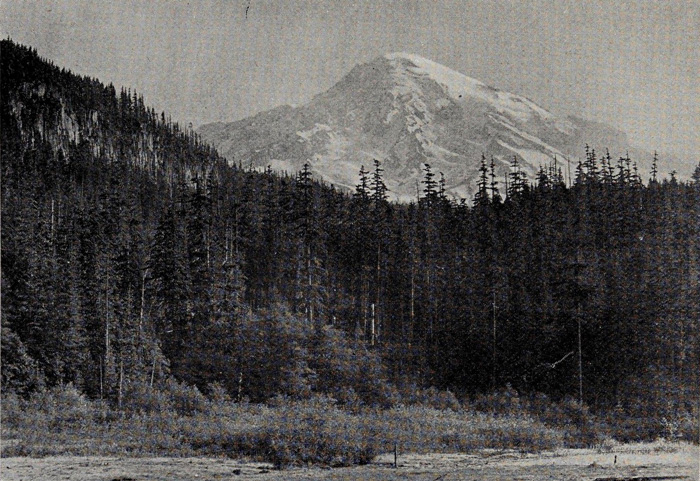
MOUNT RAINIER FROM THE SODA SPRINGS
Last summer I gained the summit from the south side, in a day and a half fromthe timberline, without encountering any desperate obstacles that could not insome way be passed in good weather. I was accompanied by Keith, the artist,Professor Ingraham, and five ambitious young climbers from Seattle. We were ledby the veteran mountaineer and guide Van Trump, of Yelm, who many years beforeguided General Stevens in his memorable ascent, and later Mr. Bailey, ofOakland. With a cumbersome abundance of campstools and blankets we set out fromSeattle, traveling by rail as far as Yelm Prairie, on the Tacoma and Oregonroad. Here we made our first camp and arranged with Mr. Longmire, a farmer inthe neighborhood, for pack and saddle animals. The noble King Mountain was infull view from here, glorifying the bright, sunny day with his presence, risingin godlike majesty over the woods, with the magnificent prairie as aforeground. The distance to the mountain from Yelm in a straight line isperhaps fifty miles; but by the mule and yellowjacket trail we had to follow itis a hundred miles. For, notwithstanding a portion of this trail runs in theair, where the wasps work hardest, it is far from being an air line as commonlyunderstood.
By night of the third day we reached the Soda Springs on the right bank of theNisqually, which goes roaring by, gray with mud, gravel, and boulders from thecaves of the glaciers of Rainier, now close at hand. The distance from the SodaSprings to the Camp of the Clouds is about ten miles. The first part of the waylies up the Nisqually Cañon, the bottom of which is flat in some places andthe walls very high and precipitous, like those of the Yosemite Valley. Theupper part of the cañon is still occupied by one of the Nisqually glaciers,from which this branch of the river draws its source, issuing from a cave inthe gray, rock-strewn snout. About a mile below the glacier we had to ford theriver, which caused some anxiety, for the current is very rapid and carriedforward large boulders as well as lighter material, while its savage roar isbewildering.
At this point we left the cañon, climbing out of it by a steep zigzag up theold lateral moraine of the glacier, which was deposited when the presentglacier flowed past at this height, and is about eight hundred feet high. It isnow covered with a superb growth of Picea amabilis[30]; so also is the corresponding portionof the right lateral. From the top of the moraine, still ascending, we passedfor a mile or two through a forest of mixed growth, mainly silver fir, Pattonspruce, and mountain pine, and then came to the charming park region, at anelevation of about five thousand feet above sea level. Here the vast continuouswoods at length begin to give way under the dominion of climate, though stillat this height retaining their beauty and giving no sign of stress of storm,sweeping upward in belts of varying width, composed mainly of one species offir, sharp and spiry in form, leaving smooth, spacious parks, with here andthere separate groups of trees standing out in the midst of the openings likeislands in a lake. Every one of these parks, great and small, is a gardenfilled knee-deep with fresh, lovely flowers of every hue, the most luxuriantand the most extravagantly beautiful of all the alpine gardens I ever beheld inall my mountain-top wanderings.
We arrived at the Cloud Camp at noon, but no clouds were in sight, save a fewgauzy ornamental wreaths adrift in the sunshine. Out of the forest at lastthere stood the mountain, wholly unveiled, awful in bulk and majesty, fillingall the view like a separate, new-born world, yet withal so fine and sobeautiful it might well fire the dullest observer to desperate enthusiasm. Longwe gazed in silent admiration, buried in tall daisies and anemones by the sideof a snowbank. Higher we could not go with the animals and find food for themand wood for our own campfires, for just beyond this lies the region of ice,with only here and there an open spot on the ridges in the midst of the ice,with dwarf alpine plants, such as saxifrages and drabas, which reach far upbetween the glaciers, and low mats of the beautiful bryanthus, while back of uswere the gardens and abundance of everything that heart could wish. Here we layall the afternoon, considering the lilies and the lines of the mountains withreference to a way to the summit.
At noon next day we left camp and began our long climb. We were in lightmarching order, save one who pluckily determined to carry his camera to thesummit. At night, after a long easy climb over wide and smooth fields of ice,we reached a narrow ridge, at an elevation of about ten thousand feet above thesea, on the divide between the glaciers of the Nisqually and the Cowlitz. Herewe lay as best we could, waiting for another day, without fire of course, as wewere now many miles beyond the timberline and without much to cover us. Aftereating a little hardtack, each of us leveled a spot to lie on among lava-blocksand cinders. The night was cold, and the wind coming down upon us in stormysurges drove gritty ashes and fragments of pumice about our ears while chillingto the bone. Very short and shallow was our sleep that night; but day dawned atlast, early rising was easy, and there was nothing about breakfast to cause anydelay. About four o’clock we were off, and climbing began in earnest. Wefollowed up the ridge on which we had spent the night, now along its crest, nowon either side, or on the ice leaning against it, until we came to where itbecomes massive and precipitous. Then we were compelled to crawl along a seamor narrow shelf, on its face, which we traced to its termination in the base ofthe great ice cap. From this point all the climbing was over ice, which washere desperately steep but fortunately was at the same time carved intoinnumerable spikes and pillars which afforded good footholds, and we crawledcautiously on, warm with ambition and exercise.
At length, after gaining the upper extreme of our guiding ridge, we found agood place to rest and prepare ourselves to scale the dangerous upper curves ofthe dome. The surface almost everywhere was bare, hard, snowless ice, extremelyslippery; and, though smooth in general, it was interrupted by a network ofyawning crevasses, outspread like lines of defense against any attempt to winthe summit. Here every one of the party took off his shoes and drove stoutsteel caulks about half an inch long into them, having brought tools along forthe purpose, and not having made use of them until now so that the points mightnot get dulled on the rocks ere the smooth, dangerous ice was reached. Besidesbeing well shod each carried an alpenstock, and for special difficulties we hada hundred feet of rope and an axe.
Thus prepared, we stepped forth afresh, slowly groping our way through tangledlines of crevasses, crossing on snow bridges here and there after cautiouslytesting them, jumping at narrow places, or crawling around the ends of thelargest, bracing well at every point with our alpenstocks and setting ourspiked shoes squarely down on the dangerous slopes. It was nerve-trying work,most of it, but we made good speed nevertheless, and by noon all stood togetheron the utmost summit, save one who, his strength failing for a time, came uplater.
We remained on the summit nearly two hours, looking about us at the vastmaplike views, comprehending hundreds of miles of the Cascade Range, with theirblack interminable forests and white volcanic cones in glorious array reachingfar into Oregon; the Sound region also, and the great plains of easternWashington, hazy and vague in the distance. Clouds began to gather. Soon of allthe land only the summits of the mountains, St. Helen’s, Adams, and Hood,were left in sight, forming islands in the sky. We found two well-formed andwell-preserved craters on the summit, lying close together like two plates on atable with their rims touching. The highest point of the mountain is locatedbetween the craters, where their edges come in contact. Sulphurous fumes andsteam issue from several vents, giving out a sickening smell that can bedetected at a considerable distance. The unwasted condition of these craters,and, indeed, to a great extent, of the entire mountain, would tend to show thatRainier is still a comparatively young mountain. With the exception of theprojecting lips of the craters and the top of a subordinate summit a shortdistance to the northward, the mountains is solidly capped with ice all around;and it is this ice cap which forms the grand central fountain whence all thetwenty glaciers of Rainier flow, radiating in every direction.
The descent was accomplished without disaster, though several of the party hadnarrow escapes. One slipped and fell, and as he shot past me seemed to be goingto certain death. So steep was the ice slope no one could move to help him, butfortunately, keeping his presence of mind, he threw himself on his face anddigging his alpenstock into the ice, gradually retarded his motion until hecame to rest. Another broke through a slim bridge over a crevasse, but hismomentum at the time carried him against the lower edge and only his alpenstockwas lost in the abyss. Thus crippled by the loss of his staff, we had to lowerhim the rest of the way down the dome by means of the rope we carried. Fallingrocks from the upper precipitous part of the ridge were also a source ofdanger, as they came whizzing past in successive volleys; but none told on us,and when we at length gained the gentle slopes of the lower ice fields, we ranand slid at our ease, making fast, glad time, all care and danger past, andarrived at our beloved Cloud Camp before sundown.
We were rather weak from want of nourishment, and some suffered from sunburn,notwithstanding the partial protection of glasses and veils; otherwise, allwere unscathed and well. The view we enjoyed from the summit could hardly besurpassed in sublimity and grandeur; but one feels far from home so high in thesky, so much so that one is inclined to guess that, apart from the acquisitionof knowledge and the exhilaration of climbing, more pleasure is to be found atthe foot of the mountains than on their tops. Doubly happy, however, is the manto whom lofty mountain tops are within reach, for the lights that shine thereillumine all that lies below.
XXI. The Physical and Climatic Characteristics of Oregon
Oregon is a large, rich, compact section of the west side of the continent,containing nearly a hundred thousand square miles of deep, wet evergreen woods,fertile valleys, icy mountains, and high, rolling wind-swept plains, watered bythe majestic Columbia River and its countless branches. It is bounded on thenorth by Washington, on the east by Idaho, on the south by California andNevada, and on the west by the Pacific Ocean. It is a grand, hearty, wholesome,foodful wilderness and, like Washington, once a part of the Oregon Territory,abounds in bold, far-reaching contrasts as to scenery, climate, soil, andproductions. Side by side there is drouth on a grand scale and overflowingmoisture; flinty, sharply cut lava beds, gloomy and forbidding, and smooth,flowery lawns; cool bogs, exquisitely plushy and soft, overshadowed by jaggedcrags barren as icebergs; forests seemingly boundless and plains with no treein sight; presenting a wide range of conditions, but as a whole favorable toindustry. Natural wealth of an available kind abounds nearly everywhere,inviting the farmer, the stock-raiser, the lumberman, the fisherman, themanufacturer, and the miner, as well as the free walker in search of knowledgeand wildness. The scenery is mostly of a comfortable, assuring kind, grand andinspiring without too much of that dreadful overpowering sublimity andexuberance which tend to discourage effort and cast people into inaction andsuperstition.
Ever since Oregon was first heard of in the romantic, adventurous, hunting,trapping Wild West days, it seems to have been regarded as the most attractiveand promising of all the Pacific countries for farmers. While yet the wholeregion as well as the way to it was wild, ere a single road or bridge wasbuilt, undaunted by the trackless thousand-mile distances and scalping,cattle-stealing Indians, long trains of covered wagons began to crawl wearilywestward, crossing how many plains, rivers, ridges, and mountains, fighting thepainted savages and weariness and famine. Setting out from the frontier of theold West in the spring as soon as the grass would support their cattle, theypushed on up the Platte, making haste slowly, however, that they might not becaught in the storms of winter ere they reached the promised land. They crossedthe Rocky Mountains to Fort Hall; thence followed down the Snake River forthree or four hundred miles, their cattle limping and failing on the rough lavaplains; swimming the streams too deep to be forded, making boats out ofwagon-boxes for the women and children and goods, or where trees could be had,lashing together logs for rafts. Thence, crossing the Blue Mountains and theplains of the Columbia, they followed the river to the Dalles. Here winterwould be upon them, and before a wagon road was built across the CascadeMountains the toil-worn emigrants would be compelled to leave their cattle andwagons until the following summer, and, in the mean time, with the assistanceof the Hudson’s Bay Company, make their way to the Willamette Valley onthe river with rafts and boats.
How strange and remote these trying times have already become! They are now dimas if a thousand years had passed over them. Steamships and locomotives withmagical influence have well-nigh abolished the old distances and dangers, andbrought forward the New West into near and familiar companionship with the restof the world.
Purely wild for unnumbered centuries, a paradise of oily, salmon-fed Indians,Oregon is now roughly settled in part and surveyed, its rivers and mountainranges, lakes, valleys, and plains have been traced and mapped in a generalway, civilization is beginning to take root, towns are springing up andflourishing vigorously like a crop adapted to the soil, and the whole kindlywilderness lies invitingly near with all its wealth open and ripe for use.
In sailing along the Oregon coast one sees but few more signs of humanoccupation than did Juan de Fuca three centuries ago. The shore bluffs riseabruptly from the waves, forming a wall apparently unbroken, though many shortrivers from the coast range of mountains and two from the interior have madenarrow openings on their way to the sea. At the mouths of these rivers goodharbors have been discovered for coasting vessels, which are of greatimportance to the lumbermen, dairymen, and farmers of the coast region. Butlittle or nothing of these appear in general views, only a simple gray wallnearly straight, green along the top, and the forest stretching back into themountains as far as the eye can reach.
Going ashore, we find few long reaches of sand where one may saunter, ormeadows, save the brown and purple meadows of the sea, overgrown with slipperykelp, swashed and swirled in the restless breakers. The abruptness of the shoreallows the massive waves that have come from far over the broad Pacific to getclose to the bluffs ere they break, and the thundering shock shakes the rocksto their foundations. No calm comes to these shores. Even in the finestweather, when the ships off shore are becalmed and their sails hang looseagainst the mast, there is always a wreath of foam at the base of these bluffs.The breakers are ever in bloom and crystal brine is ever in the air.
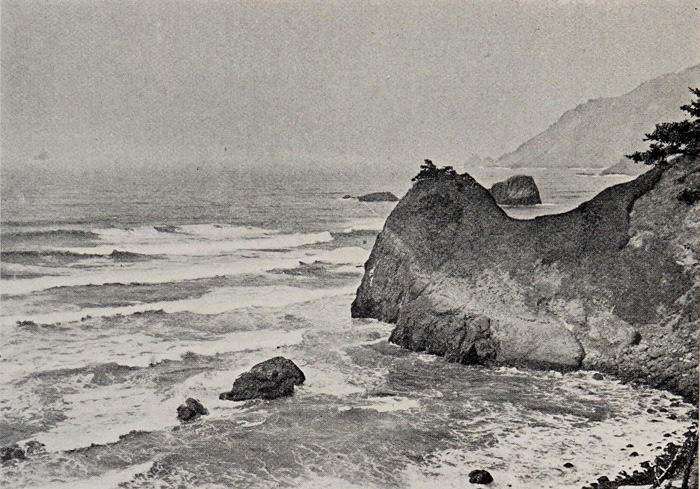
THE OREGON SEA-BLUFFS
A scramble along the Oregon sea bluffs proves as richly exciting to lovers ofwild beauty as heart could wish. Here are three hundred miles of pictures ofrock and water in black and white, or gray and white, with more or less ofgreen and yellow, purple and blue. The rocks, glistening in sunshine and foam,are never wholly dry—many of them marvels of wave-sculpture and mostimposing in bulk and bearing, standing boldly forward, monuments of a thousandstorms, types of permanence, holding the homes and places of refuge ofmultitudes of seafaring animals in their keeping, yet ever wasting away. Howgrand the songs of the waves about them, every wave a fine, hearty storm initself, taking its rise on the breezy plains of the sea, perhaps thousands ofmiles away, traveling with majestic, slow-heaving deliberation, reaching theend of its journey, striking its blow, bursting into a mass of white and pinkbloom, then falling spent and withered to give place to the next in the endlessprocession, thus keeping up the glorious show and glorious song through alltimes and seasons forever!
Terribly impressive as is this cliff and wave scenery when the skies are brightand kindly sunshine makes rainbows in the spray, it is doubly so in dark,stormy nights, when, crouching in some hollow on the top of some juttingheadland, we may gaze and listen undisturbed in the heart of it. Perhaps nowand then we may dimly see the tops of the highest breakers, looking ghostly inthe gloom; but when the water happens to be phosphorescent, as it oftentimesis, then both the sea and the rocks are visible, and the wild, exulting,up-dashing spray burns, every particle of it, and is combined into one glowingmass of white fire; while back in the woods and along the bluffs and crags ofthe shore the storm wind roars, and the rain-floods, gathering strength andcoming from far and near, rush wildly down every gulch to the sea, as if eagerto join the waves in their grand, savage harmony; deep calling unto deep in theheart of the great, dark night, making a sight and a song unspeakably sublimeand glorious.
In the pleasant weather of summer, after the rainy season is past and onlyoccasional refreshing showers fall, washing the sky and bringing out thefragrance of the flowers and the evergreens, then one may enjoy a fine, freewalk all the way across the State from the sea to the eastern boundary on theSnake River. Many a beautiful stream we should cross in such a walk, singingthrough forest and meadow and deep rocky gorge, and many a broad prairie andplain, mountain and valley, wild garden and desert, presenting landscape beautyon a grand scale and in a thousand forms, and new lessons without number,delightful to learn. Oregon has three mountain ranges which run nearly parallelwith the coast, the most influential of which, in every way, is the CascadeRange. It is about six thousand to seven thousand feet in average height, anddivides the State into two main sections called Eastern and Western Oregon,corresponding with the main divisions of Washington; while these are againdivided, but less perfectly, by the Blue Mountains and the Coast Range. Theeastern section is about two hundred and thirty miles wide, and is made up ingreat part of the treeless plains of the Columbia, which are green and floweryin spring, but gray, dusty, hot, and forbidding in summer. Considerable areas,however, on these plains, as well as some of the valleys countersunk below thegeneral surface along the banks of the streams, have proved fertile and producelarge crops of wheat, barley, hay, and other products.
In general views the western section seems to be covered with one vast, evenlyplanted forest, with the exception of the few snow-clad peaks of the CascadeRange, these peaks being the only points in the landscape that rise above thetimberline. Nevertheless, embosomed in this forest and lying in the greattrough between the Cascades and coast mountains, there are some of the bestbread-bearing valleys to be found in the world. The largest of these are theWillamette, Umpqua, and Rogue River Valleys. Inasmuch as a considerable portionof these main valleys was treeless, or nearly so, as well as surpassinglyfertile, they were the first to attract settlers; and the Willamette, being atonce the largest and nearest to tide water, was settled first of all, and nowcontains the greater portion of the population and wealth of the State.
The climate of this section, like the corresponding portion of Washington, israther damp and sloppy throughout the winter months, but the summers arebright, ripening the wheat and allowing it to be garnered in good condition.Taken as a whole, the weather is bland and kindly, and like the forest treesthe crops and cattle grow plump and sound in it. So also do the people;children ripen well and grow up with limbs of good size and fiber and, unlessoverworked in the woods, live to a good old age, hale and hearty.
But, like every other happy valley in the world, the sunshine of this one isnot without its shadows. Malarial fevers are not unknown in some places, anduntimely frosts and rains may at long intervals in some measure disappoint thehopes of the husbandman. Many a tale, good-natured or otherwise, is toldconcerning the overflowing abundance of the Oregon rains. Once an Englishtraveler, as the story goes, went to a store to make some purchases and onleaving found that rain was falling; therefore, not liking to get wet, hestepped back to wait till the shower was over. Seeing no signs of clearing, hesoon became impatient and inquired of the storekeeper how long he thought theshower would be likely to last. Going to the door and looking wisely into thegray sky and noting the direction of the wind, the latter replied that hethought the shower would probably last about six months, an opinion that ofcourse disgusted the fault-finding Briton with the “blawstedcountry,” though in fact it is but little if at all wetter or cloudierthan his own.
No climate seems the best for everybody. Many there be who waste their lives ina vain search for weather with which no fault may be found, keeping themselvesand their families in constant motion, like floating seaweeds that never strikeroot, yielding compliance to every current of news concerning countries yetuntried, believing that everywhere, anywhere, the sky is fairer and the grassgrows greener than where they happen to be. Before the Oregon and Californiarailroad was built, the overland journey between these States across theSiskiyou Mountains in the old-fashioned emigrant wagon was a long and tediousone. Nevertheless, every season dissatisfied climate-seekers, too wet and toodry, might be seen plodding along through the dust in the old“49style,” making their way one half of them from California toOregon, the other half from Oregon to California. The beautiful Sisson meadowsat the base of Mount Shasta were a favorite halfway resting place, where theweary cattle were turned out for a few days to gather strength for betterclimates, and it was curious to hear those perpetual pioneers comparing notesand seeking information around the campfires.
“Where are you from?” some Oregonian would ask.
“The Joaquin.”
“It’s dry there, ain’t it?”
“Well, I should say so. No rain at all in summer and none to speak of inwinter, and I’m dried out. I just told my wife I was on the move again,and I’m going to keep moving till I come to a country where it rains oncein a while, like it does in every reg’lar white man’s country; andthat, I guess, will be Oregon, if the news be true.”
“Yes, neighbor, you’s heading in the right direction forrain,” the Oregonian would say. “Keep right on to Yamhill andyou’ll soon be damp enough. It rains there more than twelve months in theyear; at least, no saying but it will. I’ve just come from there, plumbdrownded out, and I told my wife to jump into the wagon and we should start outand see if we couldn’t find a dry day somewhere. Last fall the hay wasout and the wood was out, and the cabin leaked, and I made up my mind to tryCalifornia the first chance.”
“Well, if you be a horned toad or coyote,” the seeker of moisturewould reply, “then maybe you can stand it. Just keep right on by theAlabama Settlement to Tulare and you can have my place on Big Dry Creek andwelcome. You’ll be drowned there mighty seldom. The wagon spokes andtires will rattle and tell you when you come to it.”
“All right, partner, we’ll swap square, you can have mine inYamhill and the rain thrown in. Last August a painter sharp came along one daywanting to know the way to Willamette Falls, and I told him: ‘Young man,just wait a little and you’ll find falls enough without going to OregonCity after them. The whole dog-gone Noah’s flood of a country will be afall and melt and float away some day.’” And more to the sameeffect.
But no one need leave Oregon in search of fair weather. The wheat and cattleregion of eastern Oregon and Washington on the upper Columbia plains is dryenough and dusty enough more than half the year. The truth is, most of thesewanderers enjoy the freedom of gypsy life and seek not homes but camps. Havingcrossed the plains and reached the ocean, they can find no farther west withinreach of wagons, and are therefore compelled now to go north and south betweenMexico and Alaska, always glad to find an excuse for moving, stopping a fewmonths or weeks here and there, the time being measured by the size of thecamp-meadow, conditions of the grass, game, and other indications. Even theirso-called settlements of a year or two, when they take up land and buildcabins, are only another kind of camp, in no common sense homes. Never a treeis planted, nor do they plant themselves, but like good soldiers in time of warare ever ready to march. Their journey of life is indeed a journey with verymatter-of-fact thorns in the way, though not wholly wanting in compensation.
One of the most influential of the motives that brought the early settlers tothese shores, apart from that natural instinct to scatter and multiply whichurges even sober salmon to climb the Rocky Mountains, was their desire to finda country at once fertile and winterless, where their flocks and herds couldfind pasture all the year, thus doing away with the long and tiresome period ofhaying and feeding necessary in the eastern and old western States andTerritories. Cheap land and good land there was in abundance in Kansas,Nebraska, Minnesota, and Iowa; but there the labor of providing for animals ofthe farm was very great, and much of that labor was crowded together into a fewsummer months, while to keep cool in summers and warm in the icy winters waswell-nigh impossible to poor farmers.
Along the coast and throughout the greater part of western Oregon in general,snow seldom falls on the lowlands to a greater depth than a few inches, andnever lies long. Grass is green all winter. The average temperature for theyear in the Willamette Valley is about 52 degrees, the highest and lowest beingabout 100 degrees and 20 degrees, though occasionally a much lower temperatureis reached.
The average rainfall is about fifty or fifty-five inches in the WillametteValley, and along the coast seventy-five inches, or even more at somepoints—figures that bring many a dreary night and day to mind, howeverfine the effect on the great evergreen woods and the fields of the farmers. Therainy season begins in September or October and lasts until April or May. Thenthe whole country is solemnly soaked and poulticed with the gray, streamingclouds and fogs, night and day, with marvelous constancy. Towards the beginningand end of the season a good many bright days occur to break the pouring gloom,but whole months of rain, continuous, or nearly so, are not at all rare.Astronomers beneath these Oregon skies would have a dull time of it. Of all theyear only about one fourth of the days are clear, while three fourths have moreor less of fogs, clouds, or rain.
The fogs occur mostly in the fall and spring. They are grand, far-reachingaffairs of two kinds, the black and the white, some of the latter being verybeautiful, and the infinite delicacy and tenderness of their touch as theylinger to caress the tall evergreens is most exquisite. On farms and highwaysand in the streets of towns, where work has to be done, there is nothingpicturesque or attractive in any obvious way about the gray, serious-facedrainstorms. Mud abounds. The rain seems dismal and heedless and gets ineverybody’s way. Every face is turned from it, and it has but few friendswho recognize its boundless beneficence. But back in the untrodden woods whereno axe has been lifted, where a deep, rich carpet of brown and golden mossescovers all the ground like a garment, pressing warmly about the feet of thetrees and rising in thick folds softly and kindly over every fallen trunk,leaving no spot naked or uncared-for, there the rain is welcomed, and everydrop that falls finds a place and use as sweet and pure as itself. An excursioninto the woods when the rain harvest is at its height is a noble pleasure, andmay be safely enjoyed at small expense, though very few care to seek it.Shelter is easily found beneath the great trees in some hollow out of the wind,and one need carry but little provision, none at all of a kind that a wettingwould spoil. The colors of the woods are then at their best, and the mightyhosts of the forest, every needle tingling in the blast, wave and sing inglorious harmony.
“’T were worth ten years of peaceful life, one glance at thisarray.”
The snow that falls in the lowland woods is usually soft, and makes a fine showcoming through the trees in large, feathery tufts, loading the branches of thefirs and spruces and cedars and weighing them down against the trunks untilthey look slender and sharp as arrows, while a strange, muffled silenceprevails, giving a peculiar solemnity to everything. But these lowlandsnowstorms and their effects quickly vanish; every crystal melts in a day ortwo, the bent branches rise again, and the rain resumes its sway.
While these gracious rains are searching the roots of the lowlands,corresponding snows are busy along the heights of the Cascade Mountains. Monthafter month, day and night the heavens shed their icy bloom in stormy,measureless abundance, filling the grand upper fountains of the rivers to lastthrough the summer. Awful then is the silence that presses down over themountain forests. All the smaller streams vanish from sight, hushed andobliterated. Young groves of spruce and pine are bowed down as by a gentle handand put to rest, not again to see the light or move leaf or limb until thegrand awakening of the springtime, while the larger animals and most of thebirds seek food and shelter in the foothills on the borders of the valleys andplains.
The lofty volcanic peaks are yet more heavily snow-laden. To their upper zonesno summer comes. They are white always. From the steep slopes of the summit thenew-fallen snow, while yet dry and loose, descends in magnificent avalanches tofeed the glaciers, making meanwhile the most glorious manifestations of power.Happy is the man who may get near them to see and hear. In some sheltered campnest on the edge of the timberline one may lie snug and warm, but after thelong shuffle on snowshoes we may have to wait more than a month ere the heavensopen and the grand show is unveiled. In the mean time, bread may be scarce,unless with careful forecast a sufficient supply has been provided and securelyplaced during the summer. Nevertheless, to be thus deeply snowbound high in thesky is not without generous compensation for all the cost. And when we atlength go down the long white slopes to the levels of civilization, the painsvanish like snow in sunshine, while the noble and exalting pleasures we havegained remain with us to enrich our lives forever.
The fate of the high-flying mountain snow-flowers is a fascinating study,though little may we see of their works and ways while their storms go on. Theglinting, swirling swarms fairly thicken the blast, and all the air, as well asthe rocks and trees, is as one smothering mass of bloom, through the midst ofwhich at close intervals come the low, intense thunder-tones of the avalanchesas they speed on their way to fill the vast fountain hollows. Here they seem atlast to have found rest. But this rest is only apparent. Gradually the loosecrystals by the pressure of their own weight are welded together into clearice, and, as glaciers, march steadily, silently on, with invisible motion, inbroad, deep currents, grinding their way with irresistible energy to the warmerlowlands, where they vanish in glad, rejoicing streams.
In the sober weather of Oregon lightning makes but little show. Thosemagnificent thunderstorms that so frequently adorn and glorify the sky of theMississippi Valley are wanting here. Dull thunder and lightning mayoccasionally be seen and heard, but the imposing grandeur of great stormsmarching over the landscape with streaming banners and a network of fire isalmost wholly unknown.
Crossing the Cascade Range, we pass from a green to a gray country, from awilderness of trees to a wilderness of open plains, level or rolling or risinghere and there into hills and short mountain spurs. Though well supplied withrivers in most of its main sections, it is generally dry. The annual rainfallis only from about five to fifteen inches, and the thin winter garment of snowseldom lasts more than a month or two, though the temperature in many placesfalls from five to twenty-five degrees below zero for a short time. That thesnow is light over eastern Oregon, and the average temperature not intolerablysevere, is shown by the fact that large droves of sheep, cattle, and horseslive there through the winter without other food or shelter than they find forthemselves on the open plains or down in the sunken valleys and gorges alongthe streams.
When we read of the mountain ranges of Oregon and Washington with detaileddescriptions of their old volcanoes towering snow-laden and glacier-laden abovethe clouds, one may be led to imagine that the country is far icier and whiterand more mountainous than it is. Only in winter are the Coast and CascadeMountains covered with snow. Then as seen from the main interior valleys theyappear as comparatively low, bossy walls stretching along the horizon andmaking a magnificent display of their white wealth. The Coast Range in Oregondoes not perhaps average more than three thousand feet in height. Its snow doesnot last long, most of its soil is fertile all the way to the summits, and thegreater part of the range may at some time be brought under cultivation. Theimmense deposits on the great central uplift of the Cascade Range are mostlymelted off before the middle of summer by the comparatively warm winds andrains from the coast, leaving only a few white spots on the highest ridges,where the depth from drifting has been greatest, or where the rate of waste hasbeen diminished by specially favorable conditions as to exposure. Only thegreat volcanic cones are truly snow-clad all the year, and these are notnumerous and make but a small portion of the general landscape.
As we approach Oregon from the coast in summer, no hint of snowy mountains canbe seen, and it is only after we have sailed into the country by the Columbia,or climbed some one of the commanding summits, that the great white peaks sendus greeting and make telling advertisements of themselves and of the countryover which they rule. So, also, in coming to Oregon from the east the countryby no means impresses one as being surpassingly mountainous, the abode of peaksand glaciers. Descending the spurs of the Rocky Mountains into the basin of theColumbia, we see hot, hundred-mile plains, roughened here the there by hillsand ridges that look hazy and blue in the distance, until we have pushed wellto the westward. Then one white point after another comes into sight to refreshthe eye and the imagination; but they are yet a long way off, and have much tosay only to those who know them or others of their kind. How grand they are,though insignificant-looking on the edge of the vast landscape! What noblewoods they nourish, and emerald meadows and gardens! What springs and streamsand waterfalls sing about them and to what a multitude of happy creatures theygive homes and food!
The principal mountains of the range are Mounts Pitt, Scott, and Thielson,Diamond Peak, the Three Sisters, Mounts Jefferson, Hood, St. Helen’s,Adams, Rainier, Aix, and Baker. Of these the seven first named belong toOregon, the others to Washington. They rise singly at irregular distances fromone another along the main axis of the range or near it, with an elevation offrom about eight thousand to fourteen thousand four hundred feet above thelevel of the sea. From few points in the valleys may more than three or four ofthem be seen, and of the more distant ones of these only the tops appear.Therefore, speaking generally, each of the lowland landscapes of the Statecontains only one grand snowy mountain.
The heights back of Portland command one of the best general views of theforests and also of the most famous of the great mountains both of Oregon andWashington. Mount Hood is in full view, with the summits of Mounts Jefferson,St. Helen’s, Adams, and Rainier in the distance. The city of Portland isat our feet, covering a large area along both banks of the Willamette, and,with its fine streets, schools, churches, mills, shipping, parks, and gardens,makes a telling picture of busy, aspiring civilization in the midst of thegreen wilderness in which it is planted. The river is displayed to fineadvantage in the foreground of our main view, sweeping in beautiful curvesaround rich, leafy islands, its banks fringed with willows.
A few miles beyond the Willamette flows the renowned Columbia, and theconfluence of these two great rivers is at a point only about ten miles belowthe city. Beyond the Columbia extends the immense breadth of the forest, onedim, black, monotonous field with only the sky, which one is glad to see is notforested, and the tops of the majestic old volcanoes to give diversity to theview. That sharp, white, broad-based pyramid on the south side of the Columbia,a few degrees to the south of east from where you stand, is the famous MountHood. The distance to it in a straight line is about fifty miles. Its upperslopes form the only bare ground, bare as to forests, in the landscape in thatdirection. It is the pride of Oregonians, and when it is visible is alwayspointed out to strangers as the glory of the country, the mountain ofmountains. It is one of the grand series of extinct volcanoes extending fromLassen’s Butte [31]to Mount Baker, a distance of aboutsix hundred miles, which once flamed like gigantic watch-fires along the coast.Some of them have been active in recent times, but no considerable addition tothe bulk of Mount Hood has been made for several centuries, as is shown by theamount of glacial denudation it has suffered. Its summit has been ground to apoint, which gives it a rather thin, pinched appearance. It has a wide-flowingbase, however, and is fairly well proportioned. Though it is eleven thousandfeet high, it is too far off to make much show under ordinary conditions in soextensive a landscape. Through a great part of the summer it is invisible onaccount of smoke poured into the sky from burning woods, logging camps, mills,etc., and in winter for weeks at a time, or even months, it is in the clouds.Only in spring and early summer and in what there may chance to be of brightweather in winter is it or any of its companions at all clear or telling. Fromthe Cascades on the Columbia it may be seen at a distance of twenty miles orthereabouts, or from other points up and down the river, and with themagnificent foreground it is very impressive. It gives the supreme touch ofgrandeur to all the main Columbia views, rising at every turn, solitary,majestic, awe-inspiring, the ruling spirit of the landscape. But, likemountains everywhere, it varies greatly in impressiveness and apparent heightat different times and seasons, not alone from differences as to the dimness ortransparency of the air. Clear, or arrayed in clouds, it changes both in sizeand general expression. Now it looms up to an immense height and seems to drawnear in tremendous grandeur and beauty, holding the eyes of every beholder indevout and awful interest. Next year or next day, or even in the same day, youreturn to the same point of view, perhaps to find that the glory has departed,as if the mountain had died and the poor dull, shrunken mass of rocks and icehad lost all power to charm.
Never shall I forget my first glorious view of Mount Hood one calm evening inJuly, though I had seen it many times before this. I was then sauntering with afriend across the new Willamette bridge between Portland and East Portland forthe sake of the river views, which are here very fine in the tranquil summerweather. The scene on the water was a lively one. Boats of every descriptionwere gliding, glinting, drifting about at work or play, and we leaned over therail from time to time, contemplating the gay throng. Several lines of ferryboats were making regular trips at intervals of a few minutes, and riversteamers were coming and going from the wharves, laden with all sorts ofmerchandise, raising long diverging swells that make all the light pleasurecraft bow and nod in hearty salutation as they passed. The crowd was beingconstantly increased by new arrivals from both shores, sailboats, rowboats,racing shells, rafts, were loaded with gayly dressed people, and here and theresome adventurous man or boy might be seen as a merry sailor on a single plankor spar, apparently as deep in enjoyment as were any on the water. It seemed asif all the town were coming to the river, renouncing the cares and toils of theday, determined to take the evening breeze into their pulses, and be cool andtranquil ere going to bed.
Absorbed in the happy scene, given up to dreamy, random observation of what layimmediately before me, I was not conscious of anything occurring on the outerrim of the landscape. Forest, mountain, and sky were forgotten, when mycompanion suddenly directed my attention to the eastward, shouting, “Oh,look! look!” in so loud and excited a tone of voice that passers-by,saunterers like ourselves, were startled and looked over the bridge as ifexpecting to see some boat upset. Looking across the forest, over which themellow light of the sunset was streaming, I soon discovered the source of myfriend’s excitement. There stood Mount Hood in all the glory of thealpenglow, looming immensely high, beaming with intelligence, and so impressivethat one was overawed as if suddenly brought before some superior being newlyarrived from the sky.
The atmosphere was somewhat hazy, but the mountain seemed neither near nor far.Its glaciers flashed in the divine light. The rugged, storm-worn ridges betweenthem and the snowfields of the summit, these perhaps might have been traced asfar as they were in sight, and the blending zones of color about the base. Butso profound was the general impression, partial analysis did not come intoplay. The whole mountain appeared as one glorious manifestation of divinepower, enthusiastic and benevolent, glowing like a countenance with ineffablerepose and beauty, before which we could only gaze in devout and lowlyadmiration.
The far-famed Oregon forests cover all the western section of the State, themountains as well as the lowlands, with the exception of a few gravelly spotsand open spaces in the central portions of the great cultivated valleys.Beginning on the coast, where their outer ranks are drenched and buffeted bywind-driven scud from the sea, they press on in close, majestic ranks over thecoast mountains, across the broad central valleys, and over the Cascade Range,broken and halted only by the few great peaks that rise like islands above thesea of evergreens.
In descending the eastern slopes of the Cascades the rich, abounding,triumphant exuberance of the trees is quickly subdued; they become smaller,grow wide apart, leaving dry spaces without moss covering or underbrush, andbefore the foot of the range is reached, fail altogether, stayed by the drouthof the interior almost as suddenly as on the western margin they are stayed bythe sea. Here and there at wide intervals on the eastern plains patches of asmall pine (Pinus contorta) are found, and a scattering growth ofjuniper, used by the settlers mostly for fence posts and firewood. Along thestream bottoms there is usually more or less of cottonwood and willow, which,though yielding inferior timber, is yet highly prized in this bare region. Onthe Blue Mountains there is pine, spruce, fir, and larch in abundance for everyuse, but beyond this range there is nothing that may be called a forest in theColumbia River basin, until we reach the spurs of the Rocky Mountains; andthese Rocky Mountain forests are made up of trees which, compared with thegiants of the Pacific Slope, are mere saplings.
XXII. The Forests of Oregon and their Inhabitants
Like the forests of Washington, already described, those of Oregon are in greatpart made up of the Douglas spruce[32], or Oregon pine (AbiesDouglasii). A large number of mills are at work upon this species,especially along the Columbia, but these as yet have made but little impressionupon its dense masses, the mills here being small as compared with those of thePuget Sound region. The white cedar, or Port Orford cedar (CupressusLawsoniana, or Chamæcyparis Lawsoniana), is one of the mostbeautiful of the evergreens, and produces excellent lumber, considerablequantities of which are shipped to the San Francisco market. It is found mostlyabout Coos Bay, along the Coquille River, and on the northern slopes of theSiskiyou Mountains, and extends down the coast into California. The silverfirs, the spruces, and the colossal arbor-vitæ, or white cedar[33](Thujagigantea), described in the chapter on Washington, are also found here ingreat beauty and perfection, the largest of these (Picea grandis, Loud.;Abies grandis, Lindl.) being confined mostly to the coast region, whereit attains a height of three hundred feet, and a diameter of ten or twelvefeet. Five or six species of pines are found in the State, the most importantof which, both as to lumber and as to the part they play in the general wealthand beauty of the forests, are the yellow and sugar pines (Pinusponderosaand P. Lambertiana). The yellow pine is most abundant onthe eastern slopes of the Cascades, forming there the main bulk of the forestin many places. It is also common along the borders of the open spaces inWillamette Valley. In the southern portion of the State the sugar pine, whichis the king of all the pines and the glory of the Sierra forests, occurs inconsiderable abundance in the basins of the Umpqua and Rogue Rivers, and it wasin the Umpqua Hills that this noble tree was first discovered by theenthusiastic botanical explorer David Douglas, in the year 1826.
This is the Douglas for whom the noble Douglas spruce is named, and many a fairblooming plant also, which will serve to keep his memory fresh and sweet aslong as beautiful trees and flowers are loved. The Indians of the lowerColumbia River watched him with lively curiosity as he wandered about in thewoods day after day, gazing intently on the ground or at the great trees,collecting specimens of everything he saw, but, unlike all the eagerfur-gathering strangers they had hitherto seen, caring nothing about trade. Andwhen at length they came to know him better, and saw that from year to year thegrowing things of the woods and prairies, meadows and plains, were his onlyobject of pursuit, they called him the “Man of Grass,” a title ofwhich he was proud.
He was a Scotchman and first came to this coast in the spring of 1825 under theauspices of the London Horticultural Society, landing at the mouth of theColumbia after a long dismal voyage of eight months and fourteen days. Duringthis first season he chose Fort Vancouver, belonging to the Hudson’s BayCompany, as his headquarters, and from there made excursions into the gloriouswilderness in every direction, discovering many new species among the trees aswell as among the rich underbrush and smaller herbaceous vegetation. It waswhile making a trip to Mount Hood this year that he discovered the two largestand most beautiful firs in the world (Picea amabilisand P.nobilis—now called Abies), and from the seeds which he thencollected and sent home tall trees are now growing in Scotland.
In one of his trips that summer, in the lower Willamette Valley, he saw in anIndian’s tobacco pouch some of the seeds and scales of a new species ofpine, which he learned were gathered from a large tree that grew far to thesouthward. Most of the following season was spent on the upper waters of theColumbia, and it was not until September that he returned to Fort Vancouver,about the time of the setting-in of the winter rains. Nevertheless, bearing inmind the great pine he had heard of, and the seeds of which he had seen, hemade haste to set out on an excursion to the headwaters of the Willamette insearch of it; and how he fared on this excursion and what dangers and hardshipshe endured is best told in his own journal, part of which I quote asfollows:—
October 26th, 1826. Weather dull. Cold and cloudy. When my friends in Englandare made acquainted with my travels I fear they will think that I have toldthem nothing but my miseries.... I quitted my camp early in the morning tosurvey the neighboring country, leaving my guide to take charge of the horsesuntil my return in the evening. About an hour’s walk from the camp I metan Indian, who on perceiving me instantly strung his bow, placed on his leftarm a sleeve of raccoon skin and stood on the defensive. Being quite sure thatconduct was prompted by fear and not by hostile intentions, the poor fellowhaving probably never seen such a being as myself before, I laid my gun at myfeet on the ground and waved my hand for him to come to me, which he did slowlyand with great caution. I then made him place his bow and quiver of arrowsbeside my gun, and striking a light gave him a smoke out of my own pipe and apresent of a few beads. With my pencil I made a rough sketch of the cone andpine tree which I wanted to obtain and drew his attention to it, when heinstantly pointed with his hand to the hills fifteen or twenty miles distanttowards the south; and when I expressed my intention of going thither,cheerfully set about accompanying me. At midday I reached my long- wished-forpines and lost no time in examining them and endeavoring to collect specimensand seeds. New and strange things seldom fail to make strong impressions andare therefore frequently overrated; so that, lest I should never see my friendsin England to inform them verbally of this most beautiful and immensely grandtree, I shall here state the dimensions of the largest I could find amongseveral that had been blown down by the wind. At three feet from the ground itscircumference is fifty-seven feet, nine inches; at one hundred and thirty-fourfeet, seventeen feet five inches; the extreme length two hundred and forty-fivefeet.... As it was impossible either to climb the tree or hew it down, Iendeavored to knock off the cones by firing at them with ball, when the reportof my gun brought eight Indians, all of them painted with red earth, armed withbows, arrows, bone-tipped spears, and flint knives. They appeared anything butfriendly. I explained to them what I wanted and they seemed satisfied and satdown to smoke; but presently I saw one of them string his bow and anothersharpen his flint knife with a pair of wooden pincers and suspend it on thewrist of his right hand. Further testimony of their intentions was unnecessary.To save myself by flight was impossible, so without hesitation I stepped backabout five paces, cocked my gun, drew one of the pistols out of my belt, andholding it in my left hand, the gun in my right, showed myself determined tofight for my life. As much as possible I endeavored to preserve my coolness,and thus we stood looking at one another without making any movement oruttering a word for perhaps ten minutes, when one at last, who seemed to be theleader, gave a sign that they wished for some tobacco; this I signified theyshould have if they fetched a quantity of cones. They went off immediately insearch of them, and no sooner were they all out of sight than I picked up mythree cones and some twigs of the trees and made the quickest possible retreat,hurrying back to my camp, which I reached before dusk. The Indian who lastundertook to be my guide to the trees I sent off before gaining my encampment,lest he should betray me. How irksome is the darkness of night to one undersuch circumstances. I cannot speak a word to my guide, nor have I a book todivert my thoughts, which are continually occupied with the dread lest thehostile Indians should trace me hither and make an attack. I now write lying onthe grass with my gun cocked beside me, and penning these lines by the light ofmy Columbian candle, namely, an ignited piece of rosin-wood.
Douglas named this magnificent species Pinus Lambertiana, in honor ofhis friend Dr. Lambert, of London. This is the noblest pine thus far discoveredin the forests of the world, surpassing all others not only in size but inbeauty and majesty. Oregon may well be proud that its discovery was made withinher borders, and that, though it is far more abundant in California, she hasthe largest known specimens. In the Sierra the finest sugar pine forests lie atan elevation of about five thousand feet. In Oregon they occupy much lowerground, some of the trees being found but little above tide-water.
No lover of trees will ever forget his first meeting with the sugar pine. Inmost coniferous trees there is a sameness of form and expression which atlength becomes wearisome to most people who travel far in the woods. But thesugar pines are as free from conventional forms as any of the oaks. No two areso much alike as to hide their individuality from any observer. Every tree isappreciated as a study in itself and proclaims in no uncertain terms thesurpassing grandeur of the species. The branches, mostly near the summit, aresometimes nearly forty feet long, feathered richly all around with short, leafybranchlets, and tasseled with cones a foot and a half long. And when thesesuperb arms are outspread, radiating in every direction, an immense crownlikemass is formed which, poised on the noble shaft and filled with sunshine, isone of the grandest forest objects conceivable. But though so wild andunconventional when full-grown, the sugar pine is a remarkably regular tree inyouth, a strict follower of coniferous fashions, slim, erect, tapering,symmetrical, every branch in place. At the age of fifty or sixty years thisshy, fashionable form begins to give way. Special branches are thrust out awayfrom the general outlines of the trees and bent down with cones. Henceforth itbecomes more and more original and independent in style, pushes boldly aloftinto the winds and sunshine, growing ever more stately and beautiful, a joy andinspiration to every beholder.
Unfortunately, the sugar pine makes excellent lumber. It is too good to live,and is already passing rapidly away before the woodman’s axe. Surely outof all of the abounding forest wealth of Oregon a few specimens might be sparedto the world, not as dead lumber, but as living trees. A park of moderateextent might be set apart and protected for public use forever, containing atleast a few hundreds of each of these noble pines, spruces, and firs. Happywill be the men who, having the power and the love and benevolent forecast todo this, will do it. They will not be forgotten. The trees and their loverswill sing their praises, and generations yet unborn will rise up and call themblessed.
Dotting the prairies and fringing the edges of the great evergreen forests wefind a considerable number of hardwood trees, such as the oak, maple, ash,alder, laurel, madrone, flowering dogwood, wild cherry, and wild apple. Thewhite oak (Quercus Garryana) is the most important of the Oregon oaks asa timber tree, but not nearly so beautiful as Kellogg’s oak (Q.Kelloggii). The former is found mostly along the Columbia River,particularly about the Dalles, and a considerable quantity of useful lumber ismade from it and sold, sometimes for eastern white oak, to wagon makers.Kellogg’s oak is a magnificent tree and does much for the picturesquebeauty of the Umpqua and Rogue River Valleys where it abounds. It is also foundin all the Yosemite valleys of the Sierra, and its acorns form an importantpart of the food of the Digger Indians. In the Siskiyou Mountains there is alive oak (Q. chrysolepis), wide-spreading and very picturesque in form,but not very common. It extends southward along the western flank of the Sierraand is there more abundant and much larger than in Oregon, oftentimes five toeight feet in diameter.
The maples are the same as those in Washington, already described, but I havenot seen any maple groves here equal in extent or in the size of the trees tothose on the Snoqualmie River.
The Oregon ash is now rare along the stream banks of western Oregon, and itgrows to a good size and furnishes lumber that is for some purposes equal tothe white ash of the Western States.
Nuttall’s flowering dogwood makes a brave display with its wealth of showinvolucres in the spring along cool streams. Specimens of the flowers may befound measuring eight inches in diameter.
The wild cherry (Prunus emarginata, var. mollis) is a small, handsome treeseldom more than a foot in diameter at the base. It makes valuable lumber andits black, astringent fruit furnishes a rich resource as food for the birds. Asmaller form is common in the Sierra, the fruit of which is eagerly eaten bythe Indians and hunters in time of need.
The wild apple (Pyrus rivularis) is a fine, hearty, handsome little treethat grows well in rich, cool soil along streams and on the edges of beavermeadows from California through Oregon and Washington to southeastern Alaska.In Oregon it forms dense, tangled thickets, some of them almost impenetrable.The largest trunks are nearly a foot in diameter. When in bloom it makes a fineshow with its abundant clusters of flowers, which are white and fragrant. Thefruit is very small and savagely acid. It is wholesome, however, and is eatenby birds, bears, Indians, and many other adventurers, great and small.
Passing from beneath the shadows of the woods where the trees grow close andhigh, we step into charming wild gardens full of lilies, orchids, heathworts,roses, etc., with colors so gay and forming such sumptuous masses of bloom,they make the gardens of civilization, however lovingly cared for, seempathetic and silly. Around the great fire-mountains, above the forests andbeneath the snow, there is a flowery zone of marvelous beauty planted withanemones, erythroniums, daisies, bryanthus, kalmia, vaccinium, cassiope,saxifrages, etc., forming one continuous garden fifty or sixty miles incircumference, and so deep and luxuriant and closely woven it seems as ifNature, glad to find an opening, were economizing space and trying to see howmay of her bright-eyed darlings she can get together in one mountain wreath.
Along the slopes of the Cascades, where the woods are less dense, especiallyabout the headwaters of the Willamette, there are miles of rhododendron, makingglorious outbursts of purple bloom, and down on the prairies in rich, damphollows the blue-flowered camassia grows in such profusion that at a littledistance its dense masses appear as beautiful blue lakes imbedded in the green,flowery plains; while all about the streams and the lakes and the beavermeadows and the margins of the deep woods there is a magnificent tangle ofgaultheria and huckleberry bushes with their myriads of pink bells, reinforcedwith hazel, cornel, rubus of many species, wild plum, cherry, and crab apple;besides thousands of charming bloomers to be found in all sorts of placesthroughout the wilderness whose mere names are refreshing, such as linnaea,menziesia, pyrola, chimaphila, brodiaea, smilacina, fritillaria, calochortus,trillium, clintonia, veratrum, cypripedium, goodyera, spiranthes, habenaria,and the rare and lovely “Hider of the North,” Calypsoborealis, to find which is alone a sufficient object for a journey into thewilderness. And besides these there is a charming underworld of ferns andmosses flourishing gloriously beneath all the woods.
Everybody loves wild woods and flowers more or less. Seeds of all these Oregonevergreens and of many of the flowering shrubs and plants have been sent toalmost every country under the sun, and they are now growing in carefullytended parks and gardens. And now that the ways of approach are open one wouldexpect to find these woods and gardens full of admiring visitors reveling intheir beauty like bees in a clover field. Yet few care to visit them. A portionof the bark of one of the California trees, the mere dead skin, excited thewondering attention of thousands when it was set up in the Crystal Palace inLondon, as did also a few peeled spars, the shafts of mere saplings from Oregonor Washington. Could one of these great silver firs or sugar pines threehundred feet high have been transplanted entire to that exhibition, howenthusiastic would have been the praises accorded to it!
Nevertheless, the countless hosts waving at home beneath their own sky, besidetheir own noble rivers and mountains, and standing on a flower-enameled carpetof mosses thousands of square miles in extent, attract but little attention.Most travelers content themselves with what they may chance to see from carwindows, hotel verandas, or the deck of a steamer on the lowerColumbia—clinging to the battered highways like drowning sailors to alife raft. When an excursion into the woods is proposed, all sorts ofexaggerated or imaginary dangers are conjured up, filling the kindly, soothingwilderness with colds, fevers, Indians, bears, snakes, bugs, impassable rivers,and jungles of brush, to which is always added quick and sure starvation.
As to starvation, the woods are full of food, and a supply of bread may easilybe carried for habit’s sake, and replenished now and then at outlyingfarms and camps. The Indians are seldom found in the woods, being confinedmainly to the banks of the rivers, where the greater part of their food isobtained. Moreover, the most of them have been either buried since thesettlement of the country or civilized into comparative innocence, industry, orharmless laziness. There are bears in the woods, but not in such numbers nor ofsuch unspeakable ferocity as town-dwellers imagine, nor do bears spend theirlives in going about the country like the devil, seeking whom they may devour.Oregon bears, like most others, have no liking for man either as meat or associety; and while some may be curious at times to see what manner of creaturehe is, most of them have learned to shun people as deadly enemies. They havebeen poisoned, trapped, and shot at until they have become shy, and it is nolonger easy to make their acquaintance. Indeed, since the settlement of thecountry, notwithstanding far the greater portion is yet wild, it is difficultto find any of the larger animals that once were numerous and comparativelyfamiliar, such as the bear, wolf, panther, lynx, deer, elk, and antelope.
As early as 1843, while the settlers numbered only a few thousands, and beforeany sort of government had been organized, they came together and held whatthey called “a wolf meeting,” at which a committee was appointed todevise means for the destruction of wild animals destructive to tame ones,which committee in due time begged to report as follows:—
It being admitted by all that bears, wolves, panthers, etc., are destructive tothe useful animals owned by the settlers of this colony, your committee wouldsubmit the following resolutions as the sense of this meeting, by which thecommunity may be governed in carrying on a defensive and destructive war on allsuch animals:—
Resolved, 1st.—That we deem it expedient for the community to takeimmediate measures for the destruction of all wolves, panthers, and bears, andsuch other animals as are known to be destructive to cattle, horses, sheep andhogs.
2d.—That a bounty of fifty cents be paid for the destruction of asmall wolf, $3.00 for a large wolf, $1.50 for a lynx, $2.00 for a bear and$5.00 for a panther.
This center of destruction was in the Willamette Valley. But for many yearsprior to the beginning of the operations of the “Wolf Organization”the Hudson’s Bay Company had established forts and trading stations overall the country, wherever fur-gathering Indians could be found, and vastnumbers of these animals were killed. Their destruction has since gone on at anaccelerated rate from year to year as the settlements have been extended, sothat in some cases it is difficult to obtain specimens enough for the use ofnaturalists. But even before any of these settlements were made, and before thecoming of the Hudson’s Bay Company, there was very little danger to bemet in passing through this wilderness as far as animals were concerned, andbut little of any kind as compared with the dangers encountered in crowdedhouses and streets.
When Lewis and Clark made their famous trip across the continent in 1804-05,when all the Rocky Mountain region was wild, as well as the Pacific Slope, theydid not lose a single man by wild animals, nor, though frequently attacked,especially by the grizzlies of the Rocky Mountains, were any of them woundedseriously. Captain Clark was bitten on the hand by a wolf as he lay asleep;that was one bite among more than a hundred men while traveling through eightto nine thousand miles of savage wilderness. They could hardly have been sofortunate had they stayed at home. They wintered on the edge of the Clatsopplains, on the south side of the Columbia River near its mouth. In the woods onthat side they found game abundant, especially elk, and with the aid of thefriendly Indians who furnished salmon and “wapatoo” (the tubers ofSagittaria variabilis), they were in no danger of starving.
But on the return trip in the spring they reached the base of the RockyMountains when the range was yet too heavily snow-laden to be crossed withhorses. Therefore they had to wait some weeks. This was at the head of one ofthe northern branches of the Snake River, and, their scanty stock of provisionsbeing nearly exhausted, the whole party was compelled to live mostly on bearsand dogs; deer, antelope, and elk, usually abundant, were now scarce becausethe region had been closely hunted over by the Indians before their arrival.
Lewis and Clark had killed a number of bears and saved the skins of the moreinteresting specimens, and the variations they found in size, color of thehair, etc., made great difficulty in classification. Wishing to get the opinionof the Chopumish Indians, near one of whose villages they were encamped,concerning the various species, the explorers unpacked their bundles and spreadout for examination all the skins they had taken. The Indian huntersimmediately classed the white, the deep and the pale grizzly red, the grizzlydark-brown—in short, all those with the extremities of the hair of awhite or frosty color without regard to the color of the ground orfoil—under the name of hoh-host. The Indians assured them that these wereall of the same species as the white bear, that they associated together, hadlonger nails than the others, and never climbed trees. On the other hand, theblack skins, those that were black with white hairs intermixed or with a whitebreast, the uniform bay, the brown, and the light reddish-brown, were classedunder the name yack-ah, and were said to resemble each other in beingsmaller and having shorter nails, in climbing trees, and being so littlevicious that they could be pursued with safety.
Lewis and Clark came to the conclusion that all those with white-tipped hairfound by them in the basin of the Columbia belonged to the same species as thegrizzlies of the upper Missouri; and that the black and reddish-brown, etc., ofthe Rocky Mountains belong to a second species equally distinct from thegrizzly and the black bear of the Pacific Coast and the East, which never varyin color.
As much as possible should be made by the ordinary traveler of thesedescriptions, for he will be likely to see very little of any species forhimself; not that bears no longer exist here, but because, being shy, they keepout of the way. In order to see them and learn their habits one must go softlyand alone, lingering long in the fringing woods on the banks of the salmonstreams, and in the small openings in the midst of thickets where berries aremost abundant.
As for rattlesnakes, the other grand dread of town dwellers when they leavebeaten roads, there are two, or perhaps three, species of them in Oregon. Butthey are nowhere to be found in great numbers. In western Oregon they arehardly known at all. In all my walks in the Oregon forest I have never met asingle specimen, though a few have been seen at long intervals.
When the country was first settled by the whites, fifty years ago, the elkroamed through the woods and over the plains to the east of the Cascades inimmense numbers; now they are rarely seen except by experienced hunters whoknow their haunts in the deepest and most inaccessible solitudes to which theyhave been driven. So majestic an animal forms a tempting mark for thesportsman’s rifle. Countless thousands have been killed for mereamusement and they already seem to be nearing extinction as rapidly as thebuffalo. The antelope also is vanishing from the Columbia plains before thefarmers and cattlemen. Whether the moose still lingers in Oregon or WashingtonI am unable to say.
On the highest mountains of the Cascade Range the wild goat roams incomparative security, few of his enemies caring to go so far in pursuit and tohunt on ground so high and dangerous. He is a brave, sturdy shaggy mountaineerof an animal, enjoying the freedom and security of crumbling ridges andoverhanging cliffs above the glaciers, oftentimes beyond the reach of the mostdaring hunter. They seem to be as much at home on the ice and snowfields as onthe crags, making their way in flocks from ridge to ridge on the great volcanicmountains by crossing the glaciers that lie between them, traveling in singlefile guided by an old experienced leader, like a party of climbers on the Alps.On these ice-journeys they pick their way through networks of crevasses andover bridges of snow with admirable skill, and the mountaineer may seldom dobetter in such places than to follow their trail, if he can. In the rich alpinegardens and meadows they find abundance of food, venturing sometimes well downin the prairie openings on the edge of the timberline, but holding themselvesever alert and watchful, ready to flee to their highland castles at thefaintest alarm. When their summer pastures are buried beneath the winter snows,they make haste to the lower ridges, seeking the wind-beaten crags and slopeswhere the snow cannot lie at any great depth, feeding at times on the leavesand twigs of bushes when grass is beyond reach.
The wild sheep is another admirable alpine rover, but comparatively rare in theOregon mountains, choosing rather the drier ridges to the southward on theCascades and to the eastward among the spurs of the Rocky Mountain chain.
Deer give beautiful animation to the forests, harmonizing finely in their colorand movements with the gray and brown shafts of the trees and the swaying ofthe branches as they stand in groups at rest, or move gracefully andnoiselessly over the mossy ground about the edges of beaver meadows and floweryglades, daintily culling the leaves and tips of the mints and aromatic busheson which they feed. There are three species, the black-tailed, white-tailed,and mule deer; the last being restricted in its range to the open woods andplains to the eastward of the Cascades. They are nowhere very numerous now,killing for food, for hides, or for mere wanton sport, having well-nighexterminated them in the more accessible regions, while elsewhere they are toooften at the mercy of the wolves.
Gliding about in their shady forest homes, keeping well out of sight, there isa multitude of sleek fur-clad animals living and enjoying their clean,beautiful lives. How beautiful and interesting they are is about as difficultfor busy mortals to find out as if their homes were beyond sight in the sky.Hence the stories of every wild hunter and trapper are eagerly listened to asbeing possibly true, or partly so, however thickly clothed in successive foldsof exaggeration and fancy. Unsatisfying as these accounts must be, atourist’s frightened rush and scramble through the woods yields far lessthan the hunter’s wildest stories, while in writing we can do but littlemore than to give a few names, as they come to mind,—beaver, squirrel,coon, fox, marten, fisher, otter, ermine, wildcat,—only this instead offull descriptions of the bright-eyed furry throng, their snug home nests, theirfears and fights and loves, how they get their food, rear their young, escapetheir enemies, and keep themselves warm and well and exquisitely clean throughall the pitiless weather.
For many years before the settlement of the country the fur of the beaverbrought a high price, and therefore it was pursued with weariless ardor. Noteven in the quest for gold has a more ruthless, desperate energy beendeveloped. It was in those early beaver-days that the striking class ofadventurers called “free trappers” made their appearance. Bold,enterprising men, eager to make money, and inclined at the same time to relishthe license of a savage life, would set forth with a few traps and a gun and ahunting knife, content at first to venture only a short distance up the beaverstreams nearest to the settlements, and where the Indians were not likely tomolest them. There they would set their traps, while the buffalo, antelope,deer, etc., furnished a royal supply of food. In a few months their packanimals would be laden with thousands of dollars’ worth of fur.
Next season they would venture farther, and again farther, meanwhile growingrapidly wilder, getting acquainted with the Indian tribes, and usually marryingamong them. Thenceforward no danger could stay them in their exciting pursuit.Wherever there were beaver they would go, however far or wild,—the wilderthe better, provided their scalps could be saved. Oftentimes they werecompelled to set their traps and visit them by night and lie hid during theday, when operating in the neighborhood of hostile Indians. Not then venturingto make a fire or shoot game, they lived on the raw flesh of the beaver,perhaps seasoned with wild cresses or berries. Then, returning to the tradingstations, they would spend their hard earnings in a few weeks of dissipationand “good time,” and go again to the bears and beavers, until atlength a bullet or arrow would end all. One after another would be missed bysome friend or trader at the autumn rendezvous, reported killed by the Indians,and—forgotten. Some men of this class have, from superior skill orfortune, escaped every danger, lived to a good old age, and earned fame, and,by their knowledge of the topography of the vast West then unexplored, havebeen able to render important service to the country; but most of them laidtheir bones in the wilderness after a few short, keen seasons. So great werethe perils that beset them, the average length of the life of a “freetrapper” has been estimated at less than five years. From the Columbiawaters beaver and beaver men have almost wholly passed away, and the men onceso striking a part of the view have left scarcely the faintest sign of theirexistence. On the other hand, a thousand meadows on the mountains tell thestory of the beavers, to remain fresh and green for many a century, monumentsof their happy, industrious lives.
But there is a little airy, elfin animal in these woods, and in all theevergreen woods of the Pacific Coast, that is more influential and interestingthan even the beaver. This is the Douglas squirrel (Sciurus Douglasi).Go where you will throughout all these noble forests, you everywhere find thislittle squirrel the master-existence. Though only a few inches long, so intenseis his fiery vigor and restlessness, he stirs every grove with wild life, andmakes himself more important than the great bears that shuffle through theberry tangles beneath him. Every tree feels the sting of his sharp feet. Naturehas made him master-forester, and committed the greater part of the coniferouscrops to his management. Probably over half of all the ripe cones of thespruces, firs, and pines are cut off and handled by this busy harvester. Mostof them are stored away for food through the winter and spring, but a part arepushed into shallow pits and covered loosely, where some of the seeds are nodoubt left to germinate and grow up. All the tree squirrels are more or lessbirdlike in voice and movements, but the Douglas is pre-eminently so,possessing every squirrelish attribute, fully developed and concentrated. He isthe squirrel of squirrels, flashing from branch to branch of his favoriteevergreens, crisp and glossy and sound as a sunbeam. He stirs the leaves like arustling breeze, darting across openings in arrowy lines, launching in curves,glinting deftly from side to side in sudden zigzags, and swirling in giddyloops and spirals around the trunks, now on his haunches, now on his head, yetever graceful and performing all his feats of strength and skill withoutapparent effort. One never tires of this bright spark of life, the brave littlevoice crying in the wilderness. His varied, piney gossip is as savory to theair as balsam to the palate. Some of his notes are almost flutelike insoftness, while others prick and tingle like thistles. He is the mockingbird ofsquirrels, barking like a dog, screaming like a hawk, whistling like ablackbird or linnet, while in bluff, audacious noisiness he is a jay. A smallthing, but filling and animating all the woods.
Nor is there any lack of wings, notwithstanding few are to be seen on short,noisy rambles. The ousel sweetens the shady glens and cañons where waterfallsabound, and every grove or forest, however silent it may seem when we chance topay it a hasty visit, has its singers,—thrushes, linnets,warblers,—while hummingbirds glint and hover about the fringing masses ofbloom around stream and meadow openings. But few of these will show themselvesor sing their songs to those who are ever in haste and getting lost, going ingangs formidable in color and accoutrements, laughing, hallooing, breakinglimbs off the trees as they pass, awkwardly struggling through briery thickets,entangled like blue-bottles in spider webs, and stopping from time to time tofire off their guns and pistols for the sake of the echoes, thus frighteningall the life about them for miles. It is this class of hunters and travelerswho report that there are “no birds in the woods or game animals of anykind larger than mosquitoes.”
Besides the singing birds mentioned above, the handsome Oregon grouse may befound in the thick woods, also the dusky grouse and Franklin’s grouse,and in some places the beautiful mountain partridge, or quail. The white-tailedptarmigan lives on the lofty snow peaks above the timber, and the prairiechicken and sage cock on the broad Columbia plains from the Cascade Range backto the foothills of the Rocky Mountains. The bald eagle is very common alongthe Columbia River, or wherever fish, especially salmon, are plentiful, whileswans, herons, cranes, pelicans, geese, ducks of many species, and water birdsin general abound in the lake region, on the main streams, and along the coast,stirring the waters and sky into fine, lively pictures, greatly to the delightof wandering lovers of wildness.
XXIII. The Rivers of Oregon
Turning from the woods and their inhabitants to the rivers, we find that whilethe former are rarely seen by travelers beyond the immediate borders of thesettlements, the great river of Oregon draws crowds of enthusiastic admirers tosound its praises. Every summer since the completion of the first overlandrailroad, tourists have been coming to it in ever increasing numbers, showingthat in general estimation the Columbia is one of the chief attractions of thePacific Coast. And well it deserves the admiration so heartily bestowed uponit. The beauty and majesty of its waters, and the variety and grandeur of thescenery through which it flows, lead many to regard it as the most interestingof all the great rivers of the continent, notwithstanding the claims of theother members of the family to which it belongs and which nobody canmeasure—the Fraser, McKenzie, Saskatchewan, the Missouri, Yellowstone,Platte, and the Colorado, with their glacier and geyser fountains, their famouscañons, lakes, forests, and vast flowery prairies and plains. These greatrivers and the Columbia are intimately related. All draw their upper watersfrom the same high fountains on the broad, rugged uplift of the RockyMountains, their branches interlacing like the branches of trees. They singtheir first songs together on the heights; then, collecting their tributaries,they set out on their grand journey to the Atlantic, Pacific, or Arctic Ocean.
The Columbia, viewed as one from the sea to the mountains, is like a rugged,broad-topped, picturesque old oak about six hundred miles long and nearly athousand miles wide measured across the spread of its upper branches, the mainlimbs gnarled and swollen with lakes and lakelike expansions, while innumerablesmaller lakes shine like fruit among the smaller branches. The main trunkextends back through the Coast and Cascade Mountains in a general easterlydirection for three hundred miles, when it divides abruptly into two grandbranches which bend off to the northeastward and southeastward.
The south branch, the longer of the two, called the Snake, or Lewis, River,extends into the Rocky Mountains as far as the Yellowstone National Park, whereits head tributaries interlace with those of the Colorado, Missouri, andYellowstone. The north branch, still called the Columbia, extends throughWashington far into British territory, its highest tributaries reaching backthrough long parallel spurs of the Rockies between and beyond the headwaters ofthe Fraser, Athabasca, and Saskatchewan. Each of these main branches, dividingagain and again, spreads a network of channels over the vast complicated massof the great range throughout a section nearly a thousand miles in length,searching every fountain, however small or great, and gathering a gloriousharvest of crystal water to be rolled through forest and plain in one majesticflood to the sea, reinforced on the way by tributaries that drain the BlueMountains and more than two hundred miles of the Cascade and Coast Ranges.Though less than half as long as the Mississippi, it is said to carry as muchwater. The amount of its discharge at different seasons, however, has neverbeen exactly measured, but in time of flood its current is sufficiently massiveand powerful to penetrate the sea to a distance of fifty or sixty miles fromshore, its waters being easily recognized by the difference in color and by thedrift of leaves, berries, pine cones, branches, and trunks of trees that theycarry.
That so large a river as the Columbia, making a telling current so far fromshore, should remain undiscovered while one exploring expedition after anothersailed past seems remarkable, even after due allowance is made for the cloudyweather that prevails hereabouts and the broad fence of breakers drawn acrossthe bar. During the last few centuries, when the maps of the world were ingreat part blank, the search for new worlds was fashionable business, and whensuch large game was no longer to be found, islands lying unclaimed in the greatoceans, inhabited by useful and profitable people to be converted or enslaved,became attractive objects; also new ways to India, seas, straits, El Dorados,fountains of youth, and rivers that flowed over golden sands.
Those early explorers and adventurers were mostly brave, enterprising, and,after their fashion, pious men. In their clumsy sailing vessels they dared togo where no chart or lighthouse showed the way, where the set of the currents,the location of sunken outlying rocks and shoals, were all unknown, facing fateand weather, undaunted however dark the signs, heaving the lead and thrashingthe men to their duty and trusting to Providence. When a new shore was found onwhich they could land, they said their prayers with superb audacity, fought thenatives if they cared to fight, erected crosses, and took possession in thenames of their sovereigns, establishing claims, such as they were, toeverything in sight and beyond, to be quarreled for and battled for, and passedfrom hand to hand in treaties and settlements made during the intermissions ofwar.
The branch of the river that bears the name of Columbia all the way to its headtakes its rise in two lakes about ten miles in length that lie between theSelkirk and main ranges of the Rocky Mountains in British Columbia, abouteighty miles beyond the boundary line. They are called the Upper and LowerColumbia Lakes. Issuing from these, the young river holds a nearly straightcourse for a hundred and seventy miles in a northwesterly direction to a plaincalled “Boat Encampment,” receiving many beautiful affluents by theway from the Selkirk and main ranges, among which are the Beaver-Foot,Blackberry, Spill-e-Mee-Chene, and Gold Rivers. At Boat Encampment it receivestwo large tributaries, the Canoe River from the northwest, a stream about ahundred and twenty miles long; and the Whirlpool River from the north, about ahundred and forty miles in length.
The Whirlpool River takes its rise near the summit of the main axis of therange on the fifty-fourth parallel, and is the northmost of all the Columbiawaters. About thirty miles above its confluence with the Columbia it flowsthrough a lake called the Punch-Bowl, and thence it passes between MountsHooker and Brown, said to be fifteen thousand and sixteen thousand feet high,making magnificent scenery; though the height of the mountains thereabouts hasbeen considerably overestimated. From Boat Encampment the river, now a large,clear stream, said to be nearly a third of a mile in width, doubles back on itsoriginal course and flows southward as far as its confluence with the Spokanein Washington, a distance of nearly three hundred miles in a direct line, mostof the way through a wild, rocky, picturesque mass of mountains, charminglyforested with pine and spruce—though the trees seem strangely small, likesecond growth saplings, to one familiar with the western forests of Washington,Oregon, and California.
About forty-five miles below Boat Encampment are the Upper Dalles, or Dalles deMort, and thirty miles farther the Lower Dalles, where the river makes amagnificent uproar and interrupts navigation. About thirty miles below theLower Dalles the river expands into Upper Arrow Lake, a beautiful sheet ofwater forty miles long and five miles wide, straight as an arrow and with thebeautiful forests of the Selkirk range rising from its east shore, and those ofthe Gold range from the west. At the foot of the lake are the Narrows, a fewmiles in length, and after these rapids are passed, the river enters LowerArrow Lake, which is like the Upper Arrow, but is even longer and not sostraight.
A short distance below the Lower Arrow the Columbia receives the KootenayRiver, the largest affluent thus far on its course and said to be navigable forsmall steamers for a hundred and fifty miles. It is an exceedingly crookedstream, heading beyond the upper Columbia lakes, and, in its mazy course,flowing to all points of the compass, it seems lost and baffled in the tangleof mountain spurs and ridges it drains. Measured around its loops and bends, itis probably more than five hundred miles in length. It is also rich in lakes,the largest, Kootenay Lake, being upwards of seventy miles in length with anaverage width of five miles. A short distance below the confluence of theKootenay, near the boundary line between Washington and British Columbia,another large stream comes in from the east, Clarke’s Fork, or theFlathead River. Its upper sources are near those of the Missouri and SouthSaskatchewan, and in its course it flows through two large and beautiful lakes,the Flathead and the Pend d’Oreille. All the lakes we have noticed thusfar would make charming places of summer resort; but Pend d’Oreille,besides being surpassingly beautiful, has the advantage of being easilyaccessible, since it is on the main line of the Northern Pacific Railroad inthe Territory of Idaho. In the purity of its waters it reminds one of Tahoe,while its many picturesque islands crowned with evergreens, and its windingshores forming an endless variety of bays and promontories lavishly crowdedwith spiry spruce and cedar, recall some of the best of the island scenery ofAlaska.
About thirty-five miles below the mouth of Clark’s Fork the Columbia isjoined by the Ne-whoi-al-pit-ku River from the northwest. Here too are thegreat Chaudiere, or Kettle, Falls on the main river, with a total descent ofabout fifty feet. Fifty miles farther down, the Spokane River, a clear, dashingstream, comes in from the east. It is about one hundred and twenty miles long,and takes its rise in the beautiful Lake Coeur d’Alene, in Idaho, whichreceives the drainage of nearly a hundred miles of the western slopes of theBitter Root Mountains, through the St. Joseph and Coeur d’Alene Rivers.The lake is about twenty miles long, set in the midst of charming scenery, and,like Pend d’Oreille, is easy of access and is already attractingattention as a summer place for enjoyment, rest, and health.
The famous Spokane Falls are in Washington, about thirty miles below the lake,where the river is outspread and divided and makes a grand descent from a levelbasaltic plateau, giving rise to one of the most beautiful as well as one ofthe greatest and most available of water-powers in the State. The city of thesame name is built on the plateau along both sides of the series of cascadesand falls, which, rushing and sounding through the midst, give singular beautyand animation. The young city is also rushing and booming. It is founded on arock, leveled and prepared for it, and its streets require no grading orpaving. As a power to whirl the machinery of a great city and at the same timeto train the people to a love of the sublime and beautiful as displayed inliving water, the Spokane Falls are unrivaled, at least as far as myobservation has reached. Nowhere else have I seen such lessons given by a riverin the streets of a city, such a glad, exulting, abounding outgush, crisp andclear from the mountains, dividing, falling, displaying its wealth, callingaloud in the midst of the busy throng, and making glorious offerings for everyuse of utility or adornment.
From the mouth of the Spokane the Columbia, now out of the woods, flows to thewestward with a broad, stately current for a hundred and twenty miles toreceive the Okinagan, a large, generous tributary a hundred and sixty mileslong, coming from the north and drawing some of its waters from the CascadeRange. More than half its course is through a chain of lakes, the largest ofwhich at the head of the river is over sixty miles in length. From itsconfluence with the Okinagan the river pursues a southerly course for a hundredand fifty miles, most of the way through a dreary, treeless, parched plain tomeet the great south fork. The Lewis, or Snake, River is nearly a thousandmiles long and drains nearly the whole of Idaho, a territory rich in scenery,gold mines, flowery, grassy valleys, and deserts, while some of the highesttributaries reach into Wyoming, Utah, and Nevada. Throughout a great part ofits course it is countersunk in a black lava plain and shut in by muralprecipices a thousand feet high, gloomy, forbidding, and unapproachable,although the gloominess of its cañon is relieved in some manner by its manyfalls and springs, some of the springs being large enough to appear as theoutlets of subterranean rivers. They gush out from the faces of the sheer blackwalls and descend foaming with brave roar and beauty to swell the flood below.
From where the river skirts the base of the Blue Mountains its surroundings areless forbidding. Much of the country is fertile, but its cañon is everywheredeep and almost inaccessible. Steamers make their way up as far as Lewiston, ahundred and fifty miles, and receive cargoes of wheat at different pointsthrough chutes that extend down from the tops of the bluffs. But though theHudson’s Bay Company navigated the north fork to its sources, theydepended altogether on pack animals for the transportation of supplies and fursbetween the Columbia and Fort Hall on the head of the south fork, which showshow desperately unmanageable a river it must be.
A few miles above the mouth of the Snake the Yakima, which drains aconsiderable portion of the Cascade Range, enters from the northwest. It isabout a hundred and fifty miles long, but carries comparatively little water, agreat part of what it sets out with from the base of the mountains beingconsumed in irrigated fields and meadows in passing through the settlementsalong its course, and by evaporation on the parched desert plains. The grandflood of the Columbia, now from half a mile to a mile wide, sweeps on to thewestward, holding a nearly direct course until it reaches the mouth of theWillamette, where it turns to the northward and flows fifty miles along themain valley between the Coast and Cascade Ranges ere it again resumes itswestward course to the sea. In all its course from the mouth of the Yakima tothe sea, a distance of three hundred miles, the only considerable affluent fromthe northward is the Cowlitz, which heads in the glaciers of Mount Rainier.
From the south and east it receives the Walla-Walla and Umatilla, rather shortand dreary-looking streams, though the plains they pass through have provedfertile, and their upper tributaries in the Blue Mountains, shaded with tallpines, firs, spruces, and the beautiful Oregon larch (Larix brevifolia),lead into a delightful region. The John Day River also heads in the BlueMountains, and flows into the Columbia sixty miles below the mouth of theUmatilla. Its valley is in great part fertile, and is noted for the interestingfossils discovered in it by Professor Condon in sections cut by the riverthrough the overlying lava beds.
The Deschutes River comes in from the south about twenty miles below the JohnDay. It is a large, boisterous stream, draining the eastern slope of theCascade Range for nearly two hundred miles, and from the great number of fallson the main trunk, as well as on its many mountain tributaries, well deservesits name. It enters the Columbia with a grand roar of falls and rapids, and attimes seems almost to rival the main stream in the volume of water it carries.Near the mouth of the Deschutes are the Falls of the Columbia, where the riverpasses a rough bar of lava. The descent is not great, but the immense volume ofwater makes a grand display. During the flood season the falls are obliteratedand skillful boatmen pass over them in safety; while the Dalles, some six oreight miles below, may be passed during low water but are utterly impassable inflood time. At the Dalles the vast river is jammed together into a long, narrowslot of unknown depth cut sheer down in the basalt.
This slot, or trough, is about a mile and a half long and about sixty yardswide at the narrowest place. At ordinary times the river seems to be set onedge and runs swiftly but without much noisy surging with a descent of abouttwenty feet to the mile. But when the snow is melting on the mountains theriver rises here sixty feet, or even more during extraordinary freshets, andspreads out over a great breadth of massive rocks through which have been cutseveral other gorges running parallel with the one usually occupied. All theseinferior gorges now come into use, and the huge, roaring torrent, still risingand spreading, at length overwhelms the high jagged rock walls between them,making a tremendous display of chafing, surging, shattered currents,counter-currents, and hollow whirls that no words can be made to describe. Afew miles below the Dalles the storm-tossed river gets itself together again,looks like water, becomes silent, and with stately, tranquil deliberation goeson its way, out of the gray region of sage and sand into the Oregon woods.Thirty-five or forty miles below the Dalles are the Cascades of the Columbia,where the river in passing through the mountains makes another magnificentdisplay of foaming, surging rapids, which form the first obstruction tonavigation from the ocean, a hundred and twenty miles distant. This obstructionis to be overcome by locks, which are now being made.
Between the Dalles and the Cascades the river is like a lake a mile or twowide, lying in a valley, or cañon, about three thousand feet deep. The wallsof the cañon lean well back in most places, and leave here and there smallstrips, or bays, of level ground along the water’s edge. But towards theCascades, and for some distance below them, the immediate banks are guarded bywalls of columnar basalt, which are worn in many places into a great variety ofbold and picturesque forms, such as the Castle Rock, the Rooster Rock, thePillars of Hercules, Cape Horn, etc., while back of these rise the sublimemountain walls, forest-crowned and fringed more or less from top to base withpine, spruce, and shaggy underbrush, especially in the narrow gorges andravines, where innumerable small streams come dancing and drifting down, mistyand white, to join the mighty river. Many of these falls on both sides of thecañon of the Columbia are far larger and more interesting in every way thanwould be guessed from the slight glimpses one gets of them while sailing paston the river, or from the car windows. The Multnomah Falls are particularlyinteresting, and occupy fern-lined gorges of marvelous beauty in the basalt.They are said to be about eight hundred feet in height and, at times of highwater when the mountain snows are melting, are well worthy of a place besidethe famous falls of Yosemite Valley.
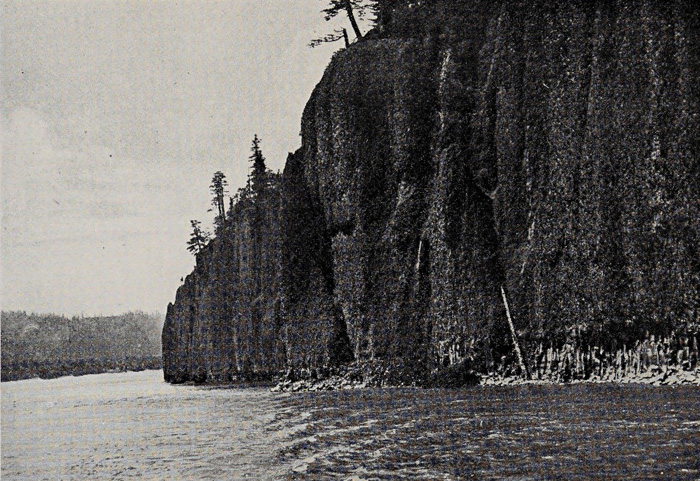
CAPE HORN, COLUMBIA RIVER
According to an Indian tradition, the river of the Cascades once flowed throughthe basalt beneath a natural bridge that was broken down during a mountain war,when the old volcanoes, Hood and St. Helen’s, on opposite sides of theriver, hurled rocks at each other, thus forming a dam. That the river has beendammed here to some extent, and within a comparatively short period, seemsprobable, to say the least, since great numbers of submerged trees standingerect may be found along both shores, while, as we have seen, the whole riverfor thirty miles above the Cascades looks like a lake or mill-pond. On theother hand, it is held by some that the submerged groves were carried intotheir places by immense landslides.
Much of interest in the connection must necessarily be omitted for want ofspace. About forty miles below the Cascades the river receives the Willamette,the last of its great tributaries. It is navigable for ocean vessels as far asPortland, ten miles above its mouth, and for river steamers a hundred milesfarther. The Falls of the Willamette are fifteen miles above Portland, wherethe river, coming out of dense woods, breaks its way across a bar of blackbasalt and falls forty feet in a passion of snowy foam, showing to fineadvantage against its background of evergreens.
Of the fertility and beauty of the Willamette all the world has heard. It liesbetween the Cascade and Coast Ranges, and is bounded on the south by theCalapooya Mountains, a cross-spur that separates it from the valley of theUmpqua.
It was here the first settlements for agriculture were made and a provisionalgovernment organized, while the settlers, isolated in the far wilderness,numbered only a few thousand and were laboring under the opposition of theBritish Government and the Hudson’s Bay Company. Eager desire in theacquisition of territory on the part of these pioneer state-builders was moretruly boundless than the wilderness they were in, and their unconscionablepatriotism was equaled only by their belligerence. For here, while negotiationswere pending for the location of the northern boundary, originated thecelebrated “Fifty-four forty or fight,” about as reasonable awar-cry as the “North Pole or fight.” Yet sad was the day thatbrought the news of the signing of the treaty fixing their boundary along theforty-ninth parallel, thus leaving the little land-hungry settlement only amere quarter-million of miles!
As the Willamette is one of the most foodful of valleys, so is the Columbia oneof the most foodful of rivers. During the fisher’s harvest time salmonfrom the sea come in countless millions, urging their way against falls,rapids, and shallows, up into the very heart of the Rocky Mountains, supplyingeverybody by the way with most bountiful masses of delicious food, weighingfrom twenty to eighty pounds each, plump and smooth like loaves of bread readyfor the oven. The supply seems inexhaustible, as well it might. Largequantities were used by the Indians as fuel, and by the Hudson’s Baypeople as manure for their gardens at the forts. Used, wasted, canned and sentin shiploads to all the world, a grand harvest was reaped every year whilenobody sowed. Of late, however, the salmon crop has begun to fail, and millionsof young fry are now sown like wheat in the river every year, from hatchingestablishments belonging to the Government.
All of the Oregon waters that win their way to the sea are a tributary to theColumbia, save the short streams of the immediate coast, and the Umpqua andRogue Rivers in southern Oregon. These both head in the Cascade Mountains andfind their way to the sea through gaps in the Coast Range, and both drain largeand fertile and beautiful valleys. Rogue River Valley is peculiarly attractive.With a fine climate, and kindly, productive soil, the scenery is delightful.About the main, central open portion of the basin, dotted with picturesquegroves of oak, there are many smaller valleys charmingly environed, the wholesurrounded in the distance by the Siskiyou, Coast, Umpqua, and CascadeMountains. Besides the cereals nearly every sort of fruit flourishes here, andlarge areas are being devoted to peach, apricot, nectarine, and vine culture.To me it seems above all others the garden valley of Oregon and the mostdelightful place for a home. On the eastern rim of the valley, in the CascadeMountains, about sixty miles from Medford in a direct line, is the remarkableCrater Lake, usually regarded as the one grand wonder of the region. It lies ina deep, sheer-walled basin about seven thousand feet above the level of thesea, supposed to be the crater of an extinct volcano.
Oregon as it is today is a very young country, though most of it seems old.Contemplating the Columbia sweeping from forest to forest, across plain anddesert, one is led to say of it, as did Byron of the ocean,—
“Such as Creation’s dawn beheld, thou rollest now.”
How ancient appear the crumbling basaltic monuments along its banks, and thegray plains to the east of the Cascades! Nevertheless, the river as well as itsbasin in anything like their present condition are comparatively but ofyesterday. Looming no further back in the geological records than the TertiaryPeriod, the Oregon of that time looks altogether strange in the few suggestiveglimpses we may get of it—forests in which palm trees wave their royalcrowns, and strange animals roaming beneath them or about the reedy margins oflakes, the oreodon, the lophiodon, and several extinct species of the horse,the camel, and other animals.
Then came the fire period with its darkening showers of ashes and cinders andits vast floods of molten lava, making quite another Oregon from the fair andfertile land of the preceding era. And again, while yet the volcanic fires showsigns of action in the smoke and flame of the higher mountains, the wholeregion passes under the dominion of ice, and from the frost and darkness anddeath of the Glacial Period, Oregon has but recently emerged to the kindlywarmth and life of today.
XXIV. The Grand Cañon of the Colorado
Happy nowadays is the tourist, with earth’s wonders, new and old, spreadinvitingly open before him, and a host of able workers as his slaves makingeverything easy, padding plush about him, grading roads for him, boringtunnels, moving hills out of his way, eager, like the Devil, to show him allthe kingdoms of the world and their glory and foolishness, spiritualizingtravel for him with lightning and steam, abolishing space and time and almosteverything else. Little children and tender, pulpy people, as well asstorm-seasoned explorers, may now go almost everywhere in smooth comfort, crossoceans and deserts scarce accessible to fishes and birds, and, dragged by steelhorses, go up high mountains, riding gloriously beneath starry showers ofsparks, ascending like Elijah in a whirlwind and chariot of fire.
First of the wonders of the great West to be brought within reach of thetourist were the Yosemite and the Big Trees, on the completion of the firsttranscontinental railway; next came the Yellowstone and icy Alaska, by thenorthern roads; and last the Grand Cañon of the Colorado, which, naturally thehardest to reach, has now become, by a branch of the Santa Fé, the mostaccessible of all.
Of course, with this wonderful extension of steel ways through our wildnessthere is loss as well as gain. Nearly all railroads are bordered by belts ofdesolation. The finest wilderness perishes as if stricken with pestilence. Birdand beast people, if not the dryads, are frightened from the groves. Too oftenthe groves also vanish, leaving nothing but ashes. Fortunately, nature has afew big places beyond man’s power to spoil—the ocean, the two icyends of the globe, and the Grand Cañon.
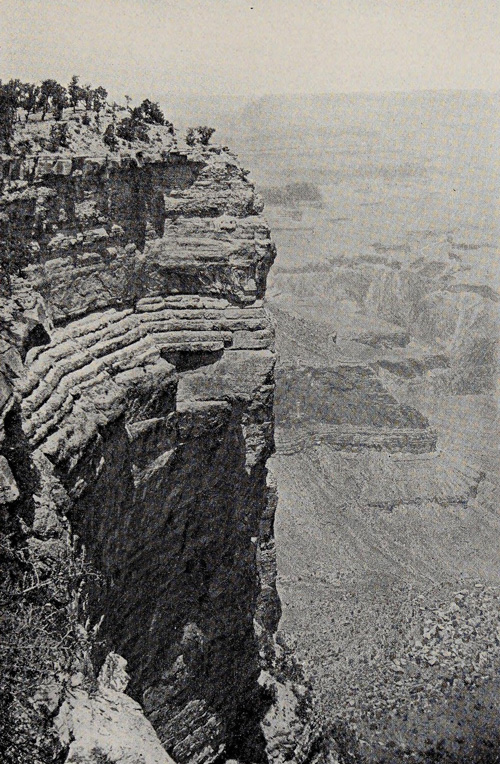
THE GRAND CAÑON AT O’NEILL’S POINT
When I first heard of the Santa Fé trains running to the edge of the GrandCañon of Arizona, I was troubled with thoughts of the disenchantment likely tofollow. But last winter, when I saw those trains crawling along through thepines of the Coconino Forest and close up to the brink of the chasm at BrightAngel, I was glad to discover that in the presence of such stupendous scenerythey are nothing. The locomotives and trains are mere beetles and caterpillars,and the noise they make is as little disturbing as the hooting of an owl in thelonely woods.
In a dry, hot, monotonous forested plateau, seemingly boundless, you comesuddenly and without warning upon the abrupt edge of a gigantic sunkenlandscape of the wildest, most multitudinous features, and those features,sharp and angular, are made out of flat beds of limestone and sandstone forminga spiry, jagged, gloriously colored mountain range countersunk in a level grayplain. It is a hard job to sketch it even in scrawniest outline; and, try as Imay, not in the least sparing myself, I cannot tell the hundredth part of thewonders of its features—the side cañons, gorges, alcoves, cloisters, andamphitheaters of vast sweep and depth, carved in its magnificent walls; thethrong of great architectural rocks it contains resembling castles, cathedrals,temples, and palaces, towered and spired and painted, some of them nearly amile high, yet beneath one’s feet. All this, however, is less difficultthan to give any idea of the impression of wild, primeval beauty and power onereceives in merely gazing from its brink. The view down the gulf of color andover the rim of its wonderful wall, more than any other view I know, leads usto think of our earth as a star with stars swimming in light, every radiantspire pointing the way to the heavens.
But it is impossible to conceive what the cañon is, or what impression itmakes, from descriptions or pictures, however good. Naturally it is untellableeven to those who have seen something perhaps a little like it on a small scalein this same plateau region. One’s most extravagant expectations areindefinitely surpassed, though one expects much from what is said of it as“the biggest chasm on earth”—“so big is it that allother big things—Yosemite, the Yellowstone, the Pyramids,Chicago—all would be lost if tumbled into it.” Naturally enough,illustrations as to size are sought for among other cañons like or unlike it,with the common result of worse confounding confusion. The prudent keepsilence. It was once said that the “Grand Cañon could put a dozenYosemites in its vest pocket.”
The justly famous Grand Cañon of the Yellowstone is, like the Colorado,gorgeously colored and abruptly countersunk in a plateau, and both are mainlythe work of water. But the Colorado’s cañon is more than a thousandtimes larger, and as a score or two of new buildings of ordinary size would notappreciably change the general view of a great city, so hundreds ofYellowstones might be eroded in the sides of the Colorado Cañon withoutnoticeably augmenting its size or the richness of its sculpture.
But it is not true that the great Yosemite rocks would be thus lost or hidden.Nothing of their kind in the world, so far as I know, rivals El Capitan andTissiack, much less dwarfs or in any way belittles them. None of the sandstoneor limestone precipices of the cañon that I have seen or heard of approachesin smooth, flawless strength and grandeur the granite face of El Capitan or theTenaya side of Cloud’s Rest. These colossal cliffs, types of permanence,are about three thousand and six thousand feet high; those of the cañon thatare sheer are about half as high, and are types of fleeting change; whileglorious-domed Tissiack, noblest of mountain buildings, far from beingovershadowed or lost in this rosy, spiry cañon company, would draw every eye,and, in serene majesty, “aboon them a’” she would take herplace—castle, temple, palace, or tower. Nevertheless a noted writer,comparing the Grand Cañon in a general way with the glacial Yosemite, says:“And the Yosemite—ah, the lovely Yosemite! Dumped down into thewilderness of gorges and mountains, it would take a guide who knew of itsexistence a long time to find it.” This is striking, and shows up wellabove the levels of commonplace description, but it is confusing, and has thefatal fault of not being true. As well try to describe an eagle by putting alark in it. “And the lark—ah, the lovely lark! Dumped down the red,royal gorge of the eagle, it would be hard to find.” Each in its ownplace is better, singing at heaven’s gate, and sailing the sky with theclouds.
Every feature of Nature’s big face is beautiful,—height and hollow,wrinkle, furrow, and line,—and this is the main master-furrow of its kindon our continent, incomparably greater and more impressive than any other yetdiscovered, or likely to be discovered, now that all the great rivers have beentraced to their heads.
The Colorado River rises in the heart of the continent on the dividing rangesand ridges between the two oceans, drains thousands of snowy mountains throughnarrow or spacious valleys, and thence through cañons of every color,sheer-walled and deep, all of which seem to be represented in this one grandcañon of cañons.
It is very hard to give anything like an adequate conception of its size; muchmore of its color, its vast wall-sculpture, the wealth of ornate architecturalbuildings that fill it, or, most of all, the tremendous impression it makes.According to Major Powell, it is about two hundred and seventeen miles long,from five to fifteen miles wide from rim to rim, and from about five thousandto six thousand feet deep. So tremendous a chasm would be one of theworld’s greatest wonders even if, like ordinary cañons cut insedimentary rocks, it were empty and its walls were simple. But instead ofbeing plain, the walls are so deeply and elaborately carved into all sorts ofrecesses—alcoves, cirques, amphitheaters, and side cañons—that,were you to trace the rim closely around on both sides, your journey would benearly a thousand miles long. Into all these recesses the level, continuousbeds of rock in ledges and benches, with their various colors, run like broadribbons, marvelously beautiful and effective even at a distance of ten ortwelve miles. And the vast space these glorious walls enclose, instead of beingempty, is crowded with gigantic architectural rock forms gorgeously colored andadorned with towers and spires like works of art.
Looking down from this level plateau, we are more impressed with a feeling ofbeing on the top of everything than when looking from the summit of a mountain.From side to side of the vast gulf, temples, palaces, towers, and spires comesoaring up in thick array half a mile or nearly a mile above their sunken,hidden bases, some to a level with our standpoint, but none higher. And in theinspiring morning light all are so fresh and rosy-looking that they seemnew-born; as if, like the quick-growing crimson snowplants of the Californiawoods, they had just sprung up, hatched by the warm, brooding, motherlyweather.
In trying to describe the great pines and sequoias of the Sierra, I have oftenthought that if one of these trees could be set by itself in some city park,its grandeur might there be impressively realized; while in its home forests,where all magnitudes are great, the weary, satiated traveler sees none of themtruly. It is so with these majestic rock structures.
Though mere residual masses of the plateau, they are dowered with the grandeurand repose of mountains, together with the finely chiseled carving and modelingof man’s temples and palaces, and often, to a considerable extent, withtheir symmetry. Some, closely observed, look like ruins; but even these standplumb and true, and show architectural forms loaded with lines strictly regularand decorative, and all are arrayed in colors that storms and time seem only tobrighten. They are not placed in regular rows in line with the river, but“a’ through ither,” as the Scotch say, in lavish, exuberantcrowds, as if nature in wildest extravagance held her bravest structures ascommon as gravel-piles. Yonder stands a spiry cathedral nearly five thousandfeet in height, nobly symmetrical, with sheer buttressed walls and arched doorsand windows, as richly finished and decorated with sculptures as the great rocktemples of India or Egypt. Beside it rises a huge castle with arched gateway,turrets, watch-towers, ramparts, etc., and to right and left palaces, obelisks,and pyramids fairly fill the gulf, all colossal and all lavishly painted andcarved. Here and there a flat-topped structure may be seen, or one imperfectlydomed; but the prevailing style is ornate Gothic, with many hints of Egyptianand Indian.
Throughout this vast extent of wild architecture—nature’s owncapital city—there seem to be no ordinary dwellings. All look like grandand important public structures, except perhaps some of the lower pyramids,broad-based and sharp-pointed, covered with down-flowing talus like loosely settents with hollow, sagging sides. The roofs often have disintegrated rocksheaped and draggled over them, but in the main the masonry is firm and laid inregular courses, as if done by square and rule.
Nevertheless they are ever changing; their tops are now a dome, now a flattable or a spire, as harder or softer strata are reached in their slowdegradation, while the sides, with all their fine moldings, are being steadilyundermined and eaten away. But no essential change in style or color is thuseffected. From century to century they stand the same. What seems confusionamong the rough earthquake-shaken crags nearest one comes to order as soon asthe main plan of the various structures appears. Every building, howevercomplicated and laden with ornamental lines, is at one with itself and everyone of its neighbors, for the same characteristic controlling belts of colorand solid strata extend with wonderful constancy for very great distances, andpass through and give style to thousands of separate structures, however theirsmaller characters may vary.
Of all the various kinds of ornamental work displayed—carving, tracery oncliff faces, moldings, arches, pinnacles—none is more admirably effectiveor charms more than the webs of rain-channeled taluses. Marvelously extensive,without the slightest appearance of waste or excess, they cover roofs and dometops and the base of every cliff, belt each spire and pyramid and massy,towering temple, and in beautiful continuous lines go sweeping along the greatwalls in and out around all the intricate system of side cañons,amphitheaters, cirques, and scallops into which they are sculptured. From onepoint hundreds of miles of the fairy embroidery may be traced. It is all sofine and orderly that it would seem that not only had the clouds and streamsbeen kept harmoniously busy in the making of it, but that every raindrop sentlike a bullet to a mark had been the subject of a separate thought, so sure isthe outcome of beauty through the stormy centuries. Surely nowhere else arethere illustrations so striking of the natural beauty of desolation and death,so many of nature’s own mountain buildings wasting in glory of highdesert air—going to dust. See how steadfast in beauty they all are intheir going. Look again and again how the rough, dusty boulders and sand ofdisintegration from the upper ledges wreathe in beauty for ashes—as inthe flowers of a prairie after fires—but here the very dust and ashes arebeautiful.
Gazing across the mighty chasm, we at last discover that it is not its greatdepth nor length, nor yet these wonderful buildings, that most impresses us. Itis its immense width, sharply defined by precipitous walls plunging suddenlydown from a flat plain, declaring in terms instantly apprehended that the vastgulf is a gash in the once unbroken plateau, made by slow, orderly erosion andremoval of huge beds of rocks. Other valleys of erosion are as great—inall their dimensions some are greater—but none of these produces aneffect on the imagination at once so quick and profound, coming without study,given at a glance. Therefore by far the greatest and most influential featureof this view from Bright Angel or any other of the cañon views is the oppositewall. Of the one beneath our feet we see only fragmentary sections in cirquesand amphitheaters and on the sides of the out-jutting promontories betweenthem, while the other, though far distant, is beheld in all its glory of colorand noble proportions—the one supreme beauty and wonder to which the eyeis ever turning. For while charming with its beauty it tells the story of thestupendous erosion of the cañon—the foundation of the unspeakableimpression made on everybody. It seems a gigantic statement for even nature tomake, all in one mighty stone word, apprehended at once like a burst of light,celestial color its natural vesture, coming in glory to mind and heart as to ahome prepared for it from the very beginning. Wildness so godful, cosmic,primeval, bestows a new sense of earth’s beauty and size. Not even fromhigh mountains does the world seem so wide, so like a star in glory of light onits way through the heavens.
I have observed scenery-hunters of all sorts getting first views of yosemites,glaciers, White Mountain ranges, etc. Mixed with the enthusiasm which suchscenery naturally excites, there is often weak gushing, and many splutter aloudlike little waterfalls. Here, for a few moments at least, there is silence, andall are in dead earnest, as if awed and hushed by an earthquake—perhapsuntil the cook cries “Breakfast!” or the stable-boy “Horsesare ready!” Then the poor unfortunates, slaves of regular habits, turnquickly away, gasping and muttering as if wondering where they had been andwhat had enchanted them.
Roads have been made from Bright Angel Hotel through the Coconino Forest to theends of outstanding promontories, commanding extensive views up and down thecañon. The nearest of them, three or four miles east and west, areO’Neill’s Point and Rowe’s Point; the latter, besidescommanding the eternally interesting cañon, gives wide-sweeping viewssoutheast and west over the dark forest roof to the San Francisco and MountTrumbull volcanoes—the bluest of mountains over the blackest of levelwoods.
Instead of thus riding in dust with the crowd, more will be gained by goingquietly afoot along the rim at different times of day and night, free toobserve the vegetation, the fossils in the rocks, the seams beneath overhangingledges once inhabited by Indians, and to watch the stupendous scenery in thechanging lights and shadows, clouds, showers, and storms. One need not gohunting the so-called “points of interest.” The verge anywhere,everywhere, is a point of interest beyond one’s wildest dreams.
As yet, few of the promontories or throng of mountain buildings in the cañonare named. Nor among such exuberance of forms are names thought of by thebewildered, hurried tourist. He would be as likely to think of names for wavesin a storm. The Eastern and Western Cloisters, Hindu Amphitheater, Cape Royal,Powell’s Plateau, Grand View Point, Point Sublime, Bissell and MoranPoints, the Temple of Set, Vishnu’s Temple, Shiva’s Temple, TwinTemples, Tower of Babel, Hance’s Column—these fairly good namesgiven by Dutton, Holmes, Moran, and others are scattered over a large stretchof the cañon wilderness.
All the cañon rock-beds are lavishly painted, except a few neutral bars and thegranite notch at the bottom occupied by the river, which makes but little sign.It is a vast wilderness of rocks in a sea of light, colored and glowing likeoak and maple woods in autumn, when the sun-gold is richest. I have just saidthat it is impossible to learn what the cañon is like from descriptions andpictures. Powell’s and Dutton’s descriptions present magnificentviews not only of the cañon but of all the grand region round about it; andHolmes’s drawings, accompanying Dutton’s report, are wonderfullygood. Surely faithful and loving skill can go no farther in putting themultitudinous decorated forms on paper. But the colors, the livingrejoicing colors, chanting morning and evening in chorus to heaven!Whose brush or pencil, however lovingly inspired, can give us these? And ifpaint is of no effect, what hope lies in pen-work? Only this: some may beincited by it to go and see for themselves.
No other range of mountainous rock-work of anything like the same extent have Iseen that is so strangely, boldly, lavishly colored. The famous YellowstoneCañon below the falls comes to mind; but, wonderful as it is, and welldeserved as is its fame, compared with this it is only a bright rainbow ribbonat the roots of the pines. Each of the series of level, continuous beds ofcarboniferous rocks of the cañon has, as we have seen, its own characteristiccolor. The summit limestone beds are pale yellow; next below these are thebeautiful rose-colored cross-bedded sandstones; next there are a thousand feetof brilliant red sandstones; and below these the red wall limestones, over twothousand feet thick, rich massy red, the greatest and most influential of theseries, and forming the main color-fountain. Between these are manyneutral-tinted beds. The prevailing colors are wonderfully deep and clear,changing and blending with varying intensity from hour to hour, day to day,season to season; throbbing, wavering, glowing, responding to every passingcloud or storm, a world of color in itself, now burning in separate rainbowbars streaked and blotched with shade, now glowing in one smooth, all-pervadingethereal radiance like the alpenglow, uniting the rocky world with the heavens.
The dawn, as in all the pure, dry desert country is ineffably beautiful; andwhen the first level sunbeams sting the domes and spires, with what a burst ofpower the big, wild days begin! The dead and the living, rocks and heartsalike, awake and sing the new-old song of creation. All the massy headlands andsalient angles of the walls, and the multitudinous temples and palaces, seem tocatch the light at once, and cast thick black shadows athwart hollow and gorge,bringing out details as well as the main massive features of the architecture;while all the rocks, as if wild with life, throb and quiver and glow in theglorious sunburst, rejoicing. Every rock temple then becomes a temple of music;every spire and pinnacle an angel of light and song, shouting colorhallelujahs.
As the day draws to a close, shadows, wondrous, black, and thick, like those ofthe morning, fill up the wall hollows, while the glowing rocks, their roughangles burned off, seem soft and hot to the heart as they stand submerged inpurple haze, which now fills the cañon like a sea. Still deeper, richer, moredivine grow the great walls and temples, until in the supreme flaming glory ofsunset the whole cañon is transfigured, as if all the life and light ofcenturies of sunshine stored up and condensed in the rocks was now being pouredforth as from one glorious fountain, flooding both earth and sky.
Strange to say, in the full white effulgence of the midday hours the brightcolors grow dim and terrestrial in common gray haze; and the rocks, after themanner of mountains, seem to crouch and drowse and shrink to less than halftheir real stature, and have nothing to say to one, as if not at home. But itis fine to see how quickly they come to life and grow radiant and communicativeas soon as a band of white clouds come floating by. As if shouting for joy,they seem to spring up to meet them in hearty salutation, eager to touch themand beg their blessings. It is just in the midst of these dull midday hoursthat the cañon clouds are born.
A good storm cloud full of lightning and rain on its way to its work on a sunnydesert day is a glorious object. Across the cañon, opposite the hotel, is alittle tributary of the Colorado called Bright Angel Creek. A fountain-cloudstill better deserves the name “Angel of the DesertWells”—clad in bright plumage, carrying cool shade and living waterto countless animals and plants ready to perish, noble in form and gesture,seeming able for anything, pouring life-giving, wonder-working floods from itsalabaster fountains, as if some sky-lake had broken. To every gulch and gorgeon its favorite ground is given a passionate torrent, roaring, replying to therejoicing lightning—stones, tons in weight, hurrying away as iffrightened, showing something of the way Grand Cañon work is done. Most of thefertile summer clouds of the cañon are of this sort, massive, swelling cumuli,growing rapidly, displaying delicious tones of purple and gray in the hollowsof their sun-beaten houses, showering favored areas of the heated landscape,and vanishing in an hour or two. Some, busy and thoughtful-looking, glide withbeautiful motion along the middle of the cañon in flocks, turning aside hereand there, lingering as if studying the needs of particular spots, exploringside cañons, peering into hollows like birds seeding nest-places, or hoveringaloft on outspread wings. They scan all the red wilderness, dispensing theirblessings of cool shadows and rain where the need is the greatest, refreshingthe rocks, their offspring as well as the vegetation, continuing theirsculpture, deepening gorges and sharpening peaks. Sometimes, blending alltogether, they weave a ceiling from rim to rim, perhaps opening a window hereand there for sunshine to stream through, suddenly lighting some palace ortemple and making it flare in the rain as if on fire.
Sometimes, as one sits gazing from a high, jutting promontory, the sky allclear, showing not the slightest wisp or penciling, a bright band of cumuliwill appear suddenly, coming up the cañon in single file, as if tracing awell-known trail, passing in review, each in turn darting its lances anddropping its shower, making a row of little vertical rivers in the air abovethe big brown one. Others seem to grow from mere points, and fly high above thecañon, yet following its course for a long time, noiseless, as if hunting,then suddenly darting lightning at unseen marks, and hurrying on. Or theyloiter here and there as if idle, like laborers out of work, waiting to behired.
Half a dozen or more showers may oftentimes be seen falling at once, while farthe greater part of the sky is in sunshine, and not a raindrop comes nigh one.These thundershowers from as many separate clouds, looking like wisps of longhair, may vary greatly in effects. The pale, faint streaks are showers thatfail to reach the ground, being evaporated on the way down through the dry,thirsty air, like streams in deserts. Many, on the other hand, which in thedistance seem insignificant, are really heavy rain, however local; these arethe gray wisps well zigzagged with lightning. The darker ones are torrent rain,which on broad, steep slopes of favorable conformation give rise to so-called“cloudbursts”; and wonderful is the commotion they cause. Thegorges and gulches below them, usually dry, break out in loud uproar, with asudden downrush of muddy, boulder-laden floods. Down they all go in onesimultaneous gush, roaring like lions rudely awakened, each of the tawny broodactually kicking up a dust at the first onset.
During the winter months snow falls over all the high plateau, usually to aconsiderable depth, whitening the rim and the roofs of the cañon buildings.But last winter, when I arrived at Bright Angel in the middle of January, therewas no snow in sight, and the ground was dry, greatly to my disappointment, forI had made the trip mainly to see the cañon in its winter garb. Soothingly Iwas informed that this was an exceptional season, and that the good snow mightarrive at any time. After waiting a few days, I gladly hailed a broad-browedcloud coming grandly on from the west in big promising blackness, very unlikethe white sailors of the summer skies. Under the lee of a rim-ledge, withanother snow-lover, I watched its movements as it took possession of the cañonand all the adjacent region in sight. Trailing its gray fringes over the spirytops of the great temples and towers, it gradually settled lower, embracingthem all with ineffable kindness and gentleness of touch, and fondled thelittle cedars and pines as they quivered eagerly in the wind like young birdsbegging their mothers to feed them. The first flakes and crystals began to flyabout noon, sweeping straight up the middle of the cañon, and swirling inmagnificent eddies along the sides. Gradually the hearty swarms closed theirranks, and all the cañon was lost in gray bloom except a short section of thewall and a few trees beside us, which looked glad with snow in their needlesand about their feet as they leaned out over the gulf. Suddenly the stormopened with magical effect to the north over the cañon of Bright Angel Creek,inclosing a sunlit mass of the cañon architecture, spanned by great whiteconcentric arches of cloud like the bows of a silvery aurora. Above these and alittle back of them was a series of upboiling purple clouds, and high aboveall, in the background, a range of noble cumuli towered aloft like snow-ladenmountains, their pure pearl bosses flooded with sunshine. The whole noblepicture, calmly glowing, was framed in thick gray gloom, which soon closed overit; and the storm went on, opening and closing until night covered all.
Two days later, when we were on a jutting point about eighteen miles east ofBright Angel and one thousand feet higher, we enjoyed another storm of equalglory as to cloud effects, though only a few inches of snow fell. Before thestorm began we had a magnificent view of this grander upper part of the cañonand also of the Coconino Forest and the Painted Desert. The march of the cloudswith their storm banners flying over this sublime landscape was unspeakablyglorious, and so also was the breaking up of the storm next morning—themingling of silver-capped rock, sunshine, and cloud.
Most tourists make out to be in a hurry even here; therefore their days orhours would be best spent on the promontories nearest the hotel. Yet asurprising number go down the Bright Angel Trail to the brink of the innergloomy granite gorge overlooking the river. Deep cañons attract like highmountains; the deeper they are, the more surely are we drawn into them. Onfoot, of course, there is no danger whatever, and, with ordinary precautions,but little on animals. In comfortable tourist faith, unthinking, unfearing,down go men, women, and children on whatever is offered, horse, mule, or burro,as if saying with Jean Paul, “fear nothing but fear”—notwithout reason, for these cañon trails down the stairways of the gods are lessdangerous than they seem, less dangerous than home stairs. The guides arecautious, and so are the experienced, much-enduring beasts. The scrawniestRosinantes and wizened-rat mules cling hard to the rocks endwise or sidewise,like lizards or ants. From terrace to terrace, climate to climate, down onecreeps in sun and shade, through gorge and gully and grassy ravine, and, aftera long scramble on foot, at last beneath the mighty cliffs one comes to thegrand, roaring river.
To the mountaineer the depth of the cañon, from five thousand to six thousandfeet, will not seem so very wonderful, for he has often explored others thatare about as deep. But the most experienced will be awestruck by the vastextent of huge rock monuments of pointed masonry built up in regular coursestowering above, beneath, and round about him. By the Bright Angel Trail thelast fifteen hundred feet of the descent to the river has to be made afoot downthe gorge of Indian Garden Creek. Most of the visitors do not like this part,and are content to stop at the end of the horse trail and look down on thedull-brown flood from the edge of the Indian Garden Plateau. By the new HanceTrail, excepting a few daringly steep spots, you can ride all the way to theriver, where there is a good spacious camp-ground in a mesquite grove. Thistrail, built by brave Hance, begins on the highest part of the rim, eightthousand feet above the sea, a thousand feet higher than the head of BrightAngel Trail, and the descent is a little over six thousand feet, through awonderful variety of climate and life. Often late in the fall, when frostywinds are blowing and snow is flying at one end of the trail, tender plants areblooming in balmy summer weather at the other. The trip down and up can be madeafoot easily in a day. In this way one is free to observe the scenery andvegetation, instead of merely clinging to his animal and watching its steps.But all who have time should go prepared to camp awhile on the riverbank, torest and learn something about the plants and animals and the mighty floodroaring past. In cool, shady amphitheaters at the head of the trail there aregroves of white silver fir and Douglas spruce, with ferns and saxifrages thatrecall snowy mountains; below these, yellow pine, nut pine, juniper,hop-hornbeam, ash, maple, holly-leaved berberis, cowania, spiraea, dwarf oak,and other small shrubs and trees. In dry gulches and on taluses and sun-beatencrags are sparsely scattered yuccas, cactuses, agave, etc. Where springs gushfrom the rocks there are willow thickets, grassy flats, and bright, flowerygardens, and in the hottest recesses the delicate abronia, mesquite, woodycompositae, and arborescent cactuses.
The most striking and characteristic part of this widely varied vegetation arethe cactaceae—strange, leafless, old-fashioned plants with beautifulflowers and fruit, in every way able and admirable. While grimly defendingthemselves with innumerable barbed spears, they offer both food and drink toman and beast. Their juicy globes and disks and fluted cylindrical columns arealmost the only desert wells that never go dry, and they always seem to rejoicethe more and grow plumper and juicier the hotter the sunshine and sand. Someare spherical, like rolled-up porcupines, crouching in rock-hollows beneath amist of gray lances, unmoved by the wildest winds. Others, standing as erect asbushes and trees or tall branchless pillars crowned with magnificent flowers,their prickly armor sparkling, look boldly abroad over the glaring desert,making the strangest forests ever seen or dreamed of. Cereus giganteus,the grim chief of the desert tribe, is often thirty or forty feet high insouthern Arizona. Several species of tree yuccas in the same desert, laden inearly spring with superb white lilies, form forests hardly less wonderful,though here they grow singly or in small lonely groves. The low, almoststemless Yucca baccata, with beautiful lily flowers and sweetbanana-like fruit, prized by the Indians, is common along the cañon rim,growing on lean, rocky soil beneath mountain mahogany, nut pines, and junipers,beside dense flowery mats of Spiræa cæspitosaand the beautifulpinnate-leaved Spiræa millefolia. The nut pine (Pinus edulis)scattered along the upper slopes and roofs of the cañon buildings, is theprincipal tree of the strange dwarf Coconino Forest. It is a picturesque stubof a pine about twenty-five feet high, usually with dead, lichened limbs thrustthrough its rounded head, and grows on crags and fissured rock tables, bravingheat and frost, snow and drought, and continuing patiently, faithfully fruitfulfor centuries. Indians and insects and almost every desert bird and beast cometo it to be fed.
To civilized people from corn and cattle and wheat-field countries the cañonat first sight seems as uninhabitable as a glacier crevasse, utterly silent andbarren. Nevertheless it is the home of the multitude of our fellow-mortals, menas well as animals and plants. Centuries ago it was inhabited by tribes ofIndians, who, long before Columbus saw America, built thousands of stone housesin its crags, and large ones, some of them several stories high, with hundredsof rooms, on the mesas of the adjacent regions. Their cliff-dwellings, almostnumberless, are still to be seen in the cañon, scattered along both sides fromtop to bottom and throughout its entire length, built of stone and mortar inseams and fissures like swallows’ nests, or on isolated ridges and peaks.The ruins of larger buildings are found on open spots by the river, but most ofthem aloft on the brink of the wildest, giddiest precipices, sites evidentlychosen for safety from enemies, and seemingly accessible only to the birds ofthe air. Many caves were also used as dwelling-places, as were mere seams oncliff-fronts formed by unequal weathering and with or without outer or sidewalls; and some of them were covered with colored pictures of animals. The mostinteresting of these cliff-dwellings had pathetic little ribbon-like strips ofgarden on narrow terraces, where irrigating water could be carried tothem—most romantic of sky-gardens, but eloquent of hard times.
In recesses along the river and on the first plateau flats above its gorge werefields and gardens of considerable size, where irrigating ditches may still betraced. Some of these ancient gardens are still cultivated by Indians,descendants of cliff-dwellers, who raise corn, squashes, melons, potatoes,etc., to reinforce the produce of the many wild food-furnishingplants—nuts, beans, berries, yucca and cactus fruits, grass and sunflowerseeds, etc.—and the flesh of animals—deer, rabbits, lizards, etc.The cañon Indians I have met here seem to be living much as did theirancestors, though not now driven into rock-dens. They are able, erect men, withcommanding eyes, which nothing that they wish to see can escape. They are neverin a hurry, have a strikingly measured, deliberate, bearish manner of movingthe limbs and turning the head, are capable of enduring weather, thirst,hunger, and over-abundance, and are blessed with stomachs which triumph overeverything the wilderness may offer. Evidently their lives are not bitter.
The largest of the cañon animals one is likely to see is the wild sheep, orRocky Mountain bighorn, a most admirable beast, with limbs that never fail, athome on the most nerve-trying precipices, acquainted with all the springs andpasses and broken-down jumpable places in the sheer ribbon cliffs, boundingfrom crag to crag in easy grace and confidence of strength, his great hornsheld high above his shoulders, wild red blood beating and hissing through everyfiber of him like the wind through a quivering mountain pine.
Deer also are occasionally met in the cañon, making their way to the riverwhen the wells of the plateau are dry. Along the short spring streams beaversare still busy, as is shown by the cottonwood and willow timber they have cutand peeled, found in all the river drift-heaps. In the most barren cliffs andgulches there dwell a multitude of lesser animals, well-dressed, clear-eyed,happy little beasts—wood rats, kangaroo rats, gophers, wood mice, skunks,rabbits, bobcats, and many others, gathering food, or dozing in theirsun-warmed dens. Lizards, too, of every kind and color are here enjoying lifeon the hot cliffs, and making the brightest of them brighter.
Nor is there any lack of feathered people. The golden eagle may be seen, andthe osprey, hawks, jays, hummingbirds, the mourning dove, and cheery familiarsingers—the black-headed grosbeak, robin, bluebird, Townsend’sthrush, and many warblers, sailing the sky and enlivening the rocks and bushesthrough all the cañon wilderness.
Here at Hance’s river camp or a few miles above it brave Powell and hisbrave men passed their first night in the cañon on the adventurous voyage ofdiscovery thirty-three[34]years ago. They faced a thousanddangers, open or hidden, now in their boats gladly sliding down swift, smoothreaches, now rolled over and over in back-combing surges of rough, roaringcataracts, sucked under in eddies, swimming like beavers, tossed and beatenlike castaway drift—stout-hearted, undaunted, doing their work through itall. After a month of this they floated smoothly out of the dark, gloomy,roaring abyss into light and safety two hundred miles below. As the floodrushes past us, heavy-laden with desert mud, we naturally think of its sources,its countless silvery branches outspread on thousands of snowy mountains alongthe crest of the continent, and the life of them, the beauty of them, theirhistory and romance. Its topmost springs are far north and east in Wyoming andColorado, on the snowy Wind River, Front, Park, and Sawatch Ranges, dividingthe two ocean waters, and the Elk, Wahsatch, Uinta, and innumerable spursstreaked with streams, made famous by early explorers and hunters. It is ariver of rivers—the Du Chesne, San Rafael, Yampa, Dolores, Gunnison,Cochetopa, Uncompahgre, Eagle, and Roaring Rivers, the Green and the Grand, andscores of others with branches innumerable, as mad and glad a band as ever sangon mountains, descending in glory of foam and spray from snow-banks andglaciers through their rocky moraine-dammed, beaver-dammed channels. Then, allemerging from dark balsam and pine woods and coming together, they meanderthrough wide, sunny park valleys, and at length enter the great plateau andflow in deep cañons, the beginning of the system culminating in this grandcañon of cañons.
Our warm cañon camp is also a good place to give a thought to the glacierswhich still exist at the heads of the highest tributaries. Some of them are ofconsiderable size, especially those on the Wind River and Sawatch ranges inWyoming and Colorado. They are remnants of a vast system of glaciers whichrecently covered the upper part of the Colorado basin, sculptured its peaks,ridges, and valleys to their present forms, and extended far out over theplateau region—how far I cannot now say. It appears, therefore, that,however old the main trunk of the Colorado may be, all its widespread upperbranches and the landscapes they flow through are new-born, scarce at allchanged as yet in any important feature since they first came to light at theclose of the Glacial Period.
The so-called Grand Colorado Plateau, of which the Grand Cañon is only one ofthe well-proportioned features, extends with a breadth of hundreds of milesfrom the flanks of the Wahsatch and Park Mountains to the south of the SanFrancisco Peaks. Immediately to the north of the deepest part of the cañon itrises in a series of subordinate plateaus, diversified with green meadows,marshes, bogs, ponds, forests, and grovy park valleys, a favorite Indianhunting ground, inhabited by elk, deer, beaver, etc. But far the greater partof the plateau is good sound desert, rocky, sandy, or fluffy with loose ashesand dust, dissected in some places into a labyrinth of stream-channel chasmslike cracks in a dry clay-bed, or the narrow slit crevasses ofglaciers—blackened with lava flows, dotted with volcanoes and beautifulbuttes, and lined with long continuous escarpments—a vast bed ofsediments of an ancient sea-bottom, still nearly as level as when first laiddown after being heaved into the sky a mile or two high.
Walking quietly about in the alleys and byways of the Grand Cañon city, welearn something of the way it was made; and all must admire effects so greatfrom means apparently so simple; rain striking light hammer blows or heavier instreams, with many rest Sundays; soft air and light, gentle sappers and miners,toiling forever; the big river sawing the plateau asunder, carrying away theeroded and ground waste, and exposing the edges of the strata to the weather;rain torrents sawing cross-streets and alleys, exposing the strata in the sameway in hundreds of sections, the softer, less resisting beds weathering andreceding faster, thus undermining the harder beds, which fall, not only insmall weathered particles, but in heavy sheer-cleaving masses, assisted downfrom time to time by kindly earthquakes, rain torrents rushing the fallenmaterial to the river, keeping the wall rocks constantly exposed. Thus thecañon grows wider and deeper. So also do the side cañons and amphitheaters,while secondary gorges and cirques gradually isolate masses of thepromontories, forming new buildings, all of which are being weathered andpulled and shaken down while being built, showing destruction and creation asone. We see the proudest temples and palaces in stateliest attitudes, wearingtheir sheets of detritus as royal robes, shedding off showers of red and yellowstones like trees in autumn shedding their leaves, going to dust like beautifuldays to night, proclaiming as with the tongues of angels the natural beauty ofdeath.
Every building is seen to be a remnant of once continuous beds ofsediments,—sand and slime on the floor of an ancient sea, and filled withthe remains of animals,—and every particle of the sandstones andlimestones of these wonderful structures to be derived from other landscapes,weathered and rolled and ground in the storms and streams of other ages. Andwhen we examine the escarpments, hills, buttes, and other monumental masses ofthe plateau on either side of the cañon, we discover that an amount ofmaterial has been carried off in the general denudation of the region comparedwith which even that carried away in the making of the Grand Cañon is asnothing. Thus each wonder in sight becomes a window through which other wonderscome to view. In no other part of this continent are the wonders of geology,the records of the world’s auld lang syne, more widely opened, ordisplayed in higher piles. The whole cañon is a mine of fossils, in which fivethousand feet of horizontal strata are exposed in regular succession over morethan a thousand square miles of wall-space, and on the adjacent plateau regionthere is another series of beds twice as thick, forming a grand geologicallibrary—a collection of stone books covering thousands of miles ofshelving, tier on tier, conveniently arranged for the student. And with whatwonderful scriptures are their pages filled—myriad forms of successivefloras and faunas, lavishly illustrated with colored drawings, carrying us backinto the midst of the life of a past infinitely remote. And as we go on and on,studying this old, old life in the light of the life beating warmly about us,we enrich and lengthen our own.
THE END
Footnotes:
[by the editor of the 1918 original of this text]:
[1]This essay was written early in1875.
[2]The wild sheep of California arenow classified as Ovis nelsoni. Whether those of the Shasta regionbelonged to the latter species, or to the bighorn species of Oregon, Idaho, andWashington, is still an unsettled question.
[3]An excerpt from a letter to afriend, written in 1873.
[4]Muir at this time was makingYosemite Valley his home.
[5]An obsolete genus of plants nowreplaced in the main by Chrysothamnusand Ericameria.
[6]An early local name for what is nowknown as Lassen Peak, or Mt. Lassen. In 1914 its volcanic activity was resumedwith spectacular eruptions of ashes, steam, and gas.
[7]Pronounced Too’-lay.
[8]Letter dated “Salt Lake City,Utah, May 15, 1877.”
[9]Letter dated “Salt Lake City,Utah, May 19, 1877.”
[10]Letter dated “Lake Point,Utah, May 20, 1877.”
[11]Letter dated “Salt Lake,July, 1877.”
[12]Letter dated “September 1,1877.”]
[13]Letter written during the firstweek of September, 1877.
[14]The spruce, or hemlock, thenknown as Abies Douglasiivar. macrocarpais now calledPseudotsuga macrocarpa.
[15]Written at Ward, Nevada, inSeptember, 1878.
[16]See footnote 5.
[17]Written at Eureka,Nevada, in October, 1878.
[18]Now called Pinusmonophylla, or one-leaf piñon.
[19]Written at Pioche, Nevada, inOctober, 1878.
[20]Written at Eureka, Nevada, inNovember, 1878.
[21]Date and place of writing notgiven. Published in the San Francisco Evening Bulletin, January 15,1879.
[22]November 11, 1889; Muir’sdescription probably was written toward the end of the same year.
[23]This tree, now known to botanistsas Picea sitchensis, was named Abies Menziesiiby Lindley in1833.
[24]Also known as “canoecedar,” and described in Jepson’s Silva of Californiaunderthe more recent specific name Thuja plicata.
[25]Now classified as TsugamertensianaSarg.
[26]Now Abies grandisLindley.
[27]Chamæcyparis lawsonianaParl. (Port Orford cedar) in Jepson’s Silva.
[28]1889.
[29]A careful re-determination of theheight of Rainier, made by Professor A. G. McAdie in 1905, gave an altitude of14,394 feet. The Standard Dictionary wrongly describes it is “the highestpeak (14,363 feet) within the United States.” The United States Baedekerand railroad literature overstate its altitude by more than a hundred feet.
[30]Doubtless the red silver fir, nowclassified as Abies amabilis.
[31]Lassen Peak on recent maps.
[32]Pseudotsuga taxifoliaBrit.
[33]Thuja plicataDon.
[34]Muir wrote this description in1902; Major J. W. Powell made his descent through the canyon, with small boats,in 1869.
Note from the transcriber:
A phrase Muir uses that readers might doubt: “fountain range,” bywhich he means a mountainous area where rain or snow fall that is the source ofwater for a river or stream downslope. So it is not a typographical error for“mountain range”! Another odd phrase is “(something) is wellworthy (something else)” rather than “well worth” or“well worthy of.” He uses this at least twice in thiswork.—jg
Related articles

The City of Dreadful Night, by James Thomson
THE CITY OF DREADFUL NIGHT By James Thomson Per me si va nella citta dolente. —Dan2026-07-30
Memoirs of Carwin the Biloquist, by Charles Brockden Brown
MEMOIRS OF CARWIN THE BILOQUIST [A fragment] By Charles Brockden Brown [1803-1805] Conte2026-07-30Memoirs of Carwin the Biloquist, by Charles Brockden Brown
MEMOIRS OF CARWIN THE BILOQUIST [A fragment] By Charles Brockden Brown [1803-1805] Conte2026-07-30 POEMS OF HENRY TIMROD With Memoir Contents Introduction The Late Judge George S. Bryan POEM2026-07-30
 THE COMEDY OF ERRORSby William ShakespeareContentsACT IScene I. A hall in the Duke’s palaceScene II.2026-07-30
- POEMS OF HENRY TIMROD With Memoir Contents Introduction The Late Judge George S. Bryan POEM2026-07-30
Latest comments